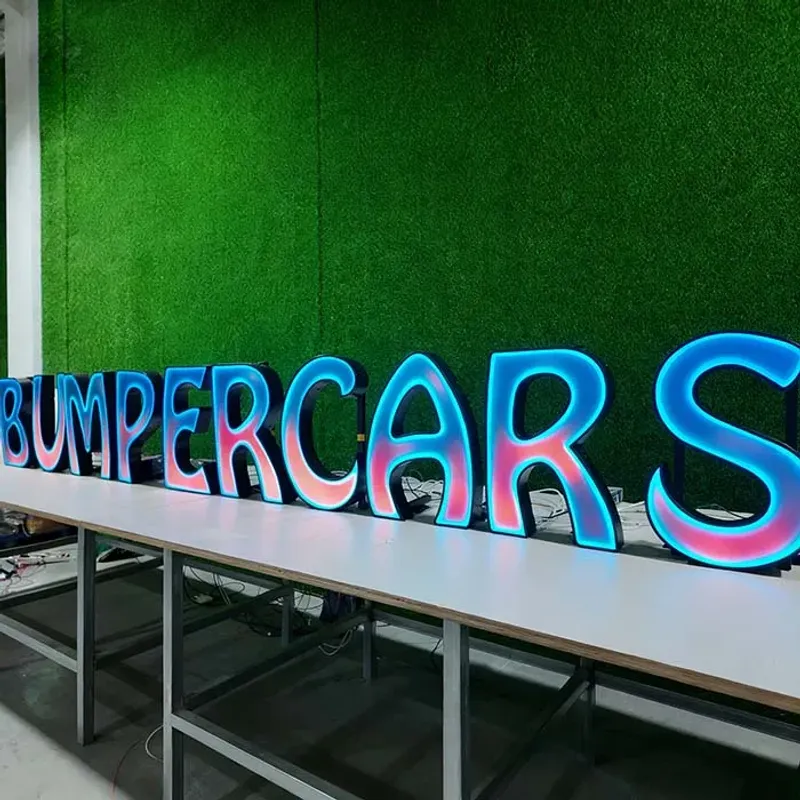
Most sign manufacturers I know won't even pick up the phone for less than 10 pieces. I've worked production floors where a single-letter order got laughed out of the morning meeting. That's not us. At Aochuang, MOQ 1 piece is real because we know you need to see, touch, and sometimes destroy a sample before you commit $20,000 on a storefront rollout.
But don't mistake that for a charity. A single letter sample costs us almost as much in setup time as ten letters. The design file still has to be checked. The CNC still runs a single path. The bender still burns an hour on a one-off piece instead of a batch. So while I'll happily ship you one front-lit channel letter, I'll be blunt about the economics because that's how trust gets built between a production manager in Anhui and a sign shop owner in Ohio.
I've seen this go wrong: a contractor ordered a single 24-inch stainless steel letter with a backlit halo effect. Looked beautiful in the video we sent. Then he tried to mount it on a stucco wall with standard anchors and the whole thing sagged because he didn't account for the weight. Stainless 304 at 2mm thickness isn't light. We'd have told him if he'd asked. But he didn't. So now I tell everyone up front.
The ugly truth is that most online “sample ordering” processes are designed to upsell you into a bulk order before you've even held the product. We don't play that game. But if you come in expecting a free sample or overnight turnaround on a one-off custom thing, you'll be disappointed. Transparency works both ways.
Here's what nobody tells you: a “free sample” of a custom sign doesn't exist. Not real ones. The acrylic might cost us $3, the aluminum $4, and the LEDs under $10 for a small letter. But the labor to cut, bend, polish, wire, seal, and test that one piece is where the money goes. A single front-lit letter that would cost you $35 in a 50-piece order might cost you $80 as a sample. We're not gouging. We're just not amortizing the CNC programming and the machine changeover across quantity.
My rule of thumb for a sample budget: take the unit price for 50 pieces, double it, and add $50 to $100 for express shipping to North America. That's roughly the landed cost per piece. For a basic 12-inch aluminum letter with vinyl face and internal LEDs, figure $100 door-to-door. For a 20-inch back-lit halo letter in 304 stainless with brushed finish, plan on $225. Those are real numbers from our factory floor, not a brochure.
If a vendor quotes you $50 shipped for a custom-engraved brass letter with RGB LED and a PVD gold finish, you're getting a paper-thin shell and LEDs that'll flicker in 8 months. I've seen competitors use 0.5mm “stainless” that dents if you sneeze on it. Ask for material thickness specs before you send payment. Real 304 stainless letters start at 1.0mm and go up to 3.0mm. We weld and grind the corners, not glue them. That costs more. It lasts a decade.
Look, I'll walk you through our actual sequence. No fluff. We've been doing this since 2010, and the process hasn't changed much because it works.
Step one is design confirmation. You send a vector file — .ai, .eps, .dxf, whatever. We check kerning, stroke width, mounting hole placement, and whether your 8-inch tall letter “M” can actually hold the LED modules you want behind a 2mm thick acrylic face. That takes a day. If you send a JPG of a logo pulled off Google, I'll ask for real artwork because a blurry image doesn't cut on a laser at ±0.1mm precision.
Step two is the build. Laser cutting the metal backs, returns, and acrylic faces. On our equipment, that's 1–2 days even for one piece. Then TIG welding the returns to the face or back, grinding and polishing those welds so they're smooth — another day or two depending on finish. Brushed #4 grain takes patience. Mirror #8 is ten times more work.
Step three is assembly. If it's a lit sign, our crew mounts LED modules, wires them to the power input, and closes the sign using neutral silicone sealant. No hot glue guns. Hot glue peels off in a Texas summer. Then the sign goes on an aging test bench for 8-12 hours powered at full voltage. I don't care if it's a single sample — if it doesn't pass the burn-in, we build it again. Only after that do we pack it in foam, then a heavy carton, then sometimes a plywood crate if it's over 24 inches or shipping freight.
This whole sequence runs 7 to 15 calendar days. We can rush it to 5 days if you're willing to pay overtime, but I'd rather you plan for the full window and get a properly cured seal on the acrylic.
One brutal thing I have to say: if you want a true UL-listed sign, the full UL 48 certification process takes 4 to 9 months and costs thousands, and we can't do that just for a sample. We use CE-certified, RoHS-compliant LED modules and power supplies, which meets code in most countries. But for some US municipalities that mandate a UL field evaluation sticker on every sign, a CE mark won't cut it. I'll tell you that before you order. No surprises.
This is where many first-time buyers screw up. They ask for “high quality” without specifics, and then we end up guessing. Don't outsource your material choice to a factory 7,000 miles away.
Acrylic: For a sample letter, we default to 3mm domestic acrylic with about 85% light transmittance and a UV-resistance rating that'll hold up 1-2 years outdoors before yellowing. If you're testing for a permanent exterior sign in Arizona, tell me you want Mitsubishi or Degussa acrylic. That stuff holds clarity 5-8 years and transmits 90-92% of light. Costs more. The difference is obvious when you hold the two letters side by side after a summer of sun. I've put both on the roof of the factory just to prove it to a client.
Stainless steel: 304 grade is our standard. 10+ years outdoor life in most climates. 316 grade, with that extra 2-3% molybdenum, is for salt air — think Miami Beach or a seafood restaurant on the coast. 316 costs 20-30% more than 304. A sample order of a stainless steel letter in 316 is a smart move if you're bidding a hotel near the ocean. But for a strip mall in Kansas, you're wasting money on marine-grade alloy.
Aluminum is a third the weight of steel and naturally rust-proof. For channel letters over 4 feet tall, aluminum returns can reduce structural headaches without losing rigidity. Our aluminum letters are typically 1.0–1.6mm thick, powder coated or anodized. I recommend anodizing for coastal jobs because salt eats powder coat eventually.
LED modules: We use SMD 2835 chips as our workhorse — 100-150 lumens per watt, with a real L70 lifespan of 50,000 hours on quality Samsung or Osram chips. If you want the highest brightness for a sign facing a highway, SMD 5730 bumps that to 40-60 lumens per chip. But more brightness means more heat, so we adjust module spacing and driver size accordingly. Cheap unbranded modules might last 12-18 months. I've pulled modules out of failed signs that looked like they'd been baked in an oven because the supplier skimped on copper traces. Don't be the guy who saves $8 on modules and pays $400 in truck-roll labor to replace them.
Color temperature: this is a subjective but critical call. Warm white (3000-3500K) works for restaurants and hospitality — it feels inviting. Neutral white (4000-5000K) is standard for corporate logos and retail because it's clean. Cool white (6000-6500K) is harsh, used on highway signage and industrial parks. If you're trying to match an existing storefront, send me a photo of the lit sign at night with a piece of white paper next to it so I can gauge the color. I can't promise a perfect match from a photo, but I'll get close.
Here's what I'd do if I were a sign shop spending my own money on a sample. First, unpack it and just stare at it under shop lights. Look at the seam where the acrylic meets the metal return. Is the silicone bead even? Any smears on the face? Then plug it in for 24 continuous hours with a power meter in line. Note the wattage. If it's supposed to pull 18 watts and it's pulling 22, something's off with the driver. Next, take it outside in the rain. I don't care if it's IP65 rated — water has a way of finding poor seals. Let it sit powered off, then power it on while still wet and see if a GFCI trips. Better to trip the breaker on your test bench than after the building inspector leaves.
Then the destructive part, if you can stomach it: drop it from 3 feet onto concrete. A well-welded stainless steel letter might dent but it won't crack at the joints. An acrylic-faced letter will probably crack the face, but that tells you how it'll survive a wind-blown branch or a drunk with a backpack. If you want a sign that survives close encounters, consider a dual-lit channel letter with a polycarbonate backer behind the acrylic for impact resistance, or go with a rimless design that has fewer edges to catch impact.
I've seen this go wrong: a client tested a back-lit halo sample, loved the halo effect on a white wall, then installed it on a dark brick building and the halo practically disappeared. The wall reflectance matters. Test your sample against the actual surface color, not a white sheet of paper.
Look, shipping a single sign sample internationally is awkward. It's a small, heavy, high-value box that's hard to stack. Express couriers like DHL or FedEx will take it in 7-10 days, charging $30 to $100 for a small letter under 10 kilos. That's door-to-door. Air freight is economical if you're ordering 10-20 kilos — roughly $4-12 per kilogram but you'll need a customs broker or use our forwarder.
Sea freight makes sense only if your sample order is actually a pilot for a container load. One cubic meter LCL might cost $80-200, taking about 65 days. You'll also need a continuous bond or single-entry bond, and the US Section 301 tariff on Chinese sign products is still around 30% on the declared value. Do the math: a $500 sample factory order could land at $900 after freight, customs, and tariff. Plan that into your test budget.
The ugly truth is some shippers will lowball the commercial invoice to save you tariff. I won't do that. If US Customs audits a shipment with a fake $12 value on a stainless steel letter that clearly cost $150, you're the importer of record and the fines are yours. We declare actual transaction value. Period.
Our 3,000-square-meter shop in Lu'an runs 50 skilled workers, one shift unless we're under the gun. We export worldwide and hold CE, RoHS, and ISO 9001. We've done everything from a 2-inch-high brass door plaque to a 12-foot aluminum pylon cabinet. But we are not a sign installer, we're not structural engineers, and we don't do on-site surveys. If your sample order requires integrated mounting templates for a complex truss system, you need to provide the exact hole coordinates. We'll fabricate them precisely, but we can't guess whether your wall can support 80 pounds of sign.
Our single-piece lead time of about 5-15 days is honest. For a complex 3D fabricated letter with push-through acrylic studs and a polished brass return, maybe 18 days. For a simple flat-cut aluminum letter with stud mounts, 5 days. We don't mass-produce. Each letter gets the same 10-step production flow, from laser cutting to export packaging.
I'll close with this: If you're serious about testing before you invest in a 20-store rebrand, order one front-lit channel letter and one back-lit halo letter in the same size and finish. Compare the illumination at night from 100 feet away. Measure the power draw. Leave them out in the weather for a month. That's the only way to know if what we build in Anhui is going to make your client happy in Philadelphia or Perth. We'll stand behind every weld, every LED module, and every silicone bead. That's not corporate jargon — that's a guy who's been on a factory floor since he was 25 and doesn't want to get a 3 a.m. phone call about a sign that went dark.
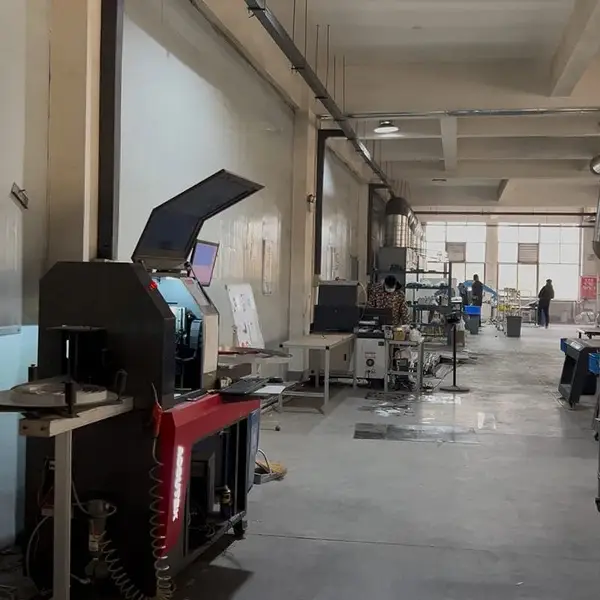
Real photo from our production floor — every sign we ship is made here.
From $24/letter · MOQ 1 piece · Flexible lead time · CE & UL certified · ships to 20+ countries
Custom sizes, colors, and finishes. Get a factory price in 24 hours.
Get a Free Quote Copy EmailWhatsApp +86 13865703472 · business@aochuangsign.cn
See pricing, specs, and get a free quote for the sign type you need. Built in our factory, shipped worldwide.