I'll tell you what the manual won't: that shiny $800 quote from a domestic fabricator? Same letter rolls out of my truck for $120. I've been installing commercial signs for 20 years across 30 states, and I've had to explain cost breakdowns to more clients than I can count. Most of what you hear is fluff. Here's what actually moves the needle on pricing, told by a guy who's lifted the heavy parts and watched the invoices come in.
Let's start with the biggest lever: what the sign is made of. Aluminum runs $10–25 per letter in my factory quotes. Stainless steel 304? $15–40 per letter. That's a 60% swing on material alone. I've watched sign shops pay $800 for a front-lit letter from a domestic fabricator. Same 304 stainless, same Samsung LEDs. We ship that letter for $120. The difference is where the metal comes from and how it's finished.
Pro tip: if you see "stainless steel" on a quote with no grade number, run. Common 304 lasts 10+ years inland. 316 costs 20–30% more and adds 5 years of life in salt air. For a strip mall in Ohio, 304 is fine. For Miami Beach, pay for 316 or you're replacing letters in 3 years. I've seen it happen. Twice.
Aluminum's lighter — one-third the weight of steel — and naturally rust-proof, but it dents easier. I've installed letters that looked like origami after a forklift tap. For light boxes, aluminum is king. For heavy duty channel letters, go stainless. And never, ever use domestic acrylic on channel letters if the bid is tight. Mitsubishi or Degussa acrylic gives 5–8 years before yellowing. Domestic stuff? 1–2 years tops. That's a 400% lifespan difference for maybe a 15% price increase.
Here's what the permit office won't tell you: the cheapest material is never the cheapest total cost. Last spring I swapped a set of back-lit halo letters on a bougie coffee shop. The original installer used cheap acrylic and 2mm aluminum. Three years in, the acrylic yellowed like a smoker's teeth, and the aluminum flexed so the letters never sat flush. The owner paid $1,200 for that sign. My retrofit: $900 for materials, $400 labor. He saved $100 and got 5 more years of life. Material grade is an investment, not an expense.
Don't make the mistake I made early on: I spec'd domestic acrylic on a pharmacy chain job to cut costs. Eighteen months later they called me back for replacements. The acrylic had turned beer-bottle amber. I ate the labor and the rush shipping. Learned that lesson the hard way.
Every bend, weld, and polish adds time. Laser cutting runs at ±0.1mm precision — that's fast, cheap. But bending and TIG welding? That's 1–2 days per batch for an experienced fabricator. Grinding and polishing another 1–2 days. Straightforward channel letters with 90° corners are cheap. Curves, sharp points, or hidden returns? Three times the labor cost. I've installed this in a chain restaurant where the designer wanted letters that looked like cursive handwriting. Each 'S' took 45 minutes to bend by hand. The quote for that one word was $2,300.
Here's a dirty secret: most "custom" letters are just stock curves with a different face. True custom fabrication involves custom dies or hand bending. That costs $40–120 per letter for 3D fabricated types. Standard front-lit channel letters run $20–80. You pay for the artisan's time, not the material.
Quickest way to spot inflated labor costs: ask for the fabrication stage breakdown. A good shop will say "2 days cutting, 3 days assembly, 1 day wiring." A lazy shop says "custom fabrication — labor: $X." How custom? A 5mm acrylic face for a sign over 2.5m wide is mandatory for strength. That's a material fact. If your fabricator is using 3mm acrylic on a 3m-long sign, they're either cutting corners or don't understand structural loads. Both are red flags.
Back-lit halo letters cost 75% more than front-lit. Why? Two layers of acrylic, a diffuser, and careful placement of individual LEDs to avoid hotspots. I've seen quotes for halo letters at $400–1,000 per letter retail. Factory-direct with Samsung SMD 2835 modules? $35–120 per letter. The gap is profit and middlemen.
LED modules look identical until you test them. SMD 2835 gives 100–150 lumens per watt — industry standard. SMD 5730 hits 40–60 lumens per chip, highest brightness, but runs hotter. Quality modules from Samsung or Osram last 5+ years real-world. Cheap modules burn out in 12–18 months. I've replaced a sign three times in two years because the owner bought the $0.60-per-module Chinese crap instead of the $1.20 Samsung ones. The labor cost alone made it a poor decision.
Pro tip: look at the solder joints. Dull gray? That's cheap solder, poor quality control. Shiny silver means proper lead-free solder and a better lifespan. If you're ordering from a factory, ask for a photo of the LED strip with a bright light. They'll send a picture. The good ones won't hesitate. The bad ones will stall.
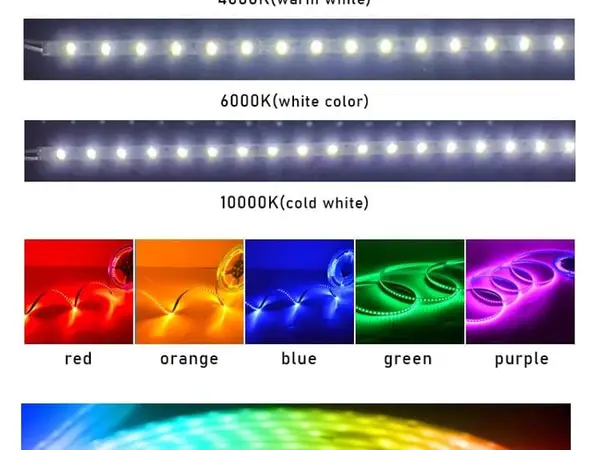
Color temperature matters for price too. 3000–3500K warm white is for hospitality. 4000–5000K neutral is retail and corporate. 6000–6500K cool white is industrial and highway. Switching a run from 5000K to 6500K doesn't affect cost. But specifying RGB-capable SMD 5050 modules bumps price 30–50% because of the controller and wiring complexity.
Power supplies: the 1-year warranty on cheap units is a joke. I've watched a $12 power supply fry a $400 sign in six months. Spend the extra $20 on a Mean Well or equivalent. The 2-year LED warranty from a good factory means nothing if the power supply dies first. And never install a power supply inside a sealed canopy without ventilation. IP65 rated? It means water jets, not heat dissipation. I've seen three signs cook themselves because the installer forgot heat.
IP65 sounds impressive. It means water jets from any direction. It does NOT mean your sign survives a Florida hurricane. For coastal or exposed installations, you need IP66 at minimum. IP68 is overkill for 99% of jobs, but if you're in a flood zone? It's not a suggestion. I've seen IP65 letters filled with saltwater after a storm surge. The client had to replace the entire set.
Aging tests are a real thing. Reputable factories run 8–12 hours of burn-in on every sign. I send mine through 24 hours. If they can't show you a test log, assume no testing happened.
Brushed 304 stainless with a #4 finish is standard. Mirror #8 finish costs 20% more because polishing takes twice as long. Powder coating adds another 15% but gives you color flexibility and corrosion resistance. PVD coating (vacuum plating) looks like gold or brass and can double the letter cost. I've installed this in a bank lobby where each letter was PVD-coated bronze. That twelve-letter set cost $4,200. Same letters in brushed stainless would've been $1,800.
Acrylic face finishing is another hidden cost. UV-resistant acrylic costs more but won't yellow in 5 years. Standard acrylic will. For signs with long-term warranties (the ones that actually mean something), the factory will use Mitsubishi or Degussa acrylic. Ask. If they say "we use a high-grade acrylic" without naming a brand, assume it's domestic. I've seen quotes where domestic acrylic was 30% of the cost but the sign yellowed in 18 months. False economy.
Sealing matters too. Neutral silicone is standard. But the best fabricators use a continuous bead, not a spot seal. I've watched rain wick through spotted sealant into the LED cavity. That sign was junk in 11 months. The installer blamed the weather. No, the installer blamed the sealer.
You picked a factory-direct price that's 50–65% less than domestic? Great. Now add shipping. Express courier for small samples: $30–100, 7-10 days. Air freight for a full sign set: $4–12 per kilogram, about 10 days. Sea freight: $80–200 per cubic meter LCL, about 65 days. Full container load: $1,200–3,000 FCL. That all sounds manageable until you account for US Section 301 tariffs: roughly 30% on Chinese sign products. Yes, 30%.
LCL sea freight: your crate gets handled 6–8 times between our dock and yours. Every touch is a chance for damage. That's not in the brochure. I've received crates that looked like they'd been drop-kicked across the warehouse. The contents? Fine, because the factory used foam + carton + plywood crate. But one time, a client saved $40 by using a cardboard-only order. The crate was missing a corner, and two letters were bent. Replacement cost: $210. The savings: negative.
Don't make the mistake I made: assuming shipping is uniform. A 20kg air shipment from China to Los Angeles costs about $180. Sea freight for the same weight (if you consolidate) is $60. But sea takes 8 weeks. If your client needs the sign in 4 weeks, you're paying express. Always ask the factory for the shipping timeline before you quote the end client.
And customs brokers? They charge $100–300 per clearance. If your shipment gets flagged for inspection, tack on another $200 and a 2-day delay. I've had a client's sign sit in customs for three weeks because the commodity code was slightly wrong. The client blamed me. I blamed the code. But I was the one who wrote the invoice.

Real photo from our production floor — every sign we ship is made here.
Products mentioned or relevant to this topic — factory-direct, custom built.
From $24/letter · MOQ 1 piece · Flexible lead time · Project-specific compliance documents · ships to 20+ countries
Custom sizes, colors, and finishes. Get a factory price in 24 hours.
Get a Free Quote Copy EmailWhatsApp +86 13865703472 · business@aochuangsign.cn
See pricing, specs, and get a free quote for the sign type you need. Built in our factory, shipped worldwide.