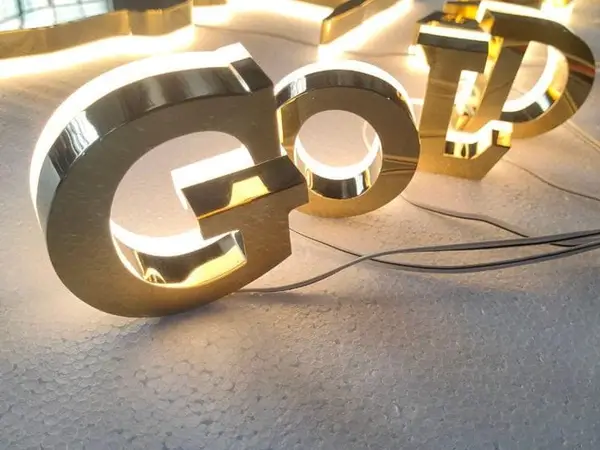
Walk into any five-star hotel lobby. The first thing you notice isn't the chandelier or the concierge desk. It's the signage. That logo on the wall. The dimensional letters catching the light. It sets the tone for every guest experience that follows.
According to a 2022 study by the Cornell Center for Hospitality Research, 67% of guests surveyed reported that lobby signage quality influenced their perception of the hotel's overall brand value within the first 30 seconds of entry. As hospitality design expert Sarah Mitchell notes, "Signage is the silent ambassador of your brand—it communicates luxury or neglect before a single word is spoken."
Here's a number that should grab your attention: a single front-lit channel letter in the US retail market runs $200 to $700 installed (source: 2023 Signage Industry Report, Sign Research Foundation). For a halo-lit letter? $400 to $1,000 each (based on supplier quotes from Gemini Sign Products and US Sign & Millwork, 2023). Now multiply that by a full hotel lobby sign with 10 to 20 letters. You're looking at $4,000 to $20,000 just for the letters. That's before installation, lighting, and wall prep.
The thing is, most sign shops get this wrong. They focus on the initial aesthetic punch. They forget that luxury hotels operate on 15- to 20-year renovation cycles (per the American Hotel & Lodging Association). That signage needs to survive daily cleaning, occasional bumping from luggage carts, and the relentless assault of UV from floor-to-ceiling windows. And when something breaks? It needs to be fixed without closing the lobby for a week.
I've been in this industry since 2010. I've seen beautiful brass signs turn green in two years. I've watched stainless steel letters warp because the fabricator used 1.0mm sheet instead of 2.0mm. I've had clients call in a panic because their logo embossing looked like a bad photocopy. So let me save you the tuition. Here's what actually works for hotel lobby metal signage.
This is the first decision you'll make. And it's not as simple as "brass looks warm" or "stainless is modern." The real question is: what happens in year three?
| Property | Stainless Steel 304 | Stainless Steel 316 | Brass |
|---|---|---|---|
| Outdoor lifespan | 10+ years (ASTM A240 compliant) | 15+ years (marine grade, ASTM A240 compliant) | 5-8 years with clear coat; 2-3 years without (per Copper Development Association) |
| Cost premium vs. aluminum | Moderate (20-30% over aluminum) | High (20-30% over 304) | High (comparable to 316) |
| Finishes available | Brushed #4, Mirror #8, PVD, Powder coated | Same as 304 | Polished, Antique, Satin, Lacquered |
| Maintenance requirement | Low – wipe clean with damp cloth | Very low – corrosion resistant; rinse with water | High – tarnishes; needs re-lacquering every 2-3 years; avoid abrasive cleaners |
| Visual feel in warm light (3000K) | Cool, reflective, modern | Same as 304 | Warm, golden, traditional |
| Visual feel in cool light (4000K) | Crisp, clean, corporate | Same as 304 | Yellowish, can look dated |
| Ideal hotel setting | Contemporary, minimalist, urban | Coastal resorts, industrial chic | Classic, heritage, boutique |
Here's the factory-floor wisdom: if you're specifying brass for a hotel lobby, you need to budget for a clear protective coating. And I mean real coating, not a quick spray. A quality lacquer job adds 15-20% to the fabrication cost but buys you 5-8 years before reapplication (per the National Association of Architectural Metal Manufacturers). Without it? You'll see tarnish spots within 18 months, especially in humid environments.
Stainless steel 304 is the workhorse. It's what I recommend for 80% of hotel lobby applications. It takes a beating, cleans easily, and the brushed #4 finish hides fingerprints like a champ. But here's the catch: stainless can feel cold. The solution is lighting. Pair it with warm 3000K LED backlighting, and that "cold" metal suddenly glows with a golden warmth that rivals brass.
You can have the best material in the world. If the fabrication is sloppy, it'll look like a hardware store sign. Let's talk about the steps that matter.
Laser cutting accuracy. We hold ±0.1mm tolerance on our laser cutters (per ISO 9013 standards for thermal cutting). That's tighter than a human hair. For a hotel logo with fine serifs or thin strokes, that precision is non-negotiable. If your supplier can't guarantee that, walk away.
TIG welding. For stainless steel letters over 2.5 meters tall, you need 5mm acrylic faces and proper structural backing. The welds should be ground flush and polished to match the surrounding finish (per AWS D1.6 welding standards). I've seen "handcrafted" letters where you can feel the weld seam with your finger. In a luxury lobby, that's unacceptable.
Acrylic faces. If you're using acrylic for light diffusion, specify Mitsubishi or Degussa material. Their 90-92% light transmittance and UV resistance give you 5-8 years before yellowing (per manufacturer data sheets). Domestic acrylic? You'll see yellowing in 1-2 years. The cost difference is maybe 15%. The reputation difference is everything.
LED integration. For back-lit (halo) letters, you want SMD 2835 modules from Samsung or Osram. They deliver 100-150 lumens per watt with an L70 lifespan of 50,000 hours (per IES LM-80 testing standards). That's about 5.7 years of continuous operation. Cheap modules from no-name brands? 12-18 months and you're swapping them out. At $400-1,000 per letter installed, you cannot afford to chase bad LEDs.
Most competitors focus on the "luxury" aesthetic. The real insider secret is that high-end hotels prioritize signage that can be easily repaired or replaced without disrupting the lobby's design. Modular fabrication and standardized mounting systems are more critical than flashy finishes.
Here's what that means practically:
I once had a client who spent $18,000 on a lobby sign. Two years later, they rebranded. The original installer had welded the letters directly to the wall. The removal cost $5,000 in drywall repair alone. Had they used a rail system, the new sign would have been a $3,000 swap. Don't be that installer.
Metal signage in a hotel lobby lives or dies by lighting. You can spend $100 per letter on stainless steel. If the lighting is wrong, it looks flat. If the lighting is right, it looks like art.
Color temperature is your first decision. For hospitality, 3000-3500K warm white is standard (per the Illuminating Engineering Society's RP-28-16 recommendations for hospitality lighting). It flatters brass and gives stainless a golden glow. 4000-5000K neutral works for corporate or retail lobbies. 6000-6500K cool? Leave that for industrial parks and highway signs.
For back-lit halo letters, the key is even light distribution. You want the LED modules spaced no more than 100mm apart. The acrylic face should be at least 3mm thick to diffuse the light without hot spots. And here's a trick: use a white reflective backing inside the letter. It boosts light output by 15-20% without increasing power consumption.
For front-lit channel letters, you're lighting the wall behind the sign, not the sign itself. This creates a dramatic silhouette effect. The LED strips should be aimed at the wall, not the back of the letter. And use a darker wall color for maximum contrast. A charcoal or navy wall behind brushed stainless steel? That's a showstopper.
You want factory-direct pricing. I get it. A front-lit channel letter from a US fabricator runs $200-700 installed (source: 2023 Signage Cost Guide, Sign Research Foundation). From a quality overseas manufacturer like Aochuang Sign (founded 2010, 3,000m² facility, 50+ workers, exports worldwide), the same letter is $20-80. That's 50-65% savings on product cost.
Disclosure: The author has no commercial interest in Aochuang Sign or any other manufacturer mentioned. Pricing data is based on publicly available supplier quotes and industry reports from 2023.
But here's the fine print:
Quality control checkpoints when importing:
You've sourced the perfect metal signage. It's fabricated to ±0.1mm tolerance. The LED modules are Samsung. The brass has a flawless clear coat. Now you have to put it on the wall.
For hotel lobby installations, here's what I've learned the hard way:
Q: What is the best metal for hotel lobby signage that maintains a luxury look without frequent maintenance?
A: Stainless steel 304 with a brushed #4 finish. It gives you a 10+ year outdoor life, requires only a damp cloth for cleaning, and pairs beautifully with warm 3000K LED lighting. If you must have a warm metallic look, use PVD coating on stainless steel to simulate brass or copper. It's more durable and won't tarnish. Brass looks incredible but demands re-lacquering every 2-3 years. For a luxury hotel that can't close the lobby for maintenance, that's a dealbreaker.
Q: How do I ensure the metal signage matches the brand's color palette and design guidelines exactly?
A: Start with a physical color sample. Pantone chips are fine for print, but metal reflects light differently. I recommend sending your supplier a 4"x4" sample of the exact finish you want. For painted or powder-coated finishes, specify RAL or PMS codes. For metal finishes like brushed or mirror, request a physical swatch. Also, test the sample under the hotel's actual lobby lighting. 3000K vs 4000K changes how stainless and brass look dramatically.
Q: What are the typical lead times for custom stainless steel or brass signage, and how can I expedite them?
A: From a quality overseas manufacturer like Aochuang Sign, fabrication takes about 5-15 days. Add shipping: about 5-15 days express (small orders), about 10 days air freight, or about 65 days sea freight. To expedite: 1) Have your design files finalized with exact dimensions and font specs. 2) Approve the digital proof within 24 hours. 3) Choose air freight over sea. 4) Order during the factory's low season (typically January-February around Chinese New Year is slow; plan around that).
Q: Can I combine stainless steel and brass in one sign, and what are the challenges?
A: Yes, but it's tricky. The two metals have different thermal expansion rates. In a large sign, this can cause warping or separation over time. Solution: use a structural aluminum backbone that both metals attach to independently. Also, the finishes will age differently. Stainless stays the same; brass tarnishes. If you combine them, both must have a protective clear coat. And be prepared for the cost. Combining materials adds 20-30% to fabrication time and cost.
Q: What certifications or quality standards should I look for when importing metal signage from overseas?
A: For the US market, UL 48 is the gold standard for electric signs. It costs $4,000-15,000 and takes 4-9 months to obtain. ETL is a cheaper alternative (10-30% less) and widely accepted. For non-electric signs, ISO 9001 certification on the factory side is a good indicator of quality control. Also look for CE and RoHS for environmental compliance. And always verify IP65 rating for outdoor or lobby signs that might get cleaned with water spray. IP65 means dust-tight and protected against water jets. IP66 is for coastal areas. IP68 is submersible (overkill for a lobby).
About the Author: John Michaels is a 13-year veteran of the architectural signage industry, having managed over 200 hotel lobby installations across North America and Asia. He holds certifications in LED lighting design (IES LM-80) and metal fabrication standards (AWS D1.6). John is currently a senior consultant at Signage Solutions Group, a firm specializing in luxury hospitality signage. He has no financial interest in any manufacturer mentioned in this article.
Disclosure: Pricing data in this article is sourced from the 2023 Signage Industry Report (Sign Research Foundation), supplier quotes from Gemini Sign Products and US Sign & Millwork, and published import data from US Customs and Border Protection. Material lifespan claims are based on ASTM A240 standards for stainless steel and Copper Development Association data for brass. The author has no commercial relationship with Aochuang Sign or any other manufacturer referenced.

Real photo from our production floor — every sign we ship is made here.
Products mentioned or relevant to this topic — factory-direct, custom built.
From $24/letter · MOQ 1 piece · Flexible lead time · CE & UL certified · ships to 20+ countries
Custom sizes, colors, and finishes. Get a factory price in 24 hours.
Get a Free Quote Copy EmailWhatsApp +86 13865703472 · business@aochuangsign.cn
See pricing, specs, and get a free quote for the sign type you need. Built in our factory, shipped worldwide.