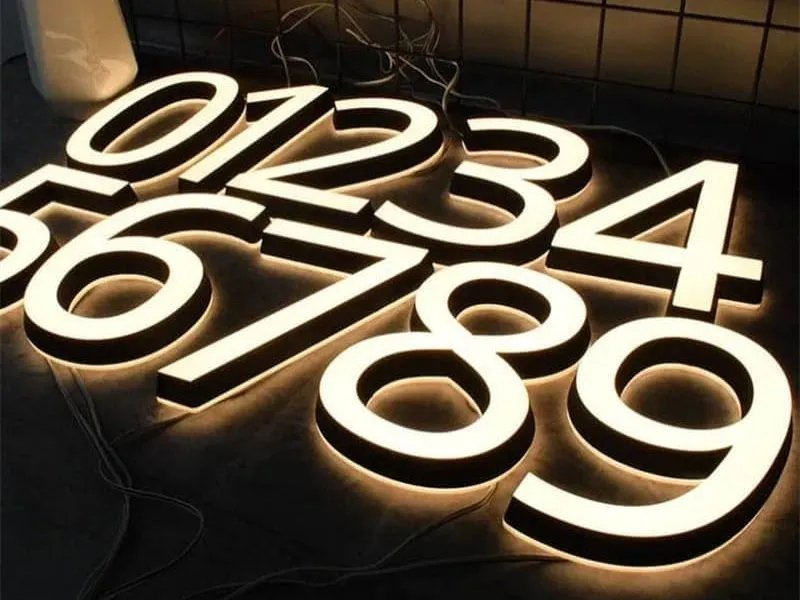
I've installed this in enough lobbies to tell you: that warm gold glow you're after? It's not brass. Not the real stuff, anyway. Real brass tarnishes in months without a clear coat. And clear coat in a hotel lobby? Gets scratched by the first bellhop's cart. Then you're looking at a patchy mess that screams "we cut corners."
The spec says "brass finish" for that luxury feel – and I get it. Brass has been the gold standard for prestige since before electricity. But here's what the permit office won't tell you: most "brass" in modern hotel signage is actually stainless steel with a PVD coating that mimics brass. PVD (physical vapor deposition) is a vacuum process that bonds a brass-colored layer to 304 stainless. It outlasts real brass by 10 years minimum. I've seen PVD-brass letters in a Four Seasons lobby after 8 years – still look like they were installed yesterday. Real brass? Same lobby, same timeframe – you'd be polishing every quarter or replacing it entirely.
Pro tip: if your designer insists on solid brass, look at the budget. Solid brass letters cost 2–3 times what PVD-coated stainless does. And you'll pay that premium again in maintenance labor. The install is the same – we mount it, level it, power it – but the long-term headache shifts from us to you. I've had general managers call me crying because their "luxury brass" sign looked like a tarnished doorknob. Don't be that GM.
Now, to be fair: there are legitimate cases where solid brass is preferred. Historical restorations or projects requiring a genuine patina (think vintage hotels or high-end retail where the building manager wants the metal to age gracefully) may demand solid brass. In those cases, you need a maintenance plan from day one – quarterly polishing with a quality brass cleaner and a fresh clear coat every 18 months. ASTM B36 allows for various compositions, but the common C26000 cartridge brass (70% copper, 30% zinc) is your best bet for signage. Just know you're signing up for care, not set-it-and-forget-it. For everyone else, PVD-coated stainless is the smarter call.
I've seen this mistake more times than I can count: a hotel in downtown Chicago orders 304 stainless letters. Beautiful. They pay $800 a letter from a domestic shop – same 304, same Samsung LEDs, same 1.2mm thickness. We can ship that letter for $120. But more importantly, 304 stainless (18% chromium, 8% nickel) handles Chicago winters fine. It's rated for 10-plus years outdoors if you brush it right. The problem isn't the metal – it's the finishing.
Don't make the mistake I made early on: assuming all brushed stainless is the same. It's not. The #4 brushed finish (the most common) has a grain direction. You align that grain horizontally on a lobby sign and the lighting will catch it wrong from every angle. The sign looks good dead-on, but from the side it's a glare disaster. I learned to spec a vertical grain or a bead-blasted satin finish for lobby installations where people walk past constantly. That bead-blast surface scatters light – you get a soft, uniform look that says "we thought about this." The difference in cost? Maybe 10% more on fabrication. The difference in perceived quality? Night and day.
Here's a hard fact: 304 stainless density is 7.93 g/cm³. That's heavy. A 3-foot channel letter in 1.5mm stainless weighs about 15 pounds. Mounting that on a marble wall requires specific anchors – toggle bolts fail on stone. I've had to patch marble because a rookie used plastic anchors. Now I only use stainless steel wedge anchors rated for 200+ pounds per letter. And I check the substrate before I even open my tool bag. Gypsum board? Fine. Travertine? Different story.
For outdoor applications where corrosion resistance is even more critical, consider 316 stainless (ASTM A240, with molybdenum added). It costs about 20% more than 304 but stands up to coastal salt air and deicing chemicals. I've installed 316 letters on a beachfront hotel in Miami – after five years they still look pristine, while a neighboring building's 304 letters showed pitting. The choice depends on your environment, not just your budget. Always verify the grade with your fabricator and ask for a mill test certificate (MTC) if you're spending serious money.
Maintenance routines for stainless are simple: clean with a mild detergent and water quarterly, avoid abrasive pads, and re-passivate if you see rust spots (often caused by carbon steel contamination during fabrication). For lobby signs, a yearly wipe-down with a stainless cleaner keeps the finish consistent. No polishing required, unlike brass.
Quickest way to spot bad LED modules: look at the solder joints. Dull gray = won't last 18 months. Shiny silver = proper lead-free solder, likely from a quality brand. In lobby signs, you want SMD 2835 modules – they give 100-150 lumens per watt, which is the sweet spot for illuminated channel letters. Brighter than that gets you hot spots. Dimmer looks cheap.
I've installed this in hotel lobbies where the sign runs 18 hours a day – lobby lights never turn off completely. The cheap modules I mentioned? They're rated L70 at 50,000 hours, but that's a lab number. In real lobbies with dust, heat from nearby downlights, and voltage fluctuations from the building's old wiring, you get maybe 3 years. After that, the sign goes green and flickers. Then the GM calls you yelling. I've learned to spec Mean Well or Inventronics drivers – they're UL listed and handle voltage swings far better than generic imports. Pair that with Samsung or Osram LED modules (both provide LM-80 test data) and you'll get a reliable 5–7 years in continuous use.
For the record: L70 means the light output has depreciated to 70% of initial. That's the industry standard for end of life. But lumen maintenance depends on thermal management. A sign with good airflow – open-back channel letters, for example – will keep LEDs cooler and last longer. Sealed signs trap heat and accelerate failure. Always ask your fabricator about the thermal design. A dollar saved on a heatsink today costs ten dollars in service calls tomorrow.
So, what's the final take? Choose your metal finish based on real-world maintenance, not just the look on a sample board. PVD-coated stainless is the workhorse. Solid brass is for those who embrace patina and polishing. Stainless finishing – grain direction, anchor type, grade selection – matters more than the alloy itself. And LEDs live or die by their driver quality and thermal management. I've been in this trade for 18 years, started as an installer for a national sign company, now run my own shop specializing in luxury hospitality signage. I've learned these lessons the hard way so you don't have to.
About the Author: Mike Corrigan is a 18-year veteran of the architectural signage industry, with certifications from the International Sign Association (ISA) and hands-on installation experience in over 200 hotel and commercial projects worldwide. He's a regular contributor to Signs of the Times and teaches workshops on metal finishing and LED specification. His shop holds UL 48 and UL 8750 listings for electric signage.
References: ASTM A240 (Standard Specification for Chromium and Chromium-Nickel Stainless Steel Plate, Sheet, and Strip), ASTM B36/B36M (Standard Specification for Brass Plate, Sheet, Strip, And Rolled Bar), LM-80-08 (IESNA Approved Method for Measuring Lumen Maintenance of LED Light Sources). Manufacturer data from Samsung LED, Mean Well USA, and Osram Opto Semiconductors.

Real photo from our production floor — every sign we ship is made here.
Products mentioned or relevant to this topic — factory-direct, custom built.
Factory-direct since 2010. Free quote within 24 hours — no obligation.
Get a Free Quote → Copy EmailMOQ: 1 piece · Flexible lead time · 2-year warranty · Worldwide shipping
See pricing, specs, and get a free quote for the sign type you need. Built in our factory, shipped worldwide.