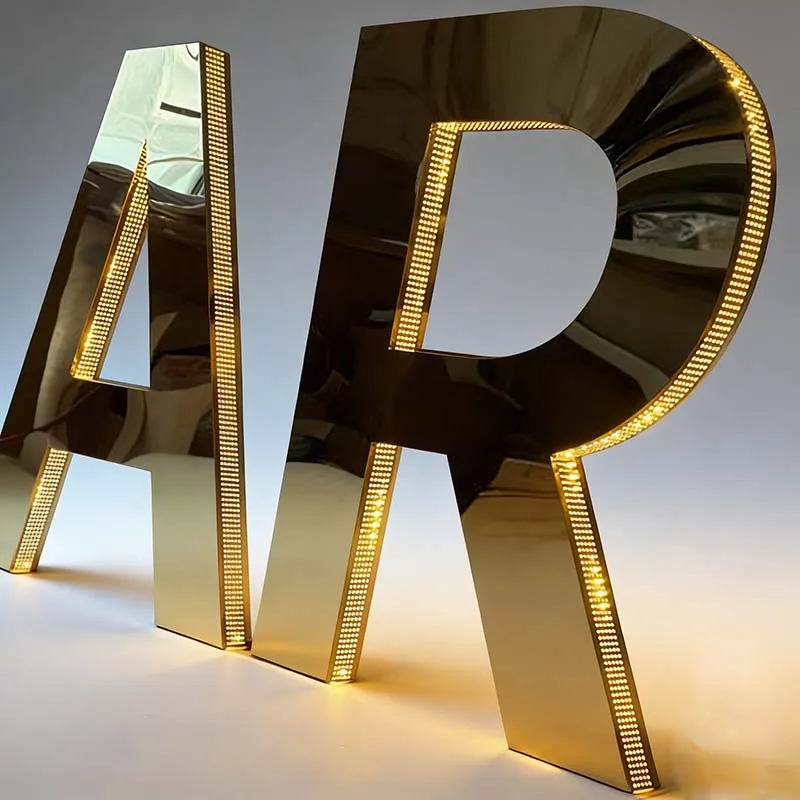
I've spent 16 years on a sign factory floor. I've burned my hands on hot acrylic. I've argued with LED suppliers until they hung up. I work at Aochuang Sign in Lu'an, Anhui, China. We've been making signs since 2010.
We run a 3,000m² facility with 50+ skilled workers. We ship worldwide. We're CE, RoHS, and ISO 9001 certified. MOQ is one piece. Lead time is about 5-15 days. So yeah, I know a thing about signs.
But here's the thing: we don't install signs in your parking lot. We can't. We're in China. You're in Ohio or Texas or Melbourne. So this guide is me telling you the truth about what happens after the crate leaves our dock.
Let's talk numbers first. Factory prices for front-lit channel letters run $20-80 per letter. Back-lit halo letters $35-120. Stainless steel non-lit $15-40. You already know this if you're shopping.
US retail installed prices? Front-lit channel letters go for $200-700 per letter installed. Halo-lit $400-1,000 per letter installed. That's the number on the invoice from the local shop.
Do the math. Even with 30% Section 301 tariff and shipping, you're saving 50-65% on the product itself by ordering factory-direct. The installation markup is where local guys make their money.
Here's what nobody tells you: The installed price isn't just labor. It's permits, liability insurance, a truck, a lift, an electrician, and a healthy profit margin. If you think you can skip all that with a ladder and a drill, keep reading.
Look, I'm not going to tell you to never DIY. I've seen plenty of small signs installed fine by business owners. A small aluminum sign on a wooden storefront? You can probably handle that.
You need a drill, a level, a stud finder, and some common sense. Stainless steel letters with pre-drilled holes and mounting studs? That's a weekend job if you have patience.
But the moment the sign is heavy, goes above head height, or has wires, you're in a different game.
The ugly truth is: Most DIY failures I hear about are electrical. Wrong voltage. Bad waterproofing. Chewed-up wires from pinching them behind the sign.
A licensed sign contractor brings three things you don't have: code knowledge, insurance, and a lift. They know NEC Article 600 for electrical signs. They know local wind load requirements. They know how to pull a permit without the inspector laughing.
Professional installation costs vary, but from the retail installed numbers above, you're looking at the difference between our $120 halo letter and their $700 installed letter. That gap pays for labor, truck, insurance, and the guy's boat payment.
Here's what nobody tells you: The permit itself isn't the expensive part. It's the fine and the redo when the inspector drives by and sees your sign wired with an extension cord.
I've seen this go wrong: A contractor called us fuming. He installed our back-lit halo letters using drywall anchors on a stucco wall. First windstorm, three letters sheared off and nearly hit a car. He blamed our mounting studs. Our studs were fine. His anchors weren't rated for stucco.
Our LED modules are low voltage. SMD 2835 chips run 100-150 lumens per watt. Quality modules from Samsung or Osram last 5+ years. Cheap ones die in 12-18 months. But even good modules fry if you wire them wrong.
We include wiring diagrams. We label polarity. We test every sign with an 8-12 hour aging test before it leaves the factory. We do 100% QC inspection.
That doesn't help if you connect a 12V module to a 24V power supply because you didn't read the label. And yes, we've had that call. The guy wanted a warranty replacement. I told him to buy a new power supply and learn to read.
The ugly truth is: If you're not comfortable using a multimeter, you shouldn't be wiring a sign. Get an electrician. It's cheaper than a fire.
Signs catch wind. That's physics. A 4-foot by 4-foot acrylic light box can weigh a lot depending on frame and LED density. Mount that on two lag bolts into siding and you're begging for it to come down.
Professional installers calculate wind load. They use backing plates. They know that stucco needs toggle bolts, brick needs sleeve anchors, and drywall needs a structural frame behind it.
We can't inspect your wall from China. We can send you a mounting template with exact hole locations. We can tell you the weight and dimensions. We can tell you if the sign needs a raceway or direct mount. But we can't tell you if your wall is made of cardboard.
Look, I've seen signs fall. It's never pretty. And the lawsuit will name you, not the factory in China.
In the US, NEC Article 600 covers electric signs. ADA has rules for tactile signs: mounting height 48-60 inches, non-glare, Grade 2 Braille. Your local jurisdiction has its own sign code. Some require UL 48 or ETL listing for illuminated signs.
We have CE and RoHS. Some of our components can be built to UL 48 standards, but that certification costs $4,000-15,000 and takes 4-9 months with quarterly audits. We tell you upfront: if your city requires UL listing on the installed sign, that's a field certification usually handled by the local installer, not us.
Here's the brutal honesty: Many factories will tell you "UL approved" without any certificate. Ask to see the certificate with today's date. If they can't produce it, walk away.
For us, we're honest: we can build to UL standards, we can provide component documentation, but we don't stamp the installed sign. Your local licensed electrician does that.
Our warranty: 2 years on LED modules, 1 year on power supply. That covers manufacturing defects. It does not cover lightning strikes, wrong voltage, physical damage, or your brother-in-law's idea of waterproofing.
I've had to deny warranty claims where the sign was installed with the drain holes pointing up. Water pooled inside, corroded the LEDs, and the guy demanded free replacements. No. That's installation error.
Professional installers know to leave drain holes at the bottom. They know to use neutral silicone sealant, not caulk from a bathroom tube. They know to leave a drip loop on the wiring so water doesn't run into the power supply.
The ugly truth is: A bad install will void any warranty faster than a lightning storm. If you DIY, you own that risk.
We can ship you a sign with pre-drilled mounting holes, mounting studs, a wiring diagram, and a packing list that survives sea freight. We can send you a video of our team installing the same sign on our test wall. We can do a video call with your installer to answer questions.
We cannot come to your site. We cannot pull a permit in your city. We cannot inspect your wall structure. We cannot guarantee that your local handyman won't use a butter knife as a drill bit.
Ordering front-lit channel letters from us saves you 50-65% on the product. That's real money. But if you spend half your savings fixing a botched DIY install, you're back to square one.
Non-illuminated letters. Small sizes. Mounting on a flat, accessible surface. Indoors or under a porch. If your sign is light and you can reach it with a step stool, go ahead.
Stainless steel letters are another DIY-friendly option for flat, accessible mounting.

Real photo from our production floor — every sign we ship is made here.
From $24/letter · MOQ 1 piece · Flexible lead time · CE & UL certified · ships to 20+ countries
Custom sizes, colors, and finishes. Get a factory price in 24 hours.
Get a Free Quote Copy EmailWhatsApp +86 13865703472 · business@aochuangsign.cn
See pricing, specs, and get a free quote for the sign type you need. Built in our factory, shipped worldwide.