Look, I'll skip the song and dance. You're reading this because you've priced out a commercial sign job and your gut said the numbers are wrong. Your gut's right.
I've spent 16 years in this industry — 25 of them on the factory floor in China. I've seen American sign shops pay $800 for a front-lit letter from a middleman. Same 304 stainless, same Samsung LEDs, same welding quality as what we ship out our door for $120. The markup isn't a "service fee." It's a tax on not knowing who to call.
This guide breaks down exactly what commercial building signage exterior wholesale should cost. Not the retail garbage. The real factory-direct numbers.
---
What "Factory Direct" Actually Means (And Doesn't)
Here's what nobody tells you: most "factory direct" suppliers on Alibaba aren't factories. They're trading companies operating out of an office with a warehouse down the street. Nothing wrong with that business model — until a QC problem shows up and nobody on the production floor takes responsibility.
We're Aochuang Sign. Founded 2010. 3,000 square meters of production facility in Lu'an, Anhui. 50+ skilled workers. If you call us, you're talking to the people who cut, weld, wire, and test your signage. That's the difference.
But let me be straight about what we can't do.
We can't match a local American shop's turnaround on a rushed replacement letter. We can't offer next-day installation. And we won't pretend UL certification is something we can snap our fingers and produce — more on that later.
What we can do: build your commercial signage at 50-65% below US retail installed pricing, hit tolerances of ±0.1mm on laser cutting, and deliver in about 5-15 days when you approve a proof quickly.
---
Why Your Current Pricing Is Wrong
The ugly truth is that most quote sheets in the sign industry are built on outdated cost assumptions. If your pricing includes $30-40 per square foot for basic aluminum-faced cabinet signs, you're either working with the wrong supplier or you're leaving money on the table.
Let's break down what commercial building signage exterior wholesale should cost straight from our factory floor:
- Front-lit channel letters: $20-80 per letter (depending on size and material)
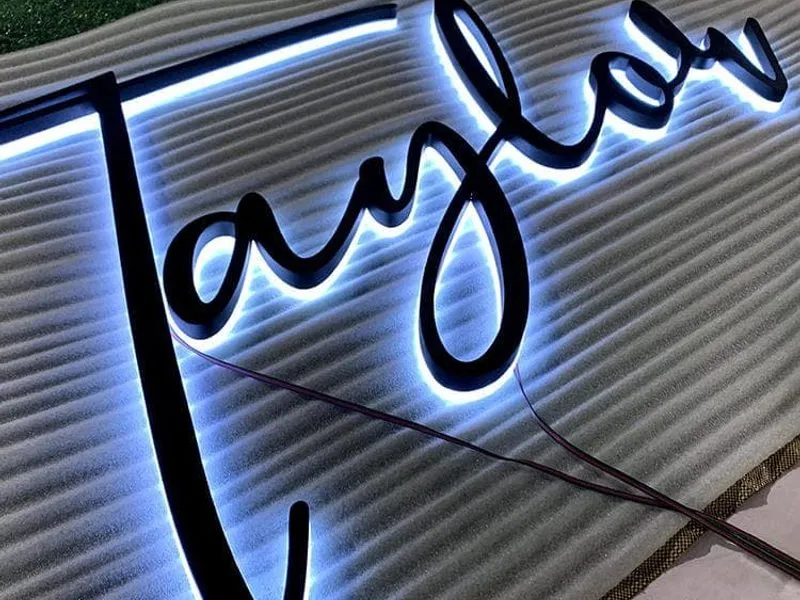
- Back-lit halo letters: $35-120 per letter
- Stainless steel non-lit letters: $15-40 per letter
- 3D fabricated letters: $40-120 per letter
- Aluminum letters: $10-25 per letter
- Light boxes: $80-250 per square meter
- Neon flex signs: $30-200 per sign
Compare that to US retail installed pricing: $200-700 per letter for front-lit, $400-1,000 per letter for halo-lit. Do the math. That's not a small gap — that's the difference between winning a bid and losing your shirt.
---
Material Pricing Truths: Where Costs Hide
Every buyer asks why one quote comes in at $45 per letter and another at $110. Here's what justifies that gap.
Acrylic Face Quality
The acrylic you spec changes everything. Mitsubishi or Degussa UV-resistant acrylic runs 90-92% light transmittance and lasts 5-8 years before yellowing. Domestic acrylic? One to two years before it starts looking like a nicotine stain. That's the difference between a sign that still looks crisp at year five and one that gets replaced on warranty — or worse, gets you sued by a client.
For larger letters over 2.5 meters, you need 5mm thickness minimum. Most factories will happily quote you 3mm and hope nobody notices. It will sag. It will deform. I've seen this go wrong on a
hotel sign in Arizona — the "L" drooped so bad it looked like a lowercase "e" by mid-summer.
Stainless Steel: 304 vs 316
Standard outdoor signage uses 304 stainless — 18% chromium, 8% nickel, 10+ year outdoor life. At 7.93 g/cm³ density, it's heavy enough that a 3-foot letter will surprise you when it lands on the workbench.
But here's the honest answer about 316: it costs 20-30% more than 304, and you probably don't need it. 316's 2-3% molybdenum content makes it marine-grade for coastal installations with salt air. Miami Beach? Pay for 316. Boise strip mall? That's an upsell — 304 will outlast the building's second tenant. Get your
stainless steel letters spec right and you'll look like a hero in five years when your competitor's cheaper jobs are rusting at the corners.
---
The LED Question: Why "Cheaper" Costs You More
Look, I could write a book about LED modules. But here's what matters when you're quoting commercial building signage exterior wholesale jobs.
SMD 2835 is the industry workhorse — 100-150 lumens per watt, and if you buy quality modules from Samsung, Osram, or the top Chinese brands, you're looking at a real 5+ year lifespan. L70 rated life of 50,000 hours means your sign stays bright enough for roughly six years running 10 hours a night.
Cheap modules? They die in 12-18 months. I've seen it. A gas station chain in Texas went with a lowball supplier I won't name. Eighteen months later, every third letter was flickering or dead. Their install crew spent three weekends replacing modules at 10 p.m. in July. Whatever they saved on the original quote, they hemorrhaged in labor and lost the client.
The color temperature also matters more than most buyers think. 3000-3500K warm for restaurants and hospitality. 4000-5000K neutral for corporate and retail. 6000-6500K cool for industrial and highway applications. If you're ordering for a building with mixed commercial tenants, neutral 4000K won't clash with anything.
For maximum punch, our
dual-lit channel letters give you front lighting and halo backlighting from the same letter. That's the day-and-night solution your most demanding clients want — visible storefront presence at noon and a glowing halo at midnight.
---
The UL Certification Elephant in the Room
Here's what nobody tells you: UL certification is not a sticker. It's a process.
A genuine UL 48 certification for sign products costs $4,000-15,000 and takes 4-9 months to complete. Plus quarterly factory audits. That's why you'll see plenty of Chinese factories claiming UL — because they bought a fake certificate off the internet for a few hundred dollars. Ask to see the current certificate with your product category listed. Ask for today's date. Watch them sweat.
ETL is a legitimate UL alternative — typically 10-30% cheaper for the factory, and most US inspectors accept it. CE marking is fine for European markets but carries zero weight in the US.
If your project requires UL, budget for it and work with us on the timeline. We can't manufacture UL-certified signage overnight, but we can guide you through what you actually need for your jurisdiction. Or we build to NEC Article 600 standards — which for the US market is the electrical code you need anyway.
---
Shipping and Tariffs: Get the Full Cost Picture
The ugly truth about importing signage is that freight and duties can add 30-50% to your landed cost if you don't plan properly.
Here's what the real numbers look like in 2024:
- Express courier (DHL/FedEx/UPS): about 5-15 days transit, $30-100 for small samples
- Air freight: about 10 days transit, $4-12 per kilogram
- Sea freight LCL (shared container): about 65 days transit, $80-200 per cubic meter
- Sea freight FCL (full container): about 65 days transit, $1,200-3,000 for a 40-foot container
Plus the US Section 301 tariff — roughly 30% on most signs imported from China. That's baked into your cost, and any factory that avoids mentioning it isn't your partner. They're your salesman.
For a typical storefront channel letter project — say 30 letters, 12 inches tall — you're looking at $400-500 cubic footage plus freight. Spread across the entire job, freight adds maybe 5-8% per letter. If you're working with sea freight timelines, you can shave costs further. But if your client has a grand opening in six weeks, sea freight is out. Air express is the way, and the math still works in your favor versus domestic manufacturing.
---
Our Production Process (And Why It Takes 7-15 Days, Not 3)
When a factory promises 3-day turnaround on custom channel letters, they're lying or they're skipping steps. Our process is 10 steps for a reason.
Day 1: Design confirmation. We can't start cutting until you approve the proof. This depends on you.
Days 1-2: Laser cutting at ±0.1mm tolerance. This is where precision matters. Cheap CNC work compounds tolerances until your "A" doesn't line up with your "B."
Days 2-3: Bending and TIG welding. Structural integrity lives here.
Days 3-5: Grinding and polishing. The difference between a sign that looks premium and one that looks like a backyard DIY project.
Day 5-6: Acrylic face CNC routing. The face must fit to within fractions of a millimeter or you'll get gaps and water infiltration.
Days 6-8: LED assembly. Modules installed, wired, and tested for polarity.
Day 8-9: Sealing with neutral silicone. Not acid-cure — acid degrades electronics over time.
Days 9-11: 8-12 hour aging test. Every sign runs before it ships. That's how we catch the bad capacitors and cold solder joints.
Day 11-12: 100% QC inspection. Every unit, not samples.
Day 12-15: Export packaging — foam, carton, plywood crate for larger signs.
If you need it faster than seven days, call a local shop. If you want it done right, that's our minimum. And this is exactly why we can include a 2-year warranty on LEDs and 1-year on power supplies — because we test what we ship.
---
Rookie Mistakes I've Seen a Hundred Times
First mistake: sourcing based on price alone and treating specs like suggestions. I had a buyer in Wisconsin demand a quote match from a Guangdong factory that was 20% cheaper. Fine. He got 0.8mm aluminum instead of 1.2mm, domestic acrylic instead of Mitsubishi, and unbranded LED modules. In year two, the banner letters started sagging and the LEDs started flickering in unison. He came back to us and paid more in expedited freight than he saved on the order.
Spec sheets are not marketing. They're engineering documents. If the factory can't produce a data sheet for their LED modules and materials, walk away.
Second mistake: not understanding the difference between IP65, IP66, and IP68. IP65 means dust-tight and protected against water jets. It's the minimum for outdoor signage. IP66 handles powerful jets — appropriate for coastal applications where wind-driven salt water hits hard. IP68 is submersible — needed only for extreme weather or if your sign sits in a flood zone.
A factory telling you "IP68 everything!" is either overcharging you or under-engineering something else. Pick the rating your site actually needs.
---
ADA Compliance Isn't Optional
For commercial building signage, especially interior wayfinding and exterior identification, ADA compliance matters legally. Mount tactile signs at 48-60 inches from the floor, use non-glare finishes, and include Grade 2 Braille.
Our
back-lit halo letters are gorgeous on a hotel entrance, but they don't help a visually impaired visitor find the restroom. Know which part of the job needs tactile compliance and which part is purely aesthetic. Mixing those up on a commercial project means redesign costs and potential liability.
---
How to Compare Quotes Intelligently
Here's what nobody tells you: the cheapest quote per letter is the most expensive quote per project — because every missed detail becomes a change order at your cost.
The
front-lit channel letters we ship are complete — LEDs, power supply, mounting hardware, and wiring schematics. Some factories quote "bare shells" and surprise you on accessories. Pro tip: ask explicitly what's included in the per-letter price. Most of us at the factory-direct level are building for sign shops and installers, not consumers, so we assume you have your own electrical expertise — but the hardware itself should be complete.
When you compare quotes, build a comparison table with these columns:
- LED brand and datasheet
- Acrylic brand and UV rating
- Metal gauge and finish
- IP rating
- Warranty terms
- Certification docs
- Packaging specifications
If a factory answers every line item with specifics, they're a real manufacturer. If they say "we use good quality stuff," they're a trader. That's the whole test.
---
The Sample Order Strategy
Before you commit a 6-figure import order, do a small sample. We do samples — our MOQ is one piece for a reason. Order one letter, or a representative section of your design, and put it through a brutal inspection. Check welds with a magnifying glass. Measure acrylic thickness with a caliper. Run the LEDs for 48 hours straight. Mount it outside for a month in your worst weather.
Any factory that won't do a sample isn't confident in their product. Any factory that charges you $500 for a sample that contains $50 of material is fleecing you. Fair samples cost a bit above material plus shipping — and we nearly always credit the sample cost against your production order.
---
When to Buy Direct vs. Local
The
acrylic light boxes menu board for a local diner with a client who "needs it Friday"? Buy local. Support them. Move on.
But for commercial building signage exterior wholesale — branded exterior signs, building directories, multi-tenant monument signs, franchise rollouts — factory-direct is the only way to hit competitive margins. A franchise with 50 locations needs 250 letters per build-out. Time those quarterly orders with sea freight and the math slides hard in your direction.
We export worldwide and ship every week of the year. Our CE, RoHS, and ISO 9001 certifications are current and verifiable — just ask. But we don't sell on paper. We sell on parts that line up, LEDs that light, and seals that hold water out for a decade.
---
Get Your Quote Right the First Time
When you request a quote from any factory — including us — give us the full picture:
- Your drawings or CAD files (PDF works)
- Letter heights and total linear footage
- Material specs if you have them
- Destination country and city (for tariffs and freight)
- Your deadline (be honest about it)
- Monitoring mount or raceway requirements
The sign industry has enough voodoo in its pricing. You don't need more guesswork.
I've watched companies in this industry for three decades. The ones who win are the ones who find a supplier they can trust and then actually bother to understand what they're buying. That's you, now.
We're ISO 9001 certified, we're not the biggest factory in Anhui, and we're not the cheapest. But when your commercial building signage arrives with welds that hold, acrylic that doesn't yellow, and LEDs that outlast your lease, you'll know exactly why that number on the invoice made sense.
Call us with your specs. We'll give you a straight quote — and a straight answer about what you actually need.