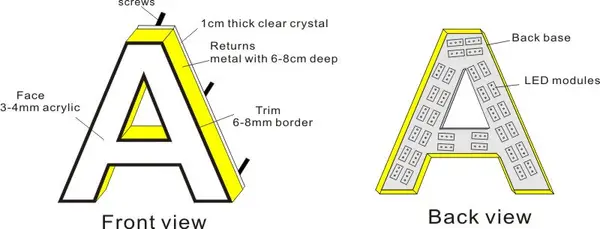
Twenty-seven years on a factory floor, and I still get the same question from sign shop owners and importers: which channel letter type actually works?
So here's the comparison I'd give you over a beer, not in a sales meeting. There are really only two illumination directions: light out the front, or light out the back. A third option combines both. Everything else is variations on acrylic, metal, and LED modules.
Look, I've watched manufacturers make this confusing on purpose. They invent terms like "halo-lit back-lit reverse channel" so you think you need three different products. You don't. A back-lit halo letter is a back-lit letter with a fancier name, usually because the halo effect is what you're selling to the client.
Let's cut through it.
Front-lit channel letters have an acrylic face, aluminum or stainless returns, and internal LED modules that shine through the face. That's the storefront standard you see on 90% of retail strips.
Back-lit or halo-lit letters have a metal face, a translucent or open back, and the LED modules fire toward the wall. You get a glow behind the letter, not through it. This is the premium architectural look. It costs more because the entire letter body is metal, not plastic.
Dual-lit is both: acrylic face and open back with LEDs firing both directions. We build those too, but I'll tell you upfront — dual-lit costs more and delivers less brightness per direction because you're splitting the light budget. For most jobs, pick one dominant direction and do it well.
Here's what nobody tells you: a true halo-lit letter needs a metal face thick enough to stay dead flat. Thin 1.0mm stainless will oil-can and warp around the mounting studs, and the halo looks wavy on the wall. Minimum 1.5mm for halo face. We use 2.0mm on anything over 600mm tall.
At our factory, a standard front-lit channel letter runs $20 to $80 for an 18-inch letter, depending on height, material, and LED quality. That's FOB Lu'an, Anhui. The same letter installed by a US sign company often retails for $200 to $700.
You save 50-65% buying factory-direct. But you also absorb the risk of rework if your local permit inspector doesn't like the electrical setup. I'm not going to pretend otherwise.
Use 3mm acrylic for anything under 2.5 meters. Over 2.5 meters, go 5mm or the face will bow in wind. UV-resistant acrylic from Mitsubishi or Degussa lasts 5-8 years before it starts to yellow. Domestic acrylic? One to two years. You won't see the yellowing until you stand next to a fresh sign, and then it's obvious.
The ugly truth is most cheap front-lit letters sold online use 2mm domestic acrylic and no-name LED modules. They look fine for the first six months. By month 18, you have dead spots and a yellow face. I've replaced enough of those for contractors who learned the hard way.
For a storefront standard, I'd still spec our front-lit channel letters with 3mm UV acrylic and Samsung or Osram LED modules. Not because I'm trying to upsell you. Because the callback costs more than the $12 per letter you'd save with cheap parts.
If a client asks for "back-lit" letters with a soft glow on the wall, they're asking for halo-lit. Same production line, same materials, same LED placement. Some shops call them reverse channel letters. I don't use that term because it makes importers think there's a reverse polarity electrical issue. There isn't.
A true halo letter has a metal face, metal returns, and an open back with clear acrylic or polycarbonate spacers to set the letter off the wall. The LED modules mount to the inside face and fire backward. The halo on the wall is the entire point.
Here's what nobody tells you: wall surface matters more than LED brightness for halo-lit signs. A dark brick wall eats light. A white stucco wall reflects it. I've had clients order the same exact halo letters for two locations and swear one is brighter. It's the wall, not the sign.
At our factory, a standard 18-inch halo-lit letter runs $35 to $120. The spread is wide because metal choice drives cost. Stainless steel 304 at 1.5mm is the baseline. Switch to 316 marine grade and you add 20-30%. Switch to painted aluminum and you drop weight and cost, but you lose that brushed steel look.
If you're ordering for a coastal property, pay for 316 stainless. The molybdenum in it buys you 15+ years of corrosion resistance. Miami Beach salt air will pit 304 in five years. Ohio strip mall? 304 is overkill, but it's still the right call if you want a 10-year outdoor life.
For the cleanest modern look, I've seen architects spec rimless channel letters with a halo back. No visible return edge. It's a pain to fabricate, but when it's right, it's right.
Dual-lit channel letters are a niche product. You use them when a building needs daytime brand visibility and nighttime halo glow. A bank headquarters, maybe. A luxury car dealership. Not a pizza shop.
We build dual-lit channel letters on request. The production cost is higher because you're installing two sets of LED modules — one firing forward, one firing backward. Or you use a single module strip with both sides. That second option is less bright, and I'll tell you that upfront.
Don't spec dual-lit unless the client understands they're paying for two lighting effects and neither will be as bright as a single-direction letter at the same wattage. I've had to talk importers out of this more times than I've sold it.
Acrylic faces matter only on front-lit and dual-lit. The number you need to know is 90-92% light transmittance for good UV-resistant acrylic. That's the ceiling. Cheap acrylic drops to 80% or lower, and it yellows faster.
Aluminum is one-third the weight of steel. For large letters over 1.5 meters, aluminum returns and faces cut labor and shipping cost. An aluminum letter runs $10 to $25 at factory pricing. It's naturally rust-proof. Anodized or powder coated finishes last 8-12 years outdoors.
Stainless steel is the premium outdoor material. Grade 304 gives you 10+ years. Grade 316 gives you 15+ years in marine environments. The density is 7.93g/cm³, so it's heavy. Shipping costs reflect that. For brushed or mirror finishes, stainless is the only choice.
Our stainless steel letters start at $15 per letter for non-lit. Add illumination and you're back to the channel letter pricing I listed above.
SMD 2835 modules at 100-150 lm/W are the industry standard. That's what you should spec for most channel letters. SMD 5730 chips give you 40-60 lm per chip for maximum brightness, but they draw more power and generate more heat. SMD 5050 is for RGB color-changing jobs.
Quality LED modules from Samsung, Osram, or Blue Jay (Blueview) will give you 5+ years of real lifespan. The L70 rating is 50,000 hours minimum. Cheap modules? 12 to 18 months before they start failing in clusters. I've seen entire signs go dark in two years because someone saved $3 per letter on LEDs.
Power supplies are the weak link. We warranty LEDs for 2 years and power supplies for 1 year. That's not because we don't trust our power supplies. It's because a power supply dies faster than LEDs, period. Water intrusion kills most of them. Seal the power supply enclosure with neutral silicone and use waterproof connectors.
IP65 is the minimum for outdoor signs. It means dust-tight and protected against water jets from any direction. It does not mean hurricane-proof. IP66 handles powerful jets — good for coastal installations. IP68 is submersible, which you don't need unless you're mounting signs in a fountain.
The ugly truth is most factories stamp IP65 on everything. Ask to see the test certificate with today's date. If they can't produce it in 24 hours, they don't have it.
Factory-direct savings run 50-65% on product cost. You still pay shipping and import duty. US Section 301 tariff is about 30% on channel letters from China. Don't forget that in your landed cost calculation.
Look, I've had importers tell me my factory price is too high because another factory quoted $12 for a front-lit letter. Then they send me photos of that factory's product after 14 months. Dead LEDs, yellow acrylic, rusted returns. That $8 savings per letter turned into a $15,000 replacement job.
Front-lit is for maximum readability. Use it for retail storefronts, gas stations, restaurants, any business where the sign needs to scream from the road. It's the cheapest option, and when built with quality materials, it lasts a decade.
Halo-lit is for brand prestige. Use it for law firms, medical buildings, luxury retail, corporate headquarters. The subtle glow reads "expensive" even if the letter itself costs less than a front-lit with a complex routed face.
Dual-lit is for clients who can't choose. Charge them for it. If they balk, sell them two separate signs — halo for night, front-lit for day. It'll cost less than one dual-lit monster and perform better.
Here's what nobody tells you: if your client's facade is glass or polished metal, halo-lit can look terrible because the wall behind the letter has no texture to catch the halo. The letter floats in a blur. Test the wall first. I've seen this go wrong: a $40,000 halo-lit sign on a glass curtain wall looked like a smudge after dark.
We're a factory in Lu'an, Anhui. We make the product, run aging tests, pack it in foam and plywood crates, and ship it to your door or your client's job site. We don't install signs in the US or Europe. We don't pull permits. We don't field-label for NEC Article 600 compliance.
We can provide CE, RoHS, and ISO 9001 documentation. We can produce UL 48 listing if the project requires it, but that's a $4,000 to $15,000 certification process that takes 4 to 9 months with quarterly audits. Most importers skip it and use a local electrician to handle installation compliance.
If you need a turnkey installed sign, buy the product from us and hire a local licensed sign contractor for install and electrical hookup. That's not an upsell. That's the law in most US municipalities.
One more thing we can't do: guarantee a sign will survive a direct hurricane hit. Any factory that promises that is lying. Wind load calculations depend on your local code, the mounting substrate, and the sign's aspect ratio. We build to standard structural specs, but we don't certify wind loads remotely.
Look, if you're comparison shopping and a factory promises 10-year warranty on cheap LED modules and free UL approval with a $12 letter, walk away. They're not selling signs. They're selling problems you'll inherit in 18 months.
Our standard lead time is 7-15 days from design confirmation to export packaging. That's not a marketing number. Our 10-step production process includes laser cutting with ±0.1mm tolerance, TIG welding, acrylic CNC routing, LED assembly, neutral silicone sealing, an 8-12 hour aging test, and 100% QC inspection.
Express shipping of a small sign runs 7-15 days and costs $30 to $100. Air freight for larger orders takes 10-20 days at $4-12 per kg. Sea freight is cheapest — 50 to 70 days at $80-200 per cubic meter for LCL, or $1,200 to $3,000 for a full container. Plan your client's timeline around that.
Section 301 tariffs add about 30% to your import cost. Some importers misclassify goods to avoid it. I don't recommend that. If US Customs audits you, the penalty is bigger than the duty.
Lie number one: "Our acrylic never yellows." No acrylic lasts forever. Even Mitsubishi UV-resistant acrylic starts yellowing after 5-8 years in direct sun. Anyone saying otherwise is selling you 2mm domestic sheet.
Lie number two: "LED modules last 100,000 hours." The L70 rating might be 50,000 hours for quality modules. L70 means the LED still produces 70% of initial brightness at that hour count, not that it's dead. Cheap modules don't come close. If a factory quotes 100,000 hours for a $2 module, they're quoting the chip manufacturer's theoretical lab test, not real outdoor performance.
Lie number three: "CE certification is included." CE marking costs 20,000 to 50,000 RMB and requires technical documentation and testing. Most factories say they have it. Ask to see the certificate with today's date and the product name on it. I've seen competitors download a blank CE template and fill in their company name.
I've burned my hands on hot acrylic and argued with LED suppliers about quality. This isn't a corporate pitch. It's what I'd tell you before you wire money to a factory.
Compare the numbers. Check material thickness. Ask about LED module brand. Ask to see the aging test video. Then make your decision.
If you want a straight answer about your project, send us the spec. We'll tell you what works, what doesn't, and what it costs. Or just read the product pages for front-lit channel letters and back-lit halo letters. The numbers are there.
Products mentioned or relevant to this topic — factory-direct, custom built.
Factory-direct since 2010. Free quote within 24 hours — no obligation.
Get a Free Quote →MOQ: 1 piece · 7-15 days · 2-year warranty · Worldwide shipping
See pricing, specs, and get a free quote for the sign type you need. Built in our factory, shipped worldwide.