I've seen this go wrong: a brand-new stainless steel and aluminum sign combo installed in a coastal town. Six months later, the aluminum's pitted like a golf ball. The installer blames the material. It's not the material. It's the connection.
Galvanic corrosion is the silent killer of mixed metal signs. Put two dissimilar metals touching each other, add moisture and salt, and you've built a battery. One metal gives up electrons and corrodes. Which one? The less noble one. Aluminum, zinc, and brass are sacrificial. Stainless steel and titanium eat them alive.
Here's what nobody tells you: your biggest risk isn't the big panels. It's the fasteners. Screws, rivets, brackets, clips. The little things. I've seen a $10,000 sign killed by a 50-cent aluminum screw corroding inside a stainless frame.
Anode. Cathode. The further apart they are on the galvanic series, the faster the corrosion. Surface area matters too. A small anode attached to a big cathode disappears fast. That's why a tiny aluminum rivet holding a large stainless steel sign is a death sentence.
The worst part? You won't see it coming. The corrosion happens behind the sign, under the mounting brackets, inside the holes. By the time you notice it, the structural integrity is gone.
And don't think "stainless" means "stop." 304 stainless has 18% chromium and 8% nickel. It's resistant, not immortal. Put it in salt spray and it freckles. 316 has 2-3% molybdenum and costs 20-30% more. That's the marine-grade insurance. For a strip mall in Ohio, 304 is fine. For Miami Beach, you pay for 316. That's just math.
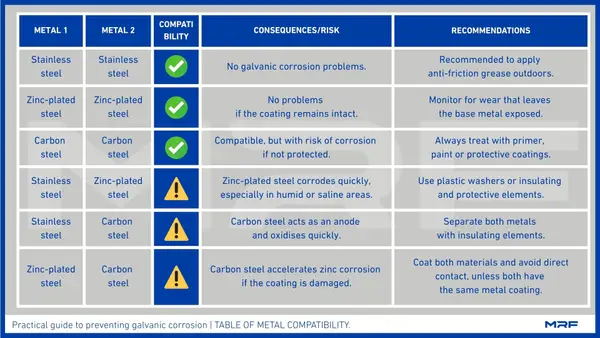
Some pairings are just begging for trouble. Here's what we've seen corrode on real job sites:
The one pair that's safe? 304 stainless and 316 stainless. They're close enough in the series. But "safe" doesn't mean "do anything." The fasteners still need to be right.
Isolation is the first commandment. Never let dissimilar metals touch. Use nylon, plastic, or rubber washers, gaskets, and bushings. We ship our stainless steel letters with isolation kits when they're going onto aluminum or galvanized raceways. It's not a luxury. It's a requirement.
Choose your fasteners like they're the whole sign. The rule is simple: match the fastener to the more noble metal. Stainless screws for stainless frames. Aluminum screws for aluminum frames. Or use coated fasteners with a corrosion-resistant plating. But never plain carbon steel screws. Ever.
Coatings are a backup, not a cure. Powder coating or anodizing does create a barrier. But one scratch, one chip at the edge, and you've got a bare-metal pinhole that starts the battery. So yes, coat. But coat in addition to isolation, not instead of it.
Drainage is the forgotten hero. Water pooling in crevices accelerates galvanic corrosion like a fire hose. We drill weep holes in our back-lit halo letters to let water escape. If your sign has flat ledges, channels, or raceways without drainage, you're building a swamp.
And don't use cheap silicone. Acidic cure silicone can corrode some metals on its own. We use neutral silicone for sealing. That's a small detail that makes a huge difference over five years.
Look, I'll be straight with you. Aochuang Sign has been in Lu'an, Anhui since 2010. We've got a 3,000m² factory, 50+ skilled workers, and we ship worldwide. We make front-lit channel letters, backlit halo letters, rimless channel letters, dual-lit letters, light boxes, and more. But that doesn't mean we magically control your job site.
We control our materials. We use Mitsubishi or Degussa acrylic with 90-92% light transmittance and UV resistance that lasts 5-8 years. The domestic stuff yellows in 1-2 years. We use 304 stainless for most outdoor work, 316 for coastal orders when you spec it. We test every sign for 8-12 hours before it goes in a crate. We do that because it has to survive the boat ride and your climate afterward.
Here's what nobody tells you: we can't control what you mount our signs on. We can't stop you from using a carbon steel frame with galvanized bolts. We can't stop you from putting our aluminum letters on a copper soffit without isolation. And we won't warranty against corrosion caused by poor installation. That's not a cop-out. That's physics.
Another hard truth: many factories claim CE and IP65 like they're accessories. CE certification costs 20,000-50,000 RMB and takes 2-8 weeks. Ask to see the certificate with today's date. IP65 means dust-tight and water jets from any direction — it does NOT mean your sign survives a Florida hurricane. We have CE, RoHS, ISO 9001. We'll send you copies. But we won't fake UL to win a bid. UL 48 costs $4,000-15,000 and takes 4-9 months with quarterly audits. Some factories lie about it. We'd rather lose the job than lose our reputation.
The ugliest failure I remember was a customer who ordered our aluminum letters and mounted them directly to a stainless steel frame using plain steel drywall screws. Within months, the letters bubbled and the screws rusted to dust. He blamed us. We sent him photos of the screw holes. He installed it wrong. The hardware store screws saved him $50 and cost him the whole sign.
Another one: a shop in Arizona asked us to quote brass letters for a restaurant in San Diego. We warned them — solid brass on a coastal facade with no coating is a recipe for swamp monster. They pushed back, said "premium look." We shipped. Six months later, the brass was green and pitted. We gave them the spec sheet before we made it. They ignored it. That's the cheapskate tax.
Look, the galvanic series isn't a suggestion. It's a law. You can't negotiate with electrochemistry. You can only plan around it.
When you order a mixed metal sign, ask your factory these questions: Which metals are touching? Where does water drain? What are the fasteners made of? What isolation material are they shipping? If the factory can't answer, you're talking to a parts dealer, not a manufacturer.
We can answer. For a standard channel letter setup, we use 304 stainless or aluminum returns, LED modules with SMD 2835 chips or better (Samsung, Osram, or Blueview — not the cheap no-name brands that die in 12-18 months). L70 rating is 50,000 hours minimum. We seal with neutral silicone and do a 100% QC inspection before packaging. Lead time is 7-15 days. MOQ is 1 piece. That's how we've exported signs for over a decade.
The price difference between premium materials and junk is small compared to the cost of a failed sign. Our factory-direct stainless letters run $15-40 for non-lit, $20-80 for front-lit, $35-120 for halo-lit. That's 50-65% less than US retail installed prices. You're not paying for cheap; you're paying for smart.
Galvanic corrosion is preventable. But it takes discipline. Separate the metals. Drain the water. Match the fasteners. Use the right grade of stainless. Don't listen to anyone who tells you "stainless never rusts" or "aluminum is rust-proof" without mentioning galvanic reactions. Those are half-truths that cost people real money.
We're not going to promise you zero corrosion. That's a lie. But we will give you the right materials, the right isolation parts, and the honest advice before you order. The rest is up to your installer. Do it right and your sign lives 10+ years — stainless 304 is 10+ years outdoors, 316 is 15+. Do it wrong and you'll be calling us for a re-order. We don't mind taking your order twice, but we'd rather you brag about us to your competitors.
The ugly truth is: most sign problems aren't factory problems. They're planning problems. So plan. Isolate. Drain. And call us when you're ready to build something that lasts.
Factory-direct since 2010. Free quote within 24 hours — no obligation.
Get a Free Quote →MOQ: 1 piece · 7-15 days · 2-year warranty · Worldwide shipping
See pricing, specs, and get a free quote for the sign type you need. Built in our factory, shipped worldwide.