Look, I've been doing this long enough to remember when grocery signs were just painted plywood and a neon tube. Now every supermarket chain wants "retail experience" and "wayfinding solutions." Fine. But here's what nobody tells you: most of those fancy signs fail before the produce aisle gets its first bruise. I've watched $50,000 exterior sign packages blister and peel in two summers because somebody spec'd the wrong stainless.
The ugly truth is that grocery signage is the hardest test of materials and installation. You've got freezing cold from the walk-in coolers, steam from the bakery, grease from the deli, and direct sunlight hitting the storefront. Your sign has to survive all that and still be readable at 50 feet. I'm going to walk you through what actually works, what doesn't, and where you're probably getting cheated.
Your main pylon sign or channel-letter storefront sign is the first thing customers see. But most grocers cheap out on the materials. I've seen this go wrong: a chain installed 1.5mm aluminum letters with cheap powder coating. Eighteen months later, the coating chipped off near the coastal store. That's a full replacement at $15,000 because they saved $600 up front.
For exterior grocery signs, stainless steel 304 is your baseline. 0.060-inch (1.5mm) minimum thickness. If you're within three miles of saltwater, spend the extra 20-30% for 316 marine grade. It contains 2-3% molybdenum. It'll last 15 years vs. 10. For the acrylic faces, use Mitsubishi or Degussa sheet. 3mm thickness gives 90-92% light transmittance. Domestic acrylic yellows in 1-2 years — that's a fact. I can spot a cheap face from across the parking lot: it's that sick yellow-brown tint that screams "budget remodel."
Here's a hard number: factory-direct 304 stainless front-lit letters run $20-80 per letter. Same letter from a US fabricator? $200-700. The savings are 50-65%. But you have to know what you're ordering. Don't assume "stainless" means 304. I've had Chinese factories try to pass 201 stainless. They don't have the 18% chromium. You need to spec the grade in writing.
The LED module choice is critical for exterior signs. SMD 2835 diodes at 100-150 lumens per watt are industry standard. If your supplier offers you SMD 5730, ask if they're genuine Samsung/Osram or cheap clones. The clones run at 40-60 lumens per chip but die in 18 months. Real L70 rating of 50,000 hours is the bare minimum for a grocery sign that's on 12 hours a day — that's about 11 years. But only if the modules have proper heat sinks and waterproofing.
And don't get me started on IP ratings. IP65 means dust-tight and protected against water jets. It does NOT mean your sign survives a Florida hurricane. For coastal or high-wind areas, you need IP66 or better. Even then, use neutral-cure silicone to seal every seam. If the factory uses acid-cure silicone, it'll corrode your aluminum framing in 3 years.
Inside the store, you've got department identifiers — Produce, Meat, Dairy, Bakery. These need to be legible from 30 feet, withstand steam and cleaning chemicals, and not look like they belong in a 1990s mall food court.
The quickest way to spot bad interior signage: look at the LED solder joints. Dull gray means cheap lead-free solder that'll crack in a year. Shiny silver is proper, high-temperature solder. I've walked into new grocery stores and seen signs flickering before opening day. That's the factory using $0.30 LED modules instead of $1.50 ones.
For suspended department signs, consider aluminum letters with 3mm acrylic faces. Aluminum is 1/3 the weight of steel, naturally rust-proof, and can be powder coated to match your brand. Expect 8-12 years outdoor life, but indoors it'll last indefinitely with proper care. Anodized aluminum is fine too, but powder coating gives better color retention for high-traffic areas.
The color temperature matters more than you think. Warm white at 3000-3500K works for the bakery and deli — it makes bread look golden, meats look appetizing. Cool white at 6000-6500K belongs in the loading dock or warehouse, not above the organic produce. Neutral 4000-5000K is your safe bet for most grocery applications. One chain I worked with had mismatched LED color temps across departments. Customers complained the meat looked "weird." That's not an opinion — it's a sales killer.
Here's what nobody tells you about acrylic thickness for interior signs: a 3mm face cuts 92% light output. A 2mm face cuts 90%. You won't notice the 2% difference, but you will notice the 40% cost bump. So use 2mm for interior unless you need the rigidity of 3mm for larger signs (over 2.5m face width). Don't let a fabricator upsell you on thickness you don't need.
Grocery stores are getting bigger. I've seen 80,000-square-foot supermarkets where customers need a map to find the canned beans. Directional signage — aisle markers, overhead directories, restroom signs — is an afterthought for most store designers. That's a mistake.
ADA compliance is not optional. For tactile signs: mount them 48-60 inches to the bottom of the sign. Use non-glare finish. Grade 2 Braille is required. The sign must be easily readable by touch. I've seen stores fined $10,000 for missing Braille dots on restroom signs. And no, you can't just add stick-on Braille labels — the entire sign must be manufactured to ADA spec with raised text and Braille on a clear background.
For overhead aisle markers, illuminated boxes work well. A 2m x 0.3m light box runs $80-250 per square meter from the factory. Use LED neon flex for a clean, even glow. That's $30-200 per sign depending on complexity. But avoid direct-view LED strips — they create hot spots and glare. You want diffused light.
The ugly truth about wayfinding: most grocery stores have too many signs. You don't need a sign for every 10-foot aisle. Group departments logically. One large "Produce" sign visible from the entrance is better than five small ones scattered around. I charge clients for removals more often than installations because they over-spec and then clutter the ceiling.
Acrylic sourcing is the biggest ripoff in this industry. Mitsubishi and Degussa sheet costs about 40% more than domestic acrylic. But the domestic stuff yellows in 1-2 years. I've had a client argue with me — "Our old signs lasted 5 years." I asked to see them. They were replaced twice in that time, they just didn't remember. Pay the premium for UV-resistant acrylic.
Stainless steel 304 has 18% chromium and 8% nickel. That chemistry is why it doesn't rust in normal conditions. 316 adds 2-3% molybdenum for salt resistance. If your sign is going on a building near a highway where de-icing salts spray in winter, go 316. The 20-30% premium is cheaper than replacing letters in 3 years.
Aluminum extrusions are great for light boxes, but not for letter returns. I see too many fabricators trying to weld aluminum letters. Aluminum welding is tricky — you need TIG with alternating current. Watch out for porosity in the weld seam. It'll leak water and cause LED failure. TIG-welded stainless steel letters are more reliable at a slight weight penalty.
I've said it before, I'll say it again: quality LED modules (Samsung, Osram, or well-known Chinese brands like Lan Jing) last 5+ years. Cheap modules last 12-18 months. How do you tell? Look at the packaging. If it's a plain white box with no certification marks, run. Ask for the LM-80 test report. If they can't produce it, they're hiding something.
Color temperature consistency is another issue. A $10 roll of SMD 2835 strips from Amazon will have 200-300K variation between rolls. That means one department sign might look 3500K and another 3800K. Side by side, it's obvious. You need strips binned for tight color tolerance — usually ±100K max. Good factories will provide that. Cheap ones won't.
And don't believe "L70 rating" unless you see the test data. L70 means 70% of original light output after 50,000 hours. But that's under lab conditions at 25°C. Your sign inside a hot supermarket ceiling can hit 60°C. That cuts lifespan in half. Good modules are rated at 85°C. Check the spec sheet.
Depends on store size. A typical 40,000-square-foot supermarket with 6 exterior letters, 25 interior department signs, 20 directional signs, and 2 pole signs: factory-direct materials $15,000-30,000. US retail install: $50,000-100,000. The savings come from buying direct — but you need someone who knows how to spec it right. Don't just send a drawing to the cheapest factory.
Technically, UL 48 is for electric signs. Many local AHJs (Authority Having Jurisdiction) require it. If they don't, ETL is a 10-30% cheaper alternative. But if you're importing, CE marking is fine for most states — just make sure the certificate is real. I can't tell you how many fake CE certificates I've seen. Ask to see the current one with today's date.
Sea freight from China: about 65 days, $80-200/m³ for LCL. But LCL means your crate gets handled 6-8 times. Every touch is a chance for damage. For fragile acrylic faces, use air freight (about 10 days, $4-12/kg) or sea freight with plywood crates and internal foam. I've had acrylic shatter from a single forklift hit. Spec double-layer packaging.
Assuming the sign will look as bright inside the store as it does in the shop. The ceiling height, ambient light, and viewer distance all affect perceived brightness. I always insist on a mock-up — one department sign installed before the whole order. Adjust the LED density. It's cheaper than remaking 20 signs.

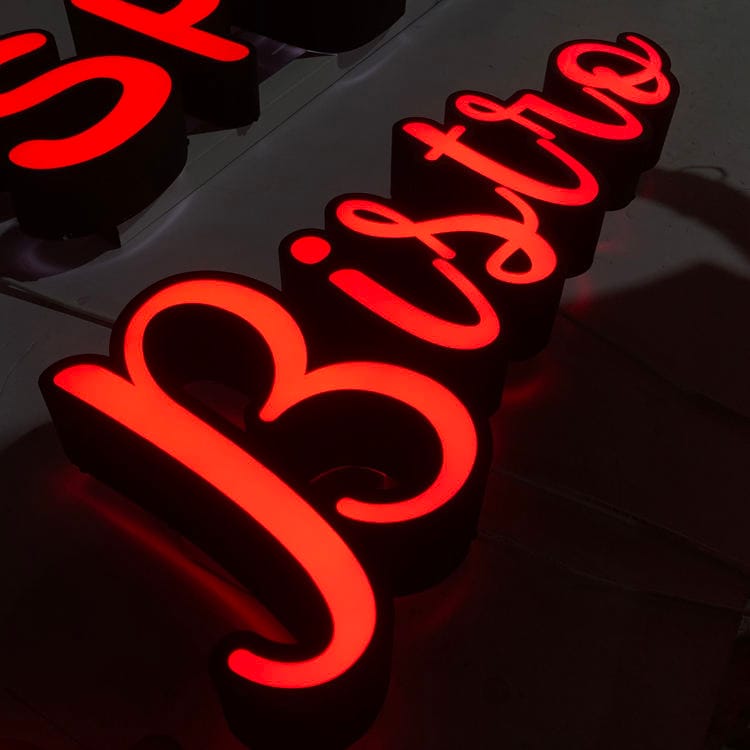
Real photo from our production floor — every sign we ship is made here.
Products mentioned or relevant to this topic — factory-direct, custom built.
From $24/letter · MOQ 1 piece · Flexible lead time · CE & UL certified · ships to 20+ countries
Custom sizes, colors, and finishes. Get a factory price in 24 hours.
Get a Free Quote Copy EmailWhatsApp +86 13865703472 · business@aochuangsign.cn
See pricing, specs, and get a free quote for the sign type you need. Built in our factory, shipped worldwide.