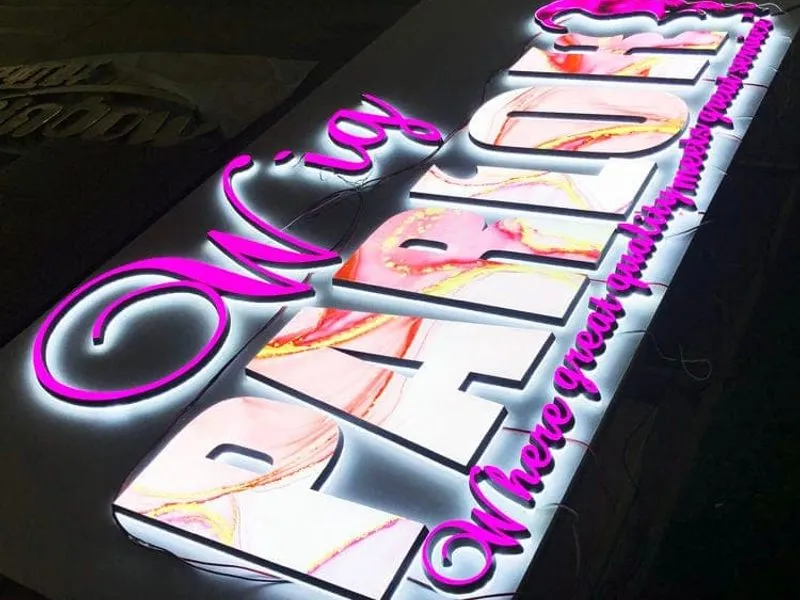
Last year, a mid-sized supermarket in Ohio swapped its old fluorescent box sign for a set of stainless steel halo-lit channel letters. Foot traffic jumped 12% in the first quarter. The only thing that changed was the sign. That’s not magic — it’s how a grocery store signals quality from 300 feet away. And it’s exactly the kind of project sign shops and business buyers miss if they don’t understand the real numbers behind materials, lighting, and sourcing.
Here’s the thing. Too many projects start with a pretty rendering and zero knowledge of what holds up after three summers of sun, salt, and shopping carts. I’m going to walk you through every category of supermarket signage — the exterior face, the interior departments, the directional signs — and I’ll give you the specs, the prices, and the production truths that keep your signs looking like they did on Day One.
The building’s front face is a grocery store’s handshake. You need a sign that’s visible at 65 mph on a highway and still elegant enough for a premium organic market. That means channel letters, light boxes, and pylon signs engineered for a 10-year outdoor life, not 18 months.
Channel letters dominate this space. Front-lit letters with a white acrylic face and aluminum returns give consistent bright glow. The acrylic needs 90–92% light transmittance and serious UV resistance. Use Mitsubishi or Degussa UV-resistant acrylic; it stays crystal clear for 5 to 8 years. Domestic acrylic starts yellowing in 1 to 2 years. That’s a warranty headache you don’t want. For faces larger than 2.5 meters, don’t even think about 2 mm acrylic — go 5 mm or thicker to prevent bowing.
For the back-lit halo effect, stainless steel 304 letters with clear acrylic backing create that crisp floating glow on brick or stucco. This isn’t the place to cheap out on LED modules. Spec SMD 2835 chips rated 100–150 lm/W. At 6000–6500K cool white, the halo reads clean and corporate, visible from the parking lot even with competing light pollution. If you’re near a coastline, push the client toward stainless 316. The 2–3% molybdenum content buys you 15+ years of marine-grade corrosion resistance instead of rust spots at year three. That’s a 20–30% cost premium on the metal but a decade of extra life.
Pylon signs — those tall freestanding structures — need 3.0 mm aluminum skins (1.0 mm is for small indoor signs, not 20-foot wind sails). Factory pricing on a 4 m² internally illuminated pylon with SMD 5730 LEDs (40–60 lumens per chip, the brightest in the class) comes in around $180–250/m². Here’s the hard-won wisdom: An aluminum cabinet that size without proper internal bracing will hum in a 30 mph wind and crack welds within two years. The corners must be TIG-welded and then ground smooth before powder coating. Skip the grinding, and the powder coat will flake at every seam — I’ve seen it peel like sunburned skin.
| Exterior Sign Type | Material/Finish | Factory Price (per unit) | US Retail Installed | Key Note |
|---|---|---|---|---|
| Front-lit channel letters | Aluminum returns, UV acrylic face, SMD 2835 LED | $20–80/letter | $200–700/letter | Use 3M VHB tape + mechanical fasteners on stone |
| Halo-lit channel letters | S/S 304 or 316, clear acrylic back, SMD 2835 LED | $35–120/letter | $400–1,000/letter | Keep letter depth ≥ 80 mm for even halo |
| Non-lit stainless steel letters | Brushed #4 or mirror #8 finish | $15–40/letter | $100–300/letter | Adhesive fails on textured stucco — use studs |
| Aluminum pylons (4 m²) | 3.0 mm aluminum, powder coated, internal LED | $180–250/sqm | $600–1,200/sqm | Must engineer for 90 mph wind load per local code |
Inside the store, the goal shifts. No one’s driving past at 45 mph; they’re pushing a cart and scanning a 12-foot aisle. Signage here needs to identify departments — Produce, Bakery, Meat & Seafood — and define category zones without shouting. Dimensional letters, backlit acrylic frames, and suspended blade signs are the workhorses.
Acrylic panels with push-through letter faces and colored returns deliver a clean, upscale look. The acrylic can be 2 mm or 3 mm because there’s no UV abuse. But that doesn’t mean you can ignore LED quality. A produce department sign that runs 16 hours a day needs modules rated L70 ≥ 50,000 hours. That’s the point where light output degrades to 70% of original — and it matters when the sign sits directly over the organic kale display. A cheap unbranded SMD 2835 strip will sag to a dull yellow-green tint in 12 to 18 months. A Samsung or Osram-based module will hold crisp 4000K neutral white for 5+ years. The maintenance crew is not going up on a ladder twice a year to swap strips — that cost eats the savings of a $3-per-meter discount ten times over.
Color temperature inside the store is not just a preference. 4000–5000K neutral white helps shoppers read fine print on packaging and labels, especially over the deli counter. Don’t use 3000K warm white there — it makes raw meat look brown. That’s a lesson I learned the hard way on a butcher shop project where the client called two days after install, furious.
One move that saves sign shops and grocery chain owners real money: modular interior light boxes. Rather than custom-build a 6-foot “BAKERY” sign, design a housing that accepts interchangeable insert panels. The client can update promotions seasonally. A 3' × 2' LED edge-lit acrylic box from a factory like Aochuang runs $80–150 — at that price, you can ship two panels and still beat the local fabricator by 45%.
Dimensional fabricated letters inside the store — say, 12-inch tall painted aluminum — land at $40–120 per letter from the factory. They’re naturally rust-proof, and the powder coat finish shrugs off humidity from the misting systems in the produce section. That same letter fabricated domestically often hits $180–280.
Nobody raves about a great wayfinding sign. But they curse the store when they can’t find the restroom. Directional signage in a grocery environment covers parking lot entry arrows, aisle markers, restroom signs, and overhead hanging blades that point to checkout, pharmacy, or customer service. The functional side is only half the picture — ADA compliance is the other half, and it’s non-negotiable in the US.
Restroom signs must be tactile with Grade 2 Braille, non-glare finish, and mounted so the centerline sits between 48 and 60 inches from the floor. At the factory level, we produce these from acrylic with raster-bead Braille or from 1.0 mm stainless steel with etched copy and black oxide filling. The steel version hits a 10-year indoor life even in high-traffic corridors. Cost: $15–25 per 6"×9" sign, with MOQ of 1 piece. The US retail markup for a single ADA-compliant restroom sign commonly reaches $60–90. That’s a margin any contractor or sign shop can capture.
For parking lot directionals, aluminum is the default. A 24"×18" non-illuminated arrow with 0.063" (1.6 mm) aluminum and 3M engineer-grade reflective vinyl holds up 8–12 years outdoors without rusting. If you need illumination, edge-lit acrylic panels with IP66-rated LED modules survive pressure washers and Florida-level thunderstorms. Going to IP65 is the minimum for outdoor — anything less, and condensation will fog the face within the first winter.
Hanging aisle markers — those double-sided blades overhead — are often done with aluminum frames and 3 mm acrylic faces. Keep the total weight under 15 pounds per unit; chain drops and ceiling attachments in grocery stores are notoriously flimsy. I’ve seen an entire 10-foot blade come down because a contractor used drywall anchors in ceiling tile grid instead of tying into the deck above. The $800 sign destroyed a $12,000 refrigerated end cap. Mounting hardware is not where you save $4.
Not all metals and plastics age the same way in a grocery environment. Give your client a clear choice, anchored in real lifespan data, not marketing fluff.
| Material | Outdoor Life | Typical Cost per Letter/Unit (Factory) | Key Characteristic | Best Use |
|---|---|---|---|---|
| Aluminum (1.0–1.6 mm) | 8–12 years | $10–25/letter | Weight 1/3 of steel, naturally rust-proof | Pylon cabinets, non-lit letters, directional signs |
| Stainless 304 | 10+ years inland | $15–40/letter | 18% Cr, 8% Ni; good for rain, not salt | Halo-lit front letters away from coast |
| Stainless 316 | 15+ years marine | 20–30% premium over 304 | Contains 2–3% Mo; resists chloride pitting | Coastal grocery fronts, industrial zones |
| UV Mitsubishi Acrylic |
