Types of Hanging Sign Brackets: Blade, Suspended, and Projecting
Look, a bracket isn't a bracket.
Most sign shops use "hanging bracket" as a catch-all for anything that holds a sign off the wall, but there are three actual types and they don't swap out. A blade bracket mounts perpendicular to the wall, the sign face runs parallel to foot traffic, and pedestrians read it as they walk toward it. A suspended bracket hangs from a ceiling or soffit, usually with aircraft cable or threaded rod, and it's a whole different animal because now you've got sway and rotation to deal with. A projecting bracket is the beefy one—it kicks the sign out from the storefront so it's visible from down the block, and it has to fight gravity and wind every second it's up.
I've watched sign shops order a "projecting bracket" off a website, get a thin steel arm with two little wall screws, and then call me when the sign is on the sidewalk. Here's what nobody tells you: if the bracket isn't engineered for the sign's weight and projection distance, you're not installing a sign. You're installing a liability.
A front-lit
channel letter from the factory runs $20-80, but the installed version in the US is $200-700. The bracket is maybe 10% of that job, and it's the part that fails first. If you're doing
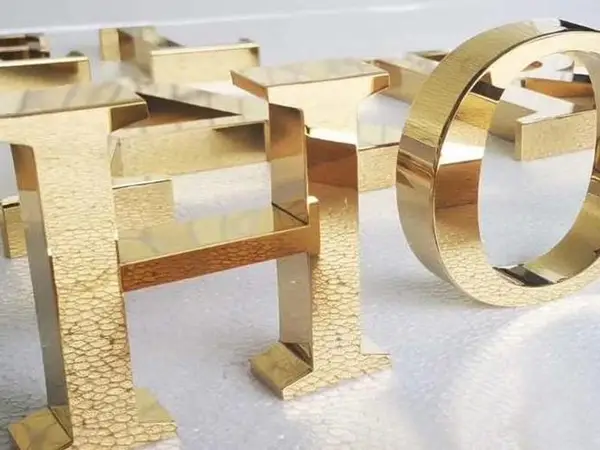
front-lit channel letters for a storefront, spec the bracket before you even think about the face.
For a suspended sign in a high-ceiling lobby, anti-sway bracing isn't optional. I don't care how "rigid" the threaded rod looks. A 30-pound sign on a 10-foot rod will swing like a pendulum when the HVAC kicks on. You need a cross-brace or a dampening cable, or you'll be back in six months to re-level.
Material Selection: Aluminum vs. Steel vs. Stainless
Here's what nobody tells you: material choice isn't about strength, it's about rust.
Aluminum weighs one-third of steel, and that matters when you're bolting a 20-pound sign to a wall that might be drywall over steel studs. But aluminum's outdoor life is 8-12 years, and in a marine environment it'll pit unless you anodize or powder coat it. 304 stainless is the workhorse—18% chromium, 8% nickel, 10+ years outdoors, density 7.93 g/cm³. If you're doing a hanging sign for a strip mall in Ohio, 304 at 3mm is plenty.
316 stainless contains 2-3% molybdenum and buys you 15+ years in coastal or industrial air. It costs 20-30% more than 304, which some clients call "over-engineering" until they see the rust stains on the 304 sign they installed in Miami Beach three years ago. I've seen this go wrong: a fabricator quoted 304 for a beachfront
restaurant sign to save $40 on the bracket, and the customer called back after two winters demanding a replacement. The rust started at the weld seams because the filler wasn't 316L.
Powder-coated steel is fine indoors. Outdoors, it's a countdown to rust. A scratch through the powder coat on a mild steel bracket turns into a rust blister in one season. If you're using steel, spec at least a zinc-rich primer under the powder. But honestly, for anything exterior, just use aluminum or stainless. If you're ordering
stainless steel letters with a matching bracket, make sure the bracket is the same grade—don't put a 304 bracket on a 316 sign.
Load Ratings and Wind Load Basics
The ugly truth is most bracket failures are fastener failures, not bracket failures.
A bracket can be rated for 200 pounds, and the 3/8-inch lag bolts into a hollow CMU block are rated for maybe 80 pounds in shear—if they're installed perfectly. Now add a 40 mph gust catching a 3-foot by 4-foot sign face. The overturning moment is sign weight times projection distance, and that math doesn't care about your bracket's polished stainless finish. I've seen this go wrong: a sign shop used 1/4-inch toggle bolts through drywall for a 25-pound blade sign because the customer didn't want to pay for a backer plate. The sign fell two weeks after install, and the shop's insurance paid for it.
For outdoor projecting signs, calculate the worst-case wind load for your zone. Don't guess. A sign that's 18 inches off the wall acts like a lever, and every inch of projection multiplies the pull-out force on the top anchors. Use through-bolts with square washers or a continuous steel backer on the interior when you can. For steel studs, don't tap threads into the stud—use a bolted connection through both flanges or anchor to structural steel behind.
If you're importing a preassemb
led sign and bracket from a factory, ask for the bracket's load rating and the anchor schedule. A factory that says "we test our brackets" but won't give you a number is lying. And remember, the US Section 301 tariff on imported signage hardware is about 30%. That's on top of the product cost and freight, so factor it in before you promise your client a delivered price.
Mounting Configuration and Wall Support
Look, the wall is the weak link. Never forget that.
A 304 stainless bracket with a 3mm plate will outlive the building, but if it's screwed into brick veneer without an expansion anchor set into the structural wall behind it, the brick face itself can pop off. Brick veneer is not structural. CMU needs epoxy-set anchors or through-bolts with a steel channel. Wood studs can take lag bolts, but you need a minimum of two bolts into solid lumber—not the top plate, not a double top plate with gaps.
Aluminum's weight advantage—one-third of steel—helps when you're mounting a sign on an exterior wall with questionable substrate, but don't use that as an excuse to undersize the bracket. A 1.6mm aluminum bracket might hold a 5-pound interior sign, but for a 30-pound exterior blade sign, you need 3mm aluminum or 2mm stainless at absolute minimum. I've seen this go wrong: someone used drywall anchors for a hanging ceiling sign in a retail space, and the whole thing dropped onto a display table. The bracket was rated for the weight, but the anchors weren't.
For suspended signs, the mounting configuration changes. You need adjustable cable clamps so you can level the sign after the building settles. You need a safety cable or secondary support so a failed cable doesn't become a falling object. And if you're in a seismic zone, you need lateral bracing. That's non-negotiable.
Code, Accessibility, and Safety Compliance
Here's the part nobody wants to hear: code compliance will cost you money, and trying to skip it will cost you more.
For lit signs, NEC Article 600 covers the electrical installation, and your LED power supply needs to be accessible for service. UL 48 certification runs $4,000-$15,000 and takes 4-9 months with quarterly audits. Most factories in China will claim CE marking—which costs 20,000-50,000 RMB and takes 2-8 weeks—but ask to see the actual certificate with today's date and watch them sweat. I've seen this go wrong: a factory showed me a CE certificate that expired three years earlier. They didn't think anyone would check.
For ADA compliance, hanging signs that project more than 4 inches from the wall have bottom-edge height restrictions—the bottom of the sign must be at least 80 inches above finished floor if it protrudes into the path of travel, or cane-detectable if it's below 27 inches. I'm not a lawyer and this isn't legal advice, but if your bracket puts a sign at face-slashing height, you're going to get sued. Touch and feel signs need 48-60" mounting height, non-glare finish, and Grade 2 Braille. That's a separate deal from the bracket.