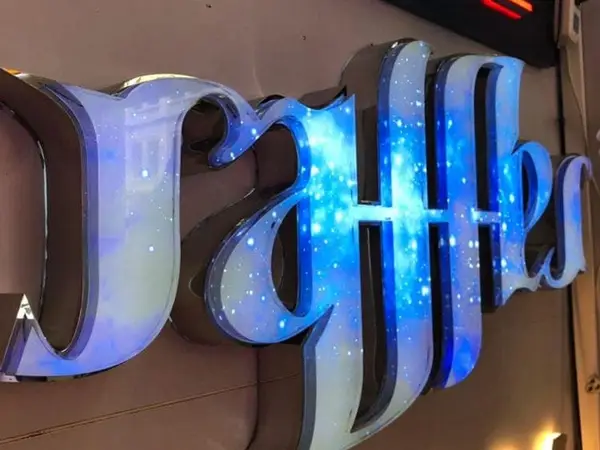
Mounting a sign on brick? It's 80% layout, 20% hardware. A single 600mm-tall, 3mm-thick 304 stainless letter weighs about 8.5 kg, but wind load is what pulls it off.
Most failures on brick are layout failures, not anchor failures. The anchor isn't the weak link. Your layout is.
Solid brick, hollow brick, and face brick all behave different under a hammer drill. Solid structural brick will eat a 1/4" anchor if you embed it deep. Hollow brick has webs—hit a core and the anchor is only holding in 20mm of clay.
Look, I've drilled test holes in three spots before I'd commit to a layout. If the bit blows out the back of a hollow brick, you're done. That anchor isn't grabbing anything.
Mortar joints are the weak point. Old lime mortar crumbles; Type S mortar might hold, but it's still softer than the brick. Drill brick. I've seen this go wrong: a contractor put six 1/4" anchors into 100-year-old mortar. Sign was on the sidewalk by Tuesday.
The ugly truth? Most anchor pull-out ratings are for new solid brick, not the 70-year-old stuff you're standing in front of. Test it on site. No torque chart in a brochure will save a bad substrate.
Concrete is homogeneous. Brick is not. That means wedge anchors and drop-ins that work in concrete can split brick because the expansion point sits too close to the surface.
Sleeve anchors engage deeper and spread load over more of the brick. Tapcons work for light signs under maybe 30 pounds. Through-bolts with a plate on the back side beat everything, but good luck finding the back side of a 12" masonry wall.
For outdoor brick, use 316 stainless anchors if you're within three miles of salt water. 316 contains 2–3% molybdenum and survives 15+ years in marine air. 304 has 18% chromium and 8% nickel, but it'll pit near the coast. 316 runs 20–30% more. Pay it in Miami Beach.
Here's the thing: epoxy anchors can outperform mechanical anchors in soft or deteriorated brick, but only if you clean the hole. A hole full of red brick dust is a lubricant, not a bonding surface.
First, mark your template. Level it. Check it twice. I don't care if you've been doing this 20 years—layout is where the mistakes happen.
Use a hammer drill, not a standard rotary drill. Drill 1/8" smaller than your anchor if the manufacturer doesn't specify. Keep the bit straight. If you angle down 5 degrees, water pools in the hole and freeze-thaw cracks the brick.
Clean the hole. Compressed air, then a nylon brush, then air again. A hole with brick dust loses 30–50% of its pull-out strength. That's not published in most manuals; it's what the old-timers know.
Set the anchor to the manufacturer's torque. Over-torquing a sleeve anchor in brick is a rookie move. It spalls the face and you'll see a half-moon crack before lunch.
I've seen this go wrong: a guy used an impact driver to set a 1/2" anchor. He ended up with a 4" crater he had to patch. The sign hung crooked.
A front-lit channel letter isn't that heavy—maybe 5 to 15 pounds depending on size and acrylic thickness. But if it's on a raceway, the wind load multiplies. Raceway mounts need anchors that handle shear, not just tension.
If you're ordering front-lit channel letters for a storefront, ask the factory for mounting holes pre-punched to your template. Then your anchors line up without drilling through the letter back and hitting an LED module.
Back-lit halo letters stand off the wall on studs. That standoff creates a lever arm. Every gust of wind becomes a pull-out force on the top anchor. Use a stronger anchor than the letter weight suggests.
Stainless steel letters are heavier. A 900mm-tall 3mm 304 stainless letter weighs around 12 kg. For 304/316 stainless steel letters on brick, I won't use anything less than 3/8" sleeve anchors or through-bolts, even if the dead weight says a 1/4" Tapcon would hold.
Acrylic LED letters are light enough to mount with adhesive on smooth surfaces, but brick is not smooth. On brick, use mechanical fasteners. Silicone alone won't hold 8.5 kg when the wall sheds moisture.
Wind load isn't linear. A 4'x8' sign at 90 mph can see over 700 pounds of total force. If you only put four anchors in the corners, each one is holding 175 pounds. On aged brick, that's a coin flip.
Every hole in brick is a water pathway. Seal around the anchor with neutral-cure silicone after setting. Don't use acid-cure silicone on metal—it'll corrode the anchor and stain the brick.
IP65 means the sign enclosure can take water jets from any direction. It does not mean your sign survives a Florida hurricane. It also doesn't mean your anchor points are waterproof.
If you're in the US, NEC Article 600 says electric signs need listed components and disconnects. UL 48 certification runs $4,000 to $15,000 and takes 4 to 9 months. If a fabricator says "UL listed" but can't show you today's certificate, walk. That's not a joke.
Lease compliance gets ugly. Some landlords won't let you drill into the brick at all. Others require you to repoint every hole on move-out. Get it in writing before you drill, and photograph the wall condition first.
Drilling into mortar joints. It's the number one mistake I see. Mortar is not brick. An anchor in mortar holds 40% less than the same anchor in solid brick.
Drilling within 2 inches of a brick edge. Brick is brittle. Edge distance matters more than embedment depth. A hole too close to the edge will spall the corner off.
Using the wrong anchor metal. Galvanized anchors in brick near a coast will rust inside the hole, expand, and split the brick from the inside. Use stainless steel.
Not installing weep holes or sealing penetrations. Water gets in, freezes, and the brick face pops off. I've seen an entire header joint open up after one winter because someone didn't caulk the top anchor hole.
The ugly truth? Most sign mounting failures aren't about weight. They happen because someone didn't clean the hole, didn't seal it, or didn't check the brick before drilling.
Our factory in Lu'an, Anhui, laser-cuts sign faces to ±0.1mm. We can pre-drill mounting holes into the back plates and send you a paper template that matches. You don't have to field-measure letters on a ladder.
Here's the kicker: ordering factory-direct signs without pre-engineered mounting holes means you're drilling through stainless on site. That takes time, it's loud, and you'll chew through cobalt bits. Let the factory do it.
We make front-lit channel letters, back-lit halo letters, stainless steel letters, and acrylic LED letters. MOQ is 1 piece. Lead time runs 7–15 days after design confirmation. Signs ship with foam, carton, and plywood crate packaging. Pre-drilled holes match your anchor layout if you give us accurate CAD.
But I'll be blunt: no factory pre-engineering saves you if the brick is garbage. The hole pattern is nice. The wall condition is everything.
Can I drill into mortar instead of brick? No. Mortar holds 40% less and crumbles. Drill into the brick face.
What size anchor for a small channel letter? 1/4" sleeve or Tapcon if under 30 pounds and solid brick. Use stainless outdoors.
Do I need a permit for a sign on brick? Probably. NEC Article 600 and local building codes. Check before you drill.
Can I mount a sign with silicone on brick? Not outside and not on brick. Mechanical fasteners only.
Products mentioned or relevant to this topic — factory-direct, custom built.
From $16/letter · MOQ 1 piece · 7–15 day production · CE & UL certified · ships to 20+ countries
Custom sizes, colors, and finishes. Get a factory price in 24 hours.
Get a Free QuoteWhatsApp +86 13865703472 · cairuisheng@aochuangsign.cn