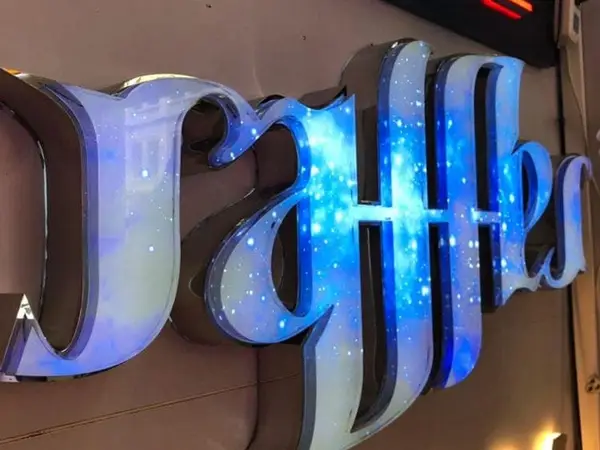
Factory-direct stainless steel channel letters from our shop run $0.60 to $1.50 per centimeter of letter height, depending on finish and whether they're lit. A 40cm (16-inch) letter lands between $24 and $60 before freight, power supplies, and installation. That's our floor price—not what a sign shop charges at retail.
If someone quotes you $2,000 for one 16-inch letter and doesn't explain installation, permits, and local markup, they're either doing a boutique install or robbing you. No third option.
You want a factory price sheet? Here it is. No "request a quote" runaround. Baked paint, electroplated gold—it's all priced per centimeter of letter height.
A 50cm (20-inch) baked-paint letter runs $30–$35. Go electroplated backlit halo on that same size and you're at $50–$60. See the gap? Small letters cost more per cm because cutting, welding, and polishing a 10cm letter eats nearly the same labor as a 30cm one. The price doesn't scale straight up. It just looks that way on a price sheet.
Size scales per centimeter. Finish is where people get lied to.
The ugly truth: "stainless steel" on a quote usually means 201-grade, not 304 or 316. 201 runs about 16% chromium and barely any nickel. It's cheap, it's hard, and it starts rusting in coastal air within two years. If the quote doesn't specify 304 or 316, assume 201. That's not me being cynical—that's fifteen years of redoing somebody else's rusted job. Our 304/316 stainless letters use 18% Cr and 8% Ni for 304. 316 adds 2–3% Mo, which buys a marine-grade 15+ year outdoor life. The 316 premium runs 20–30% over 304. Strip mall in Ohio? 304 is plenty. Miami Beach? Pay for 316 or plan on replacing those letters in three years.
I've watched this go wrong. A hotel in Fort Lauderdale ordered 304 stainless letters to save $600. Three years later, the faces pitted and the LEDs flickered from salt corrosion. They paid us to remake the set in 316. Total cost of that $600 savings? About $2,400.
Lighting adds $0.20 to $0.60 per cm over non-lit stainless, depending on whether you want a simple front-lit acrylic face or a backlit halo effect. The real cost hides in LED module quality. Cheap modules have dull gray solder joints. They die. 12–18 months. Good ones—Bluesky or Rishang—use shiny lead-free solder, push 100–150 lumens per watt from SMD 2835 chips, and hold L70 for 50,000 hours. That's five-plus years of actual nighttime brightness. Not a lab number.
Watch the returns. Returns are the metal sides that give a letter depth. Our standard is 1.2mm stainless. A 1.5mm return adds stiffness and cost. The depth changes how much shadow and light wash you get. Shallow returns look cheap. Deep returns eat more material and welding time. Specify 2.5–3 inches if you want real architectural presence.
Acrylic face thickness matters too. We default to 5mm. A 3mm face transmits 92% of light. A 2mm face transmits 90%. Your customer won't notice that 2% difference, but they'll notice the 40% cost bump if someone upcharges you for "premium optical acrylic." Mitsubishi or Degussa UV-resistant acrylic lasts 5–8 years before yellowing. Domestic acrylic starts yellowing in a year or two. That's why our standard face is UV-resistant.
Laser cutting holds ±0.1mm. TIG welding is where labor costs pile up.
Here's what nobody tells you: a $0.65/cm letter and a $0.90/cm letter aren't always different steel. Often, the shop either grinds every weld flat or just hits it with a flap disc and paints over the seam. We run a 10-step process: design confirmation, laser cutting, bending/TIG welding, grinding/polishing, acrylic face CNC, LED assembly, neutral silicone sealing, an 8–12 hour aging test, full QC inspection, then foam, carton, and plywood crate. Skipping the aging test saves a day. It also means a dead LED module or bad solder joint heads out your door.
Quickest way to spot bad LED modules? Look at the solder joints. Dull gray means they won't last 18 months. Shiny silver means proper lead-free solder. I've torn apart competitor letters where the "waterproofing" was hot glue and prayer. If the factory can't show you an aging test video with your actual sign running for 8 hours, walk.
Hand polishing a mirror #8 finish on stainless takes real labor. That's why mirror costs more than brushed #4 or powder coat. Electroplating gold or chrome adds another $0.10–$0.20 per cm—plating baths and prep work aren't free. If you want a gold/chrome electroplated finish, don't expect it to hide flaws like baked paint does. Plating shows every scratch underneath.
I can quote you an exact factory price. I can't quote installed price because your local electrician charges what he charges.
Shipping is real. Express takes 7–10 days. Air freight runs about 10 days. Fast sea takes 40–50 days. Standard sea is about 65 days. Freight cost depends on destination, volume, and whether you're shipping one crate or a full 20-foot container. LCL sea freight means your crate gets handled 6–8 times between our dock and yours. Every touch is a chance for damage. Brochures don't mention that.
Here's another thing nobody volunteers: a $35 letter can turn into a $500 install if the wall is stucco, the sign sits 20 feet up, or the city demands a UL 48 label and an electrical permit. UL 48 certification costs $4,000–$15,000 and takes 4–9 months with quarterly audits. CE runs 20,000–50,000 RMB and 2–8 weeks. Most factories will claim they have both. Ask to see the certificate with today's date. Watch them sweat.
IP65 sounds impressive. It means water jets from any direction. It doesn't mean your sign survives a Florida hurricane. For coastal salt spray, you want IP66 at minimum. IP65 handles rain. IP68 is submersible—you don't need that on a storefront unless you're building a sign for a boat dock.
So the hidden line items: freight, crating, insurance, electrical permit, lift rental, installation labor, and certified electrical inspection. Installation labor often matches or beats the factory letter cost, but that's your local market, not Lu'an. I won't pretend to know your exact labor rate, but I've watched $40 letters become $400 installs because the wall was stone and the city inspector wanted a disconnect switch within sight.
I've watched sign shops pay $800 for a front-lit letter from a domestic fabricator. Same 304 stainless. Same Samsung LEDs. We ship that letter for $120.
Look, I'll be straight with you. That's factory-direct versus the three-layer food chain. A broker grabs a 30% cut. A sign shop carries rent, payroll, and sales commissions. A domestic fabricator has higher labor and material costs. By the time a $40 letter from our floor reaches a storefront in Chicago, it's $400. That's not greed—it's logistics and markup. But order five or ten letters, and the math gets stupid.
Our MOQ is 1 piece. Sample lead time runs about 5 days. Mass production takes around 15 days, flexible by quantity and size. We export worldwide. CE and UL paperwork is in place. If a factory can't produce one letter as a sample, they're not a factory. They're a trading company with a laptop.
Ugly truth: some "factories" online are just resellers buying from the same Lu'an workshops and adding 50%. Ask for a live video walkthrough of the production floor. Ask to see the laser cutter, the TIG welder, the aging test bench. If they hesitate, you're paying for a middleman's plane tickets.
Don't email me "How much for a sign?" I'll reply with this checklist. Send it to every factory you're considering.
A 40cm baked-paint front-lit 304 letter with a 3-inch return, brushed finish, 4000K LEDs, flush mount, for a Chicago storefront—that's a quote I can turn around in a day. A "sign quote" without those specs isn't a quote. It's a guess with your money attached. Warranty is 2 years on LEDs and 1 year on the power supply. Cheap modules die in 12–18 months. Our warranty exists because the actual lifespan runs 5+ years.
Q: Can I get stainless channel letters for under $50?
A: If you want 10cm letters, sure. If you want a 60cm building sign, no. Do the math: $0.70 per cm times 60cm is $42. That's one letter. No freight. No power supply. No install. Stop asking for a complete storefront sign for $50.
Q: How much is shipping to the US?
A: Depends on weight, volume, and whether you want it in 7 days or 65 days. I won't give you a fake freight number because I haven't weighed your crate. Send me the specs and I'll get a forwarder quote the same day.
Q: What's the difference between front-lit and backlit stainless letters?
A: Front-lit shines through an acrylic face. Backlit (halo) bounces light off the wall behind the letter. Backlit costs 30–40% more because of the open-face fabrication and LED mounting. A classy hotel look? Pay for backlit halo letters. Strip mall pylon? Front-lit is fine.
Q: Can you match my Pantone color?
A: Baked paint, yes. Electroplated gold or chrome, no—it's a metal finish, not paint. Don't ask for Pantone chrome. I can't help you.
Products mentioned or relevant to this topic — factory-direct, custom built.
From $16/letter · MOQ 1 piece · 7–15 day production · CE & UL certified · ships to 20+ countries
Custom sizes, colors, and finishes. Get a factory price in 24 hours.
Get a Free QuoteWhatsApp +86 13865703472 · cairuisheng@aochuangsign.cn