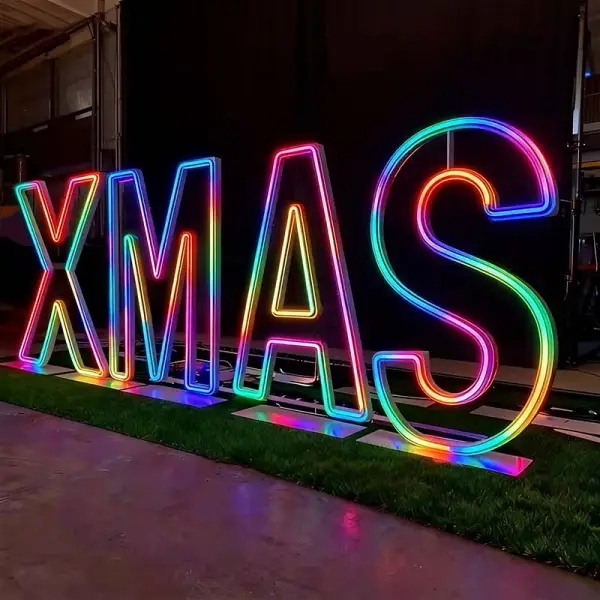
Look, I've watched sign shops pay $800 for a front-lit letter from a domestic fabricator. Same 304 stainless, same Samsung LEDs. We ship that letter for $120. That's not a sales pitch—that's why you're reading this.
Here's what nobody tells you: the online quote you get is not the price you pay. Not even close. Freight, crating, liftgate, inside delivery, and a 30% Section 301 tariff on Chinese-made signs stack up faster than bad LED solder joints. I've seen a $3,000 order turn into $6,200 by the time it hit the dock in Ohio. The factory quote was honest. The logistics buried it.
The ugly truth is that most online sign vendors quote you on materials that they don't actually intend to use. Domestic acrylic in the build? Sure, if you don't ask. That stuff yellows in 1-2 years. UV-resistant Mitsubishi or Degussa acrylic lasts 5-8 years before it fades. Cost difference is maybe 15-20%, but the lifespan difference is 4x.
Let's start with the first thing that separates pros from suckers.
I've seen this go wrong: a casino in Vegas ordered 304 stainless steel letters for an outdoor marquee. They got 304, but the vendor welded them with cheap filler rod and skipped passivation. Six months later, rust streaks down the face. The spec said "stainless steel." The reality was garbage.
Stainless 304 has 18% chromium and 8% nickel. It's good for 10+ years outdoors in most places. But if you're within a mile of salt water, you need 316 stainless. That adds 2-3% molybdenum and costs 20-30% more. For a strip mall in Ohio, 304 is fine. For Miami Beach, pay for 316 or you're replacing letters in 3 years.
Here's what nobody tells you: acrylic thickness matters more than you think. A 2mm face blocks 90% of LED light output. A 3mm face blocks 92%. That 2% difference is invisible to your customer, but the 40% cost bump from 3mm to 5mm is not. Unless the letter is over 2.5 meters, 5mm is overkill. Most sign shops don't know that. They just upsell you.
LEDs are where the real scam lives. Quality modules from Samsung, Osram, or Blueview run 100-150 lumens per watt and last 5+ years real-world. Cheap no-name LEDs? 12-18 months and they start flickering like a dying fluorescent. Quickest way to spot bad LED modules: look at the solder joints. Dull gray solder means it won't last 18 months. Shiny silver is proper lead-free solder. I've taken a macro photo of a joint and sent it to a vendor. The silence was loud.
If you're ordering front-lit channel letters for a storefront, specify the LED brand in writing. Don't accept "high-quality LED." That phrase means nothing. Ask for the exact chip model. SMD 2835 is industry standard at 100-150 lm/W. SMD 5050 is for RGB. SMD 5730 is highest brightness at 40-60 lm per chip. If they can't tell you the chip number, walk.
The single biggest hidden cost is sea freight LCL. Your crate gets handled 6-8 times between our dock and yours. Every touch is a chance for damage. That's not in the brochure. A $80-200 per cubic meter quote sounds cheap until you add the $150 crating fee, the $85 liftgate, the $120 inside delivery, and the 30% tariff on the declared value. I've had customers rage about this. The quote wasn't fake. It was incomplete.
Air freight is faster but brutal on price: $4-12 per kilogram. Express small packages run $30-100 for about 5-15 days. Sea freight takes about 65 days and costs $1,200-3,000 for a full container. If you need two letters for a grand opening next month, sea freight is not your friend.
Look, if a vendor quotes you "free shipping" on a custom sign order over $500, they've already buried the freight cost in the unit price. You're paying it either way. The only question is whether you see the line item.
CE marking costs 20,000-50,000 RMB in China. Most factories will say they have it. Ask to see the certificate with today's date. Watch them sweat. The same goes for RoHS and ISO 9001. ISO 9001 is a factory process cert, not a product cert. It doesn't mean your sign won't fail.
For the US market, UL 48 is the gold standard for electric signs. It costs $4,000-15,000 and takes 4-9 months with quarterly audits. Most Chinese factories don't have it because it's expensive and they don't sell enough into the US to justify it. ETL is a cheaper alternative, 10-30% less. CE is not a substitute for UL in the US. If a vendor says "CE certified, so it's fine for US electrical code," they're either lying or clueless. NEC Article 600 governs sign electrical in the US. ADA compliance for tactile signs means mounting at 48-60 inches, non-glare finish, and Grade 2 Braille. None of that is negotiable.
IP ratings are another joke. IP65 means dust-tight and protected against water jets. It does NOT mean your sign survives a Florida hurricane. That's IP66 or IP68 territory. If you're in a coastal area, ask for IP66 minimum. Otherwise you'll be rewiring after the first tropical storm.
Our warranty is 2 years on LEDs and 1 year on the power supply. That's the industry standard from a factory that actually honors it. But here's the ugly truth: a warranty is only as good as the vendor's willingness to answer your email after you've paid. I've seen customers buy from a vendor who offered a 5-year warranty, then ghosted them when 40% of the LEDs failed at month 14. The warranty was marketing.
Chargebacks and legal recourse across international borders are a nightmare. Your best protection is to pay with a credit card or PayPal with buyer protection. Document every spec in the order confirmation: acrylic brand and thickness, stainless grade, LED chip model, IP rating, crating method, freight terms, and delivery date. If the vendor won't put it in writing, that's your answer.
Aging tests matter. Every sign we build goes through an 8-12 hour burn-in before it leaves the floor. 100% QC inspection is not optional. If a vendor can't send you a photo of the sign lit up on the test bench, don't send money.
MOQ of 1 piece is fine for prototypes, but don't order one letter and expect it to look like the catalog. Get a sample. Pay the $50-100 for a single back-lit halo letter in your exact spec. Put it in your hand. Check the acrylic thickness with calipers. Check the LED solder joints with a magnifier. Then decide.
Here's what nobody tells you: the production process is only 10 steps—design confirmation, laser cutting at ±0.1mm, TIG welding, grinding and polishing, CNC acrylic face, LED assembly, neutral silicone sealing, aging test, 100% QC, export packaging with foam, carton, and plywood crate. That whole thing takes about 5-15 days. If a vendor promises custom signs in 3 days, they're cutting a corner somewhere. Probably the aging test. Maybe the sealing.
Ask for a photo of the actual plywood crate before it ships. Not a drawing. A photo. LCL sea freight crates get fork-lifted, stacked, and dropped. If your sign isn't crated with 2 inches of foam on all sides, it's going to arrive with a dent. That's not the vendor's fault. It's yours for not specifying crating.
Look, I'm not here to make you paranoid. I'm here to make you profitable. Buying custom signs online can save you 50-65% on product cost compared to US retail installed pricing. But only if you know what to ask and you verify before you pay. The factories that do it right—like the one I work at, 3,000 square meters in Lu'an, Anhui, with 50+ workers and CE, RoHS, ISO 9001—those factories don't hide their specs. They put the LED brand, acrylic grade, and stainless composition in the quote because they know you'll check.
The ones that don't? They're selling you a headache with a 30% tariff on top.
Do I need UL listed signs in the US? If your local inspector requires it, yes. UL 48 is the electric sign standard. But most small shops don't have UL certification because it costs $4,000-15,000 and takes months. ETL is accepted by many inspectors. Ask your city first. Don't ask the vendor to tell you what you need—they'll tell you whatever closes the sale.
Why is sea freight so cheap but takes about 65 days? Because a container ship moves at 18 knots and your crate sits in a port for two weeks waiting for customs clearance. Then it gets transferred to a truck. Then it sits again. Sea freight is cheap per cubic meter but slow as hell. If time is money, air freight at $4-12/kg is worth it for small jobs.
Can I just order online without seeing a sample? Sure, and you can also buy a car without test driving it. But when the LED solder joints are dull gray and the acrylic is 2mm when you ordered 3mm, don't come crying. Pay $50 for a sample letter. It's the cheapest insurance you'll ever buy.
What does MOQ of 1 piece really mean? It means they'll take your order for one letter. It does not mean the unit price is good. One letter costs more per letter because setup time is the same. Order 10 letters and the price drops 30-40% per letter. That's not a scam. That's manufacturing.

Real photo from our production floor — every sign we ship is made here.
Products mentioned or relevant to this topic — factory-direct, custom built.
From $24/letter · MOQ 1 piece · Flexible lead time · CE & UL certified · ships to 20+ countries
Custom sizes, colors, and finishes. Get a factory price in 24 hours.
Get a Free Quote Copy EmailWhatsApp +86 13865703472 · business@aochuangsign.cn
See pricing, specs, and get a free quote for the sign type you need. Built in our factory, shipped worldwide.