Look, I've seen a $40,000 exterior sign order turn into a courtroom argument because the drawing said "stainless steel" and didn't say 304 or 316. The client wanted marine grade. The shop quoted 304. Guess who ate the difference?
Your technical drawing is not a suggestion. It's the only thing between you and a crate full of signs that don't fit, don't light, or don't survive the first winter. Put every dimension on it. Height, stroke width, return depth, mounting hole locations, power feed location. If it's not on the drawing, it doesn't exist.
Here's what nobody tells you: most sign factories in China won't ask you for missing details. They'll guess. And their guess is usually the cheapest option. That's how you end up with 2mm returns on a 6-foot letter that waves in the wind like a sheet of paper.
I've seen this go wrong: a contractor sent us a logo file and said "make it 4 feet wide." That's it. No depth. No finish. No LED color. We had to call him three times. By the time he answered, his client was furious and the install date was blown. Don't be that guy.
On every drawing, specify these five things: overall width and height, letter stroke width, return depth (the side wall), material and thickness, and mounting method. For lit signs, add LED color temperature and power supply location. For aluminum or steel letters, add finish — brushed, mirror, powder coated, or PVD. One missing finish callout and you'll get raw metal with fingerprints.
Tolerances matter. Our laser cutting holds ±0.1mm. You don't need to put that on your drawing, but you should know it because it means your 24-inch letters won't come out 23.8 inches. If you need tighter than ±0.1mm, you need a different process, and probably a bigger budget.
The ugly truth is that most buyers obsess over the render and ignore the material callouts. Render looks great. Reality rusts. Here's what you need to spec.
Acrylic: for lit faces, use UV-resistant acrylic. Mitsubishi or Degussa sheet holds up 5-8 years outdoors before yellowing. Domestic acrylic? 1-2 years, then it looks like a smoker's teeth. Common thickness is 2mm, 3mm, or 5mm. If the sign is over 2.5 meters wide, use 5mm minimum. Don't let anyone sell you 2mm acrylic on a 3-meter sign. I've watched it sag in direct sunlight.
For front-lit channel letters, the acrylic face is the whole show. You want 90-92% light transmittance and UV-stable resin. Cheap acrylic blocks 15% of your LED output and turns yellow before the warranty runs out.
Stainless steel: 304 grade is 18% chromium, 8% nickel. It'll last 10+ years outdoors in most places. Thickness runs 1.0mm to 3.0mm. For stainless steel letters, I tell buyers in Ohio to spec 304 and move on. But if the job is Miami Beach or any coastal salt spray, pay for 316. That's 2-3% molybdenum added. It costs 20-30% more, and it's worth every cent when 304 would pit after three seasons.
Here's what nobody tells you: 304 and 316 look identical on day one. The difference shows up 18 months later as rust streaks down a white wall. If your drawing just says "stainless steel," a factory can legally ship 304. Specify the grade or own the rust.
Aluminum is a different animal. It weighs one-third of steel, won't rust, and lasts 8-12 years outdoors. Thickness is 0.040-0.063 inches (1.0-1.6mm). For aluminum letters, anodized or powder coated finishes hold up fine. Don't spec aluminum for heavy structural returns over 18 inches deep — it flexes. Use steel for the structure, aluminum for the face if you want light weight.
Look, LEDs are where factories cut corners and buyers never notice until month 14. Cheap modules last 12-18 months. Quality modules from Samsung, Osram, or Lan Jing run 5+ years real-world. The spec sheet says L70 ≥50,000 hours, but that's lab conditions, not a Texas parking lot in August.
Here's the spec: SMD 2835 is the industry standard, 100-150 lumens per watt. SMD 5050 is what you need for RGB color-changing signs. SMD 5730 gives the highest brightness, 40-60 lumens per chip. For most front-lit channel letters, 2835 is the right call. Don't pay extra for 5730 unless you're lighting a highway pylon.
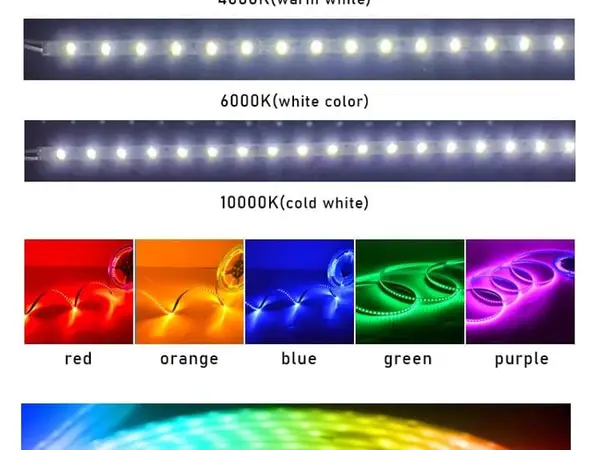
Color temperature is not a preference. It's a specification. 3000-3500K warm white for restaurants and hospitality. 4000-5000K neutral for corporate lobbies and retail. 6000-6500K cool for industrial parks and highway signs. Put the Kelvin number on the drawing. "White" means nothing. I've had a coffee shop get 6500K because the buyer wrote "white LED." They looked like a gas station bathroom.
The ugly truth is that IP65 is the minimum for outdoor signs, and a lot of shops sell it as premium. IP65 means dust-tight and protected from water jets. It does not mean hurricane-proof. For coastal or high-wash areas, go IP66. For submersed or extreme weather, IP68. Ask the factory for the test report, not a sticker.
I've seen this go wrong: an importer ordered 42 back-lit halo letters with no power supply spec. The factory used 12V power supplies. The installer ran wire 60 feet from the sign to the electrical panel. Voltage drop killed the LEDs at the far end. By the time they cut open the wall to fix it, the sign cost double.
Spec the power supply on the drawing. Voltage, wattage, and location. If the run is long, use 24V. If you don't know, ask the factory to calculate the voltage drop. We do it every day. It's not a favor. It's the job.
Another classic: no mounting template. You get a 200-pound stainless steel sign with no hole locations. The installer has to measure and guess. They drill one hole off by half an inch and now the sign hangs crooked. A proper drawing includes mounting hole centers with ±2mm tolerance. We include a full-size paper template with every order. Ask for it.
Here's what nobody tells you: the drawing is also your packaging spec. If you need the sign to survive a sea container for about 65 days, say so. We pack foam, then carton, then plywood crate. But if you don't ask, some factories wrap it in bubble wrap and call it done. Salt air kills uncrated signs. I've opened containers that smelled like a wet dog and looked worse.
Look, we're Aochuang Sign in Lu'an, Anhui. We've been doing this since 2010. 3,000 square meters, 50+ workers, exports worldwide. We'll tell you exactly what we can and can't do. That's how trust works.
We can do front-lit channel letters, back-lit halo letters, stainless steel letters, aluminum letters, acrylic light boxes, and neon flex. MOQ is one piece. Lead time about 5-15 days. We age-test every lit sign 8-12 hours, then 100% QC inspect before packing. We include a 2-year warranty on LEDs and 1 year on power supplies. That's real.
We can't do UL 48 certification in-house. That costs $4,000-15,000 and takes 4-9 months with quarterly audits. If your US project requires UL, we can work with a third-party lab, but we won't fake the sticker. We have CE, RoHS, and ISO 9001. Ask to see the certificate with today's date. Don't take a factory's word for it. I've seen expired CE certs with a 2018 date passed off as current.
Here's a hard fact: CE marking is not a product test. It's a self-declaration backed by a test report. It costs 20,000-50,000 RMB and takes 2-8 weeks. Any factory that says "CE certified" without showing the test report is lying. Call them out.
The ugly truth is that US retail pricing for installed signs is brutal. Front-lit channel letters run $200-700 per letter installed. Back-lit halo letters $400-1,000 per letter. That includes labor, permits, and markup. Factory-direct product cost is a fraction. Our front-lit channel letters run $20-80 per letter. Back-lit halo $35-120. Stainless steel non-lit $15-40. You do the math.
You save 50-65% on product buying factory direct. Shipping adds cost: express 7-10 days at $30-100 for small orders, air about 10 days at $4-12/kg, sea about 65 days at $80-200 per cubic meter LCL. Add US Section 301 tariff around 30% for many sign categories. Even with all that, you're still ahead. But don't forget the tariff. A lot of buyers do, and then they're surprised when customs holds the crate.
For a quick material price check: acrylic light boxes run $80-250 per square meter. Neon flex signs $30-200 per sign. Aluminum letters $10-25 per letter. If a factory quotes half that, they're using domestic acrylic, cheap LEDs, or 0.5mm aluminum. You'll pay for it later.
Put this on your drawing before you send it to any factory. I don't care if you're ordering one sign or forty.
Here's the deal. A clear drawing gets you a clean quote and a sign that installs like it was made for the wall. A vague drawing gets you a cheap price, a late delivery, and a phone call from an angry contractor. I've answered that call too many times.
If you've got a project in front of you, send us the drawing. We'll quote it straight, tell you if something's overkill, and tell you if you're about to make a $5,000 mistake. That's not sales talk. That's 16 years of not wanting to see another sign end up in a dumpster.

Real photo from our production floor — every sign we ship is made here.
From $24/letter · MOQ 1 piece · Flexible lead time · CE & UL certified · ships to 20+ countries
Custom sizes, colors, and finishes. Get a factory price in 24 hours.
Get a Free Quote Copy EmailWhatsApp +86 13865703472 · business@aochuangsign.cn
See pricing, specs, and get a free quote for the sign type you need. Built in our factory, shipped worldwide.