Sending a JPEG of a logo and saying "make it look good" doesn't make you a professional buyer. It makes you a mark.
I've been on the factory floor for 16 years. I've watched sign shops pay $800 for a single front-lit channel letter when we ship the same 304 stainless steel and Samsung LED letter for under $120. The difference isn't magic. The difference is a technical drawing that leaves zero room for guesses.
Here's what nobody tells you: your drawing is the contract. Not the email thread. Not the WhatsApp messages. When the crate opens and the letters are 10mm too thin, we build what you actually sent. If you didn't send it, that's on you.
If you're ordering front-lit channel letters, your drawing needs five numbers at minimum. No exceptions.
I once got a drawing for a 900mm "A" with no stroke width. The client wanted two SMD 2835 modules per letter. The stroke was 5mm. You can't fit two modules in a 5mm channel without melting the acrylic. We caught it before production. Most factories won't.
Look, if you don't specify return depth, the factory picks for you. Usually the cheapest option. That's not a scam. That's what happens when there's no control on the drawing.
For stainless steel letters, don't just write "stainless." 304 and 316 are different animals.
304 has 18% chromium and 8% nickel. It'll last 10+ years outdoors in Ohio. 316 has 2-3% molybdenum added, which buys you 15+ years near salt water. It costs 20-30% more. For Miami Beach, pay for 316. For a strip mall in Ohio, 304 is fine.
Here's what nobody tells you: "brushed stainless" is not a finish callout. You need #4 or #8. #4 is satin, directional. #8 is mirror. PVD and powder coat are entirely different processes. Write it down.
If you're buying stainless steel letters, also specify face thickness. 1.0mm is standard for small letters under 300mm. 1.5mm for medium. 3.0mm for big architectural letters over 1m. Don't let a factory sell you 0.8mm and call it professional.
Acrylic matters too. UV-resistant acrylic from Mitsubishi or Degussa lasts 5-8 years before yellowing. Domestic acrylic yellows in 1-2 years. On a sign over 2.5m wide, you need 5mm acrylic minimum or the face will bow like a wet pizza box.
The ugly truth is most buyers spec "3mm acrylic" because it's cheaper. Then their 3-meter sign looks wavy in six months. That's not a shipping problem. That's a drawing problem.
Aluminum letters weigh one-third of steel and won't rust. Outdoor life 8-12 years. If you're specing letters over 1m for a high wall, aluminum returns cut the load on your anchors. Just don't mix aluminum with stainless fasteners without isolation pads, or you'll get galvanic corrosion. I've seen that happen twice.
You must write the LED module on the drawing. Not just "LED".
SMD 2835 runs 100-150 lumens per watt, industry standard. SMD 5730 gives 40-60 lumens per chip, highest brightness. Quality Samsung or Osram modules last 5+ years real world. Cheap no-name modules die in 12-18 months.
Spec the color temperature exactly. 3000-3500K is warm, good for hospitality. 4000-5000K neutral, corporate and retail. 6000-6500K cool, industrial and highway. If you don't write it, you'll get 6500K because it's slightly cheaper and the factory assumes you want bright.
Also write voltage and power supply. We stock mean well power supplies with 1-year warranty. LED modules carry 2-year warranty. But if you tell us to use a $20 cheap driver to hit a price, you'll be replacing it in 18 months. I've seen this go wrong: a buyer demanded 12V non-waterproof supplies for an outdoor sign to save $120. The first rain shorted the whole thing.
For outdoor signs, minimum IP65. That means dust-tight and water jets from any direction. IP66 is powerful jets, better for coastal storm exposure. IP68 is submersible, overkill for most signs. But IP65 does not mean hurricane-proof. I've seen signs ripped off walls and the LED still lit on the ground. The IP rating didn't fail. The mounting did.
One thing I can't stand: suppliers who put a 24V power supply on a 12V LED string because "it's brighter." It works for about three days. Then you have a fire. I won't do it. If you ask me to, I'll hang up.
If you're speccing back-lit halo letters, you need standoff distance. That's the gap between the letter and the wall. 15-25mm is standard. Too close and the halo looks like a blob. Too far and you see the mounting studs.
For rimless channel letters, the acrylic face sits flush to the return. It looks clean, but the edge catches dust. Be ready to clean it. That's not a defect. That's physics.
Dual-lit channel letters have white face by day and halo at night. They look fantastic. They also cost 30-50% more than single-lit because you're installing two lighting systems in one letter. If your budget is tight, skip the dual-lit dream or reduce letter count.
Our laser cutting runs ±0.1mm. That's tighter than any hand-cut stencil. But welding and polishing add material and remove material. The final letter will be within ±1mm on overall dimensions for letters under 1m. Over 1m, ±2mm. If your project needs aerospace tolerance, you're in the wrong industry.
Here's what nobody tells you: powder coat color will not match Pantone perfectly. Ever. We can get close, but batch to batch varies 2-5% on color. If you need exact brand color, send a physical sample and we'll match to that, not a PDF.
Look, we can build almost any sign shape you can draw. That includes logos with complex curves, 3D fabricated letters, and brass luxury letters. We've done 50+ workers and worldwide. But we're not magicians. A 100mm letter with full LED illumination and 6mm stroke won't work. Physics says no.
We are ISO 9001, CE, and RoHS certified. We can build to most international electrical standards. We are not automatically UL listed on every product. Full UL 48 listing costs $4,000-15,000 and takes 4-9 months with quarterly audits. If your US project requires UL listing, we can build using UL-listed components and provide documentation, but the final sign may still need local field evaluation. I won't lie about that.
We can ship one piece because minimum order quantity is 1. Lead time is about 5-15 days. Express shipping takes about 5-15 days for small orders, air about 10 days, sea about 65 days. US Section 301 tariff on signs runs about 30%. Factor that in. Our factory prices for front-lit channel letters start at $20 and top out around $80 per letter, while back-lit halo starts at $35 and goes to $120. You'll still save 50-65% over US retail installed prices even after shipping and tariff.
We can't give you a $15 stainless steel letter that won't rust and won't fall apart. That $15 letter exists. It's 201 stainless or 304 with 0.6mm thickness. It'll last 2 years. I won't sell it without telling you. If someone quotes you $15 for a 304 stainless letter with real LED, they're lying about material or LED.
The mounting pattern is part of the drawing. If you don't show stud locations, we'll use our best guess. But your wall doesn't match our best guess. Include a template PDF with drill holes to scale. It takes ten minutes. It saves a $500 service call.
Raceway is a metal channel that holds all the letters and hides wiring. It's faster to install but uglier. Stud mount is cleaner but requires power access behind each letter or conduit. For a strip mall with stucco, raceway is usually the right call. For architectural glass, stud mount or standoffs.
Factory-direct since 2010. Free quote within 24 hours — no obligation.
Get a Free Quote → Copy EmailMOQ: 1 piece · Flexible lead time · 2-year warranty · Worldwide shipping

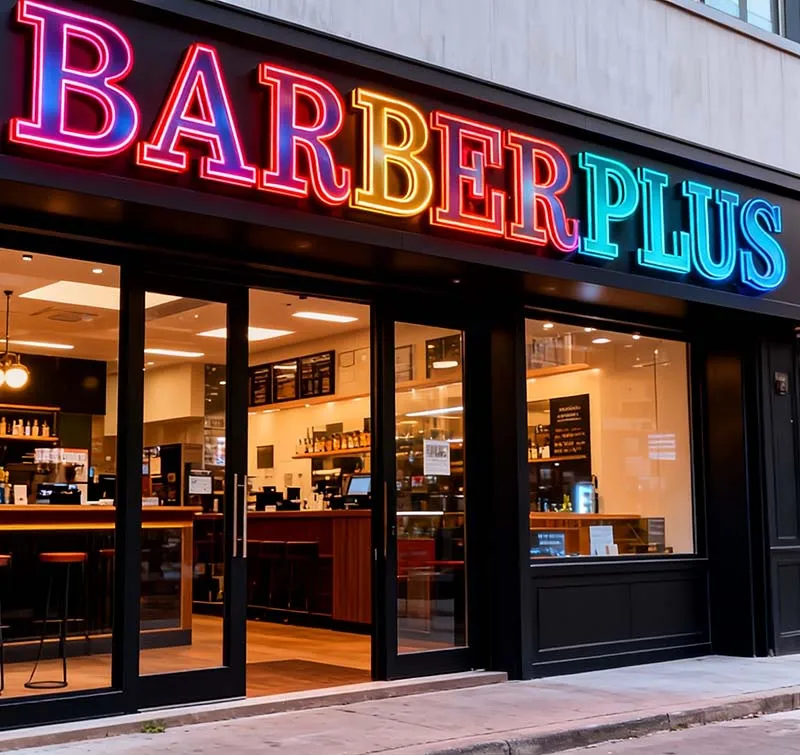
Real photo from our production floor — every sign we ship is made here.
See pricing, specs, and get a free quote for the sign type you need. Built in our factory, shipped worldwide.