Look, the biggest mistake sign buyers make is sending a photo from Pinterest and typing “I want this.” That’s not a spec. That’s a wish.
I’ve been on the factory floor for 16 years. I’ve seen a 40-foot container show up with channel letters that were 600mm instead of 800mm because the PO said “standard size.” I’ve seen a $12,000 order rejected because the stainless finish was mirror when everyone assumed brushed. Assumptions burn cash. Front-lit channel letters don’t come with telepathy. A professional spec starts with three things: exact dimensions, a material call-out, and a color temperature. Everything else is noise until you lock those in.
Here’s what nobody tells you: scale is a weapon. I don’t mean “scale to fit page.” I mean a 1:1 vector file in millimeters, with every stroke, every return, every trim cap dimension called out.
Send a .jpg screenshot and our laser cutter operator will guess. Send a PDF or AI file with stroke outlines expanded and all text converted to curves, and he’ll cut within ±0.1mm. I’ve watched a sign shop owner argue for three weeks over a 2mm gap on an acrylic face because his designer drew a 590mm panel for a 592mm can. Two millimeters. Two. In the field, that gap fills with silicone that yellows in 18 months. In a professional drawing, you dimension from the letter face edge to the return bend line. You specify the return depth—30mm, 50mm, 80mm—not just “medium.” You note whether the acrylic is flush, inset, or proud. That one note on a drawing saves 12 emails and a reorder.
The ugly truth is that most “stainless” letters you buy online are 201-grade mystery metal with a film that peels off after a Chicago winter.
You want stainless steel letters that last a decade? Write this: “304 stainless, 18% Cr / 8% Ni, 1.2mm thickness, #4 brushed finish, graining horizontal.” Those six parameters kill 90% of the guesswork. 304 handles 10+ years outdoors without pitting unless you’re on a coast. If you’re in Miami Beach or Dubai, spend the 20-30% premium and spec 316 marine grade—it has 2-3% molybdenum that fights chloride corrosion. I’ve had clients save $200 on a 304 sign only to replace it in three years because the beach air ate it alive. Brutal honesty: if the quote doesn’t mention grade, assume it’s the cheapest alloy the factory can bend.
Aluminum gets simpler. Aluminum letters give you 8-12 years outdoors and weigh a third of steel. Spec 5052 or 6061 alloy, 1.6mm minimum, with a note on powder coat—RAL 9003 matte, 60-80 microns thickness, oven-cured. I see builders order “white aluminum letters” and get glossy car-paint white when the monument sign called for satin. RAL numbers are free. Use them.
I’ve seen this go wrong: a restaurant chain ordered 47 back-lit halo letters with “warm white” LEDs, and every one landed at 4000K—clinical, cold, wrecking the Tuscan vibe. Because no one wrote down 3000K.
LED specs break into four locks. Kelvin: 3000-3500K for hospitality, 4000-5000K for corporate and retail, 6000-6500K for industrial signs that need to shout. Lumens per watt: SMD 2835 modules push 100-150 lm/W, which is plenty for a front-lit can under 200mm deep. Chip brand: Samsung, Osram, or Lan Jing modules deliver 5+ years real life. Cheap no-name modules die in 12-18 months—I’ve ripped enough of them out of signs to know. And module spacing: for a 100mm-deep channel letter, modules spaced at 80mm on center will hotspot. Go 60mm center-to-center for even light. Draw a module layout on your spec sheet and mark the power feed location. Your electrician will thank you.
Here’s what nobody tells you: IP65 sounds impressive. It means dust-tight and protected against water jets from any direction. It does NOT mean your sign survives a Florida hurricane or a week of salt spray. For outdoor channel letters, IP65 is the floor, not the ceiling.
If the sign mounts on a building with zero overhang in Seattle, insist on IP66—it handles powerful jets and heavy rain. For coastal storm zones, I spec IP68 submersible-grade power supplies and fully potted LED modules, then wrap the whole wiring cavity in marine-grade heat shrink. The extra 8% in material cost buys you a sign that doesn’t flicker in the first nor’easter. And sealing matters more than the rating on the label. Every joint needs neutral-cure silicone, not the acid-cure stuff that corrodes LED legs. I’ve seen factory workers swap silicone to hit a deadline, and six months later the sign is a fish tank. Look for “neutral silicone, full perimeter seal” in the QC section of your spec. If the drawing doesn’t call out sealing method, assume water gets in.
Look, I’m going to be honest with you about the certification game. We carry CE, RoHS, and ISO 9001 at Aochuang Sign. That means our processes are audited, our materials are traceable, and our electrical safety meets EU standards. But if you’re importing into the US and your local inspector demands UL 48 listing, we have a conversation.
UL 48 certification costs $4,000-15,000 and takes 4-9 months, with quarterly factory audits afterwards. I don’t keep a UL stamp on a shelf for every SKU—no custom sign factory does. If your project requires it, we build the cost and timeline into the PO, and I walk you through exactly which components get listed. ETL is an alternative that’s 10-30% cheaper and equally accepted in most jurisdictions. The brutal honesty: many factories say they have UL. Ask to see the certificate with today’s date, and match the file number to the UL online directory. I’ve seen Photoshop disasters. For most US commercial projects, CE compliance plus a field inspection from the local AHJ gets you approved, but don’t guess—ask your sign contractor before you spend a dime.
The ugly truth is that powder coat doesn’t hit a Pantone 185C red perfectly. Ever. It gets close—our line matches RAL and Pantone to within a Delta E of 1.5 on a smooth aluminum face—but metallic finishes shift under different light, and textured powder scatters color reading. If your brand manual demands “Nike Orange” and your monument sign faces west into sunset, you need a physical sample, not just a PMS number on a PDF.
Spec the primary color as “Pantone 021C, powder coat, gloss 70%” and add a note: “Factory to submit 100x100mm aluminum chip for approval before production.” That one sentence saves you from the “this looks different in person” fight. For acrylic faces, call out the specific Mitsubishi or Degussa sheet if UV stability matters—those preserve 92% light transmittance for 5-8 years without yellowing. Domestic acrylic fogs in 2 years. I don’t care which you pick, but don’t leave it blank and then complain that your white logo turned cream.
When you get a quote back, scan for five line items that separate the pros from the gamblers: material grade and thickness, LED brand and Kelvin, power supply IP rating, mounting method with fastener type, and warranty terms by component.
I write our quotes with exactly that breakdown—304 stainless, 1.2mm, Samsung SMD 2835 5000K, Mean Well IP67 driver, 2-year LED warranty, 1-year on the power supply. If a competitor’s quote just says “illuminated letter,” price them into the risk pile. Factory-direct savings of 50-65% on product compared to US retail only work when the factory and the buyer speak the same technical language. We can build you a single front-lit channel letter for $20-80 or a full set for a 10-store rollout, MOQ 1 piece, lead time about 5-15 days from approved drawing. But the drawing has to be tight.
So send me a vector file with dimensions in millimeters, a material grade, a Kelvin number, and a finish call-out. I’ll send you a sample photo within 48 hours. No Pinterest mood boards, no “make it pop.” Just a spec that’s as solid as the sign you’re hanging for the next decade.

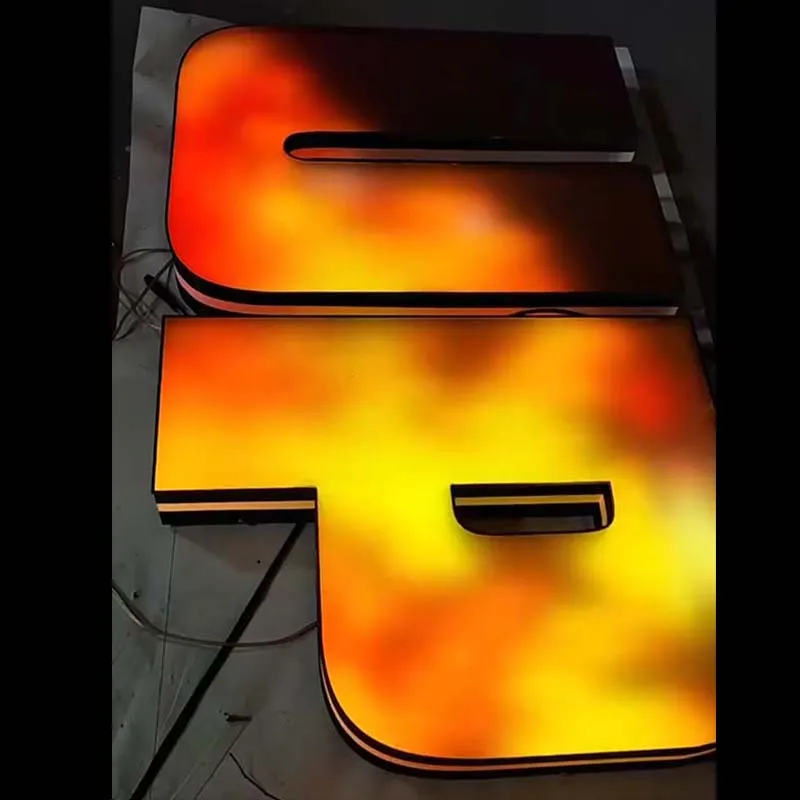
Real photo from our production floor — every sign we ship is made here.
From $24/letter · MOQ 1 piece · Flexible lead time · CE & UL certified · ships to 20+ countries
Custom sizes, colors, and finishes. Get a factory price in 24 hours.
Get a Free Quote Copy EmailWhatsApp +86 13865703472 · business@aochuangsign.cn
See pricing, specs, and get a free quote for the sign type you need. Built in our factory, shipped worldwide.