Look, I've spent 16 years on a sign factory floor. Aochuang Sign, Lu'an, Anhui. We ship worldwide. If you're comparison shopping right now, you need to think like a professional buyer. That starts with a technical drawing a factory can't hide behind.
The ugly truth is most buyers send a photo from Pinterest and say "quote this." Then they get 14 different prices and can't figure out why. The reason: no two factories are reading the same drawing.
Here's what nobody tells you: a pretty 3D render is not a spec. A render won't show you that a 2mm acrylic face will warp on a 3-meter letter. It won't tell you your LED module spacing is too wide and you'll get hot spots. If your drawing doesn't call out the ugly details, the factory will pick the cheapest option. Not because they're dishonest. Because you left the door open.
Every professional buyer I've worked with does the same thing. They put dimensions, material grades, finishes, LED type, color temperature, and mounting method on one sheet. Then they send that sheet to five factories. That's how you get apples-to-apples pricing.
For front-lit channel letters, I need four things minimum: letter height, stroke width, acrylic thickness, and return depth. Miss one, and you'll get a quote that looks cheap but fails in year two.
Look, I don't care if you use AutoCAD, Illustrator, or a napkin. The drawing needs these six items. Every time.
Here's what nobody tells you: factories won't ask for missing tolerances. They'll assume you don't care. Then you'll reject the sign, and both sides lose money.
The ugly truth is most sign shops sell you the expensive material because the margin is higher. I'll give you the straight numbers.
Acrylic from Mitsubishi or Degussa has 90-92% light transmittance and UV resistance for 5-8 years. Domestic acrylic? 1-2 years before it starts yellowing. If your sign is over 2.5m, use 5mm+ face. If it's under, 3mm is standard. Anything less, and you'll see waves when the sun hits it.
For stainless steel letters, 304 lasts 10+ years outdoors. 316 adds 2-3% molybdenum and costs 20-30% more. A strip mall in Ohio? 304 is fine. Miami Beach or a coastal parking garage? Pay for 316. Don't let someone upsell you on marine grade for a logo that'll never see salt.
Aluminum weighs one-third of steel and lasts 8-12 years outdoors. It's naturally rust-proof. If you need a large sign and the wall can't take heavy steel, aluminum letters are the right call. Don't spec 3mm stainless for a 4m sign unless you've confirmed the facade can hold it.
I've seen this go wrong: a client ordered 6000K cool white for a steakhouse because it was "brighter." The sign looked like a hospital sign. Cool white is for industrial sites and highways. Warm white 3000-3500K is for hospitality. Neutral 4000-5000K for corporate and retail.
Ask for SMD 2835 modules at 100-150 lm/W. That's the industry standard. SMD 5050 gives you RGB. SMD 5730 gives you 40-60 lm per chip and the highest brightness, but it runs hotter. Don't let a factory quote "SMD LED" without the number. That's like saying "car" without saying if it's a Corolla or a semi.
For back-lit halo letters, module spacing matters more than chip type. If you want a clean halo, spec minimum 100mm spacing and a 15mm air gap between the face and the wall. Any tighter, and you'll see hot spots on the wall.
Cheap LED modules die in 12-18 months. Quality modules from Samsung, Osram, or Blueview will last 5+ years real lifespan. Our warranty is 2 years on LED, 1 year on the power supply. If a factory offers 10 years on LEDs for a sign that sits in Texas sun, they're lying or they've never been in business long enough to pay claims.
Here's what nobody tells you: factory-direct savings of 50-65% are real, but only if you know the actual factory price range.
Front-lit channel letters run $20-80 per letter from a factory. Back-lit halo letters $35-120. Stainless steel non-lit $15-40. 3D fabricated $40-120. Aluminum $10-25. Light boxes $80-250 per square meter. Neon flex $30-200 per sign. That's from a Chinese factory with 3,000m² of floor space and 50+ workers.
A US retail install of one front-lit letter costs $200-700. Halo-lit $400-1,000. The product cost is a fraction. If you're an importer, you already know the game: buy the product right, don't pay retail markup.
Shipping changes everything. Express is about 5-15 days and $30-100 for small signs. Air freight is about 10 days at $4-12/kg. Sea freight is about 65 days at $80-200/m³ LCL or $1,200-3,000 FCL. And don't forget US Section 301 tariffs of about 30%. A $120 letter becomes $156 landed. Still $300 cheaper than local, but you need to run the math before you order.
The ugly truth is almost every factory says they have CE, RoHS, ISO 9001. Ask to see the certificate with today's date. CE marking costs 20,000-50,000 RMB and takes 2-8 weeks. It's not a lifetime pass. RoHS is a test report, not a certificate. Most factories buy the CE once and let it expire.
UL 48 is the one that matters for US electrical signs. It costs $4,000-15,000 and takes 4-9 months with quarterly audits. ETL is a UL alternative that's 10-30% cheaper. If your local inspector demands a UL label, tell the factory before production. We don't keep an off-the-shelf UL file for every product. We can build to UL standards or coordinate with a certified partner, but that adds cost and time. Don't spring it on us two weeks before your opening.
IP ratings: IP65 is dust-tight and survives water jets. That's the minimum for outdoor. IP66 handles powerful jets — coastal. IP68 is submersible. If you're not installing under a waterfall, you don't need IP68. And IP65 does not mean your sign survives a Florida hurricane. It means water jets for 15 minutes.
Our process has 10 steps. Design confirmation 1 day. Laser cutting ±0.1mm 1-2 days. Bending and TIG welding 1-2 days. Grinding and polishing 1-2 days. Acrylic face CNC 1 day. LED assembly 1-2 days. Sealing with neutral silicone 1 day. Then 8-12 hours of aging test. Then 100% QC inspection. Then export packaging with foam, carton, and plywood crate. Total lead time about 5-15 days. MOQ is 1 piece.
If a factory tells you they can push a custom stainless letter set through in 3 days, they're skipping the aging test. That's the step that catches a bad LED module before it ships. You want the 8-hour test. You don't want your client calling you about a dead letter a week after install.
Ask for photos of the aging test. Ask for a QC checklist. If they won't send it, that's a red flag.
Look, I'm not going to sell you a lie. We can't do local permitting, electrical hookup, or crane installation. We can make the sign and ship it, but the install is on you or your contractor.
We can't give you a UL listing for every custom sign without the 4-9 month lead time and $4,000-15,000 cost. If you need that, we can work with a certified partner, but it adds time and money. We're honest about it because I've seen factories stamp a fake UL logo on a sign and walk away.
We can't guarantee 316 stainless steel if the drawing says "stainless steel." You'll get 304 unless you spec 316. That's not us being cheap. That's you not being specific. So be specific.
We also can't promise a 2m acrylic face won't bow if you mount it in full sun with no backing. Physics doesn't care about your deadline. Use 5mm+ for anything over 2.5m. Or accept the wave.
Here's what I'd want from you if I were quoting your job:
Send that to three factories. You'll get three quotes you can actually compare. That's how you spec a sign like a professional buyer. Anything less is a guess, and guesses cost money.
We've been doing this since 2010. 3,000 square meters. 50+ skilled workers. Exports worldwide. CE, RoHS, ISO 9001. MOQ one piece. Lead time about 5-15 days. If you send me a complete drawing, I'll quote it within 24 hours. If you send me a photo from Pinterest, I'll ask you the same six questions I just listed. No BS.
One more thing: acrylic light boxes at $80-250/sqm are the best value for storefronts, but only if you spec the LED spacing. And rimless channel letters look clean, but they expose the acrylic edge — so don't cheap out on the face material. You've been warned.

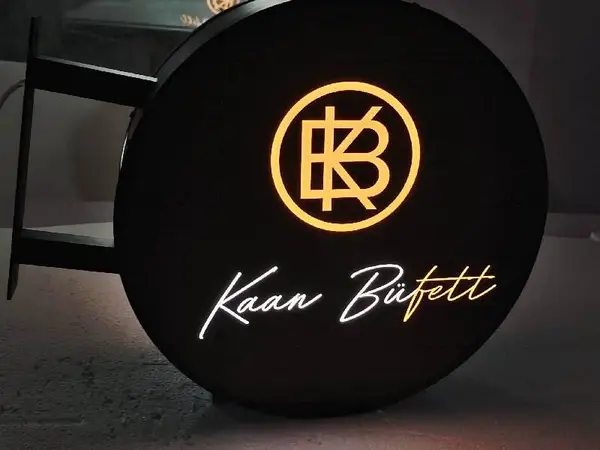
Real photo from our production floor — every sign we ship is made here.
From $24/letter · MOQ 1 piece · Flexible lead time · CE & UL certified · ships to 20+ countries
Custom sizes, colors, and finishes. Get a factory price in 24 hours.
Get a Free Quote Copy EmailWhatsApp +86 13865703472 · business@aochuangsign.cn
See pricing, specs, and get a free quote for the sign type you need. Built in our factory, shipped worldwide.