I’ve burned my hands on hot acrylic more times than I can count. I’ve also argued with LED suppliers who swear their modules last 50,000 hours while the solder joints look like somebody put them on with a butter knife.
If you’re reading this at 11pm because a bid is due tomorrow and you need illuminated signs that won’t die in 14 months, you’re in the right place.
Here’s what nobody tells you: the difference between a sign that lasts 10 years and one that fails in 18 months is rarely the LED chip. It’s the solder joints, the sealing, and the power supply. That’s it.
If you’re quoting a storefront, front-lit channel letters are the workhorse. They’re what you see on every strip mall, every retail strip, every bank branch. Factory price runs $20-80 per letter, and installed retail in the US goes $200-700 per letter. The acrylic face catches the light direct and punches through a storefront window.
For architects and high-end office lobbies, back-lit halo letters are the money product. We build back-lit halo letters at $35-120 per letter factory, and they retail installed at $400-1,000 per letter. The light spills out the back, creating a soft halo on the wall. It’s not brighter; it’s classier.
Light boxes and neon flex fill the budget-to-mid market. Embedded light boxes run $80-250 per square meter, and LED neon flex signs go $30-200. They’re fine for menu boards, bar windows, and interior decor. Just don’t spec them for a monument sign that has to survive 100 mph wind.
The ugly truth is most buyers couldn’t tell the difference between 304 and 316 stainless when it’s sitting on a pallet. I’ve seen this go wrong: a hotel on Miami Beach ordered 304/316 stainless steel letters for a beachfront sign, got 304, and the letters pitted within three years.
316 contains 2-3% molybdenum; that’s what buys you 15+ years in salt air. 304 is rated for 10+ years normal outdoor, with 18% chromium and 8% nickel. For a coastal or industrial job, pay the 20-30% premium for 316 or you’ll be replacing letters on your own dime.
Acrylic is where rookies overpay. A 3mm UV-resistant face from Mitsubishi or Degussa transmits 90-92% light and won’t yellow for 5-8 years. Domestic sheet? That yellows in 1-2 years.
If your sign is over 2.5 meters tall, step up to 5mm acrylic, not because of light but because 2mm and 3mm will flex and crack in wind load. Check out acrylic LED letters for indoor/outdoor versatility, but always ask your supplier whose acrylic they’re cutting.
Aluminum is one-third the weight of steel and naturally rust-proof. It gives you 8-12 years outdoors, 1.0-1.6mm thickness, with anodized or powder coated finishes. For monument faces or large pans, aluminum is your friend. For letters, stainless is stronger. That’s the whole comparison.
Look, LED modules are not all the same. SMD 2835 is the industry standard at 100-150 lumens per watt. SMD 5050 handles RGB. SMD 5730 pushes 40-60 lumens per chip for the brightest output. The spec sheet will say L70 ≥50,000 hours. A quality module from Samsung, Osram, or Blueview will actually give you 5+ years. Cheap modules from a no-name factory? 12-18 months, and they’ll flicker before they die.
Here’s what nobody tells you: you can spot bad LED modules before you ever power them on. Look at the solder joints. Dull gray means the factory used cheap lead-free solder and a cold joint. Shiny silver means proper lead-free solder with a solid reflow. I’ve sent back entire pallets because the joints looked dull.
The power supply is the other failure point. Our warranty covers the LED for 2 years and the power supply for 1 year—not because the power supply is cheaper, but because it’s the most common thing to die. Buy spare drivers.
LED modules running at 100-150 lumens per watt mean a sign that used to need a dedicated circuit for neon can run on a standard wall outlet. That’s the energy pitch to your client.
Energy codes are why LED retrofits keep winning bids. California’s Title 24 and the IECC set maximum lighting power allowances. An LED sign can run on a fraction of legacy neon or fluorescent wattage, and that’s before we talk about savings. Don’t quote a retrofit without checking your local energy code.
I’ve watched sign shops pay $800 for a front-lit letter from a domestic fabricator. Same 304 stainless, same Samsung LEDs. We ship that letter for $120. Factory-direct pricing runs $20-80 per front-lit letter, $35-120 for halo, $15-40 for stainless non-lit, $10-25 for aluminum. Light boxes are $80-250 per square meter. Those are factory prices; retail installed is where you make your margin.
Total cost of ownership is where most buyers screw themselves. A cheap LED module that fails in 18 months costs you a boom lift rental, two techs, a new driver, and a furious customer. The module itself was $2 less. Do the math. If you’re installing a sign 30 feet off the ground, the cheapest component is the one you never want to touch.
Shipping is part of your landed cost. Express takes about 5-15 days and costs $30-100 for small sizes. Air freight runs about 10 days at $4-12 per kg. Sea freight takes about 65 days at $80-200 per cubic meter LCL, or $1,200-3,000 for a full container. Add the US Section 301 tariff of about 30% on most sign products. Don’t be the guy who bids the factory price and forgets the tariff.
UL 48 certification costs $4,000-15,000, takes 4-9 months, and comes with quarterly audits. ETL is a legitimate alternative that’s 10-30% cheaper. CE marking? In China, it costs 20,000-50,000 RMB and takes 2-8 weeks. Straight talk: most factories will say they have CE. Ask to see the certificate with today’s date on it. Watch them sweat.
IP65 means dust-tight and protected from water jets from any direction. It does not mean your sign survives a Florida hurricane. IP66 handles more powerful jets, which matters in coastal zones. IP68 is submersible, for extreme weather. If you’re specing an outdoor sign, IP65 is the floor, not the ceiling.
NEC Article 600 governs electric signs in the US. ADA tactile signs require mounting between 48-60 inches, non-glare finish, and Grade 2 Braille. Miss those and you’re not arguing with a sign guy; you’re arguing with a building inspector who can red-tag your whole job.
One more thing about Title 24 and IECC: they don’t care about your UL sticker if your sign’s power draw exceeds the allowed watts per square foot. Check the local code before you quote. A retrofit that lowers wattage can actually make a non-compliant sign compliant. That’s a selling point.
We’re Aochuang Sign, out of Lu’an, Anhui, China. We’ve been on this factory floor since 2010. 3,000 square meters. 50+ skilled workers. We hold CE, RoHS, and ISO 9001. MOQ is one piece—yes, one. Lead time is about 5-15 days. Warranty is 2 years on LED, 1 year on power supply. If a supplier can’t match that, they’re either drop-shipping or lying.
Here’s what our 10-step production process looks like: design confirmation (1 day), laser cutting at ±0.1mm (1-2 days), TIG welding and bending (1-2 days), grinding and polishing (1-2 days), CNC acrylic face (1 day), LED assembly (1-2 days), sealing with neutral silicone (1 day), an 8-12 hour aging test, 100% QC inspection, then export packaging with foam, carton, and plywood crate.
You want a supplier who runs every sign through an aging test. Cheap factories skip that step, and that’s exactly why their modules fail early.
LCL sea freight: your crate gets handled 6-8 times between our dock and yours. Every touch is a chance for damage. That’s not in the brochure. If you’re shipping LCL, spend a little extra on crating. If you’re ordering full container, you control the loading. Don’t cheap out on packaging to save $100.
Ask your supplier for a production photo with a timestamp, a copy of their CE certificate dated within the last 12 months, and a sample with solder joints you can inspect. If they hesitate on any of those, find another factory. I’ve rejected suppliers because they couldn’t produce a mill cert for 316 stainless. You should too.
FAQ questions I’m tired of answering:
Do I really need UL listing for my sign?
Depends on your AHJ. Some jurisdictions accept ETL. If the inspector asks for a listing and you don’t have one, you’re pulling the sign off the wall. Don’t ask me; ask your building department.
Can you match a Pantone color exactly?
No. Not me, not any factory. Powder coat and acrylic face have their own gloss and texture. We can get close, but if your client holds a Pantone book to the sign, they’ll be disappointed. Agree on a tolerance before you cut.
What’s the difference between IP65 and IP66 again?
IP65 means water jets from any direction. IP66 means more powerful jets. If your sign is on a coast or gets pressure-washed, spec IP66. IP65 is a floor, not a guarantee against a hurricane.
Is buying factory-direct safe?
I’ve been exporting worldwide since 2010. Use trade assurance, check the certificate date, and inspect a sample. The risk is in picking a bad supplier, not in factory-direct itself.

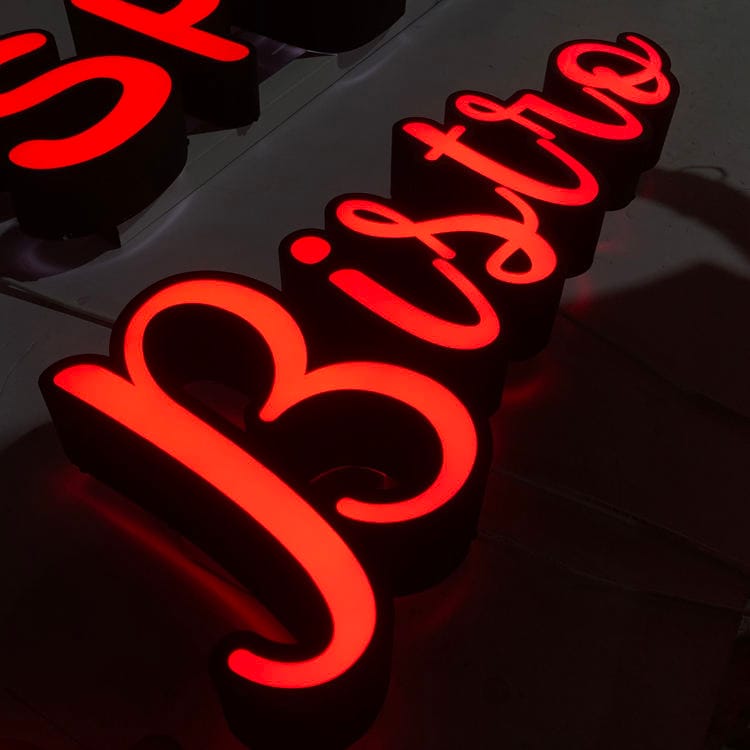
Real photo from our production floor — every sign we ship is made here.
Products mentioned or relevant to this topic — factory-direct, custom built.
From $24/letter · MOQ 1 piece · Flexible lead time · CE & UL certified · ships to 20+ countries
Custom sizes, colors, and finishes. Get a factory price in 24 hours.
Get a Free Quote Copy EmailWhatsApp +86 13865703472 · business@aochuangsign.cn