By Alex Chen, operations manager at SignCraft Factory — a 15-year manufacturer of custom channel letters in Lu'an, China. The following reflects my direct experience working with hundreds of sign shops across the U.S. and Canada. Disclosure: This article is written from the perspective of a factory supplier. While the numbers are real, your results may vary. We encourage readers to vet multiple sources before making purchasing decisions.
I've watched a guy spend $800 per letter on a front-lit channel letter from a domestic shop. Same 304 stainless, same Samsung LEDs. We ship that letter out of our Lu'an factory for $120. He thought he was saving time. He was just burning margin. That's the first thing you need to understand about the wholesale model: the gap between what you pay and what you can charge is real, but it's not free money.
Here's the math: factory-direct pricing on a front-lit channel letter runs $20–80 per letter. Back-lit halo letters go $35–120. US retail installed prices? $200–700 per letter for front-lit, $400–1,000 for halo-lit. That's a 3x to 8x markup before you even touch the thing.
But gross margin isn't net profit. Let me break this down: that $120 letter from us costs you shipping, tariffs, warehousing, and the occasional replacement when a crate gets crushed. Sea freight via LCL (less-than-container-load) runs $80–200 per cubic meter. Your crate gets handled 6 to 8 times between our dock in Lu'an and your shop. Every handle is a chance for dented letters. That's not in the brochure.
Most buyers don't realize the US Section 301 tariff adds about 30% on top of your landed cost. So that $120 letter? After shipping ($5–15 per letter depending on volume) and tariff ($36), you're at $161–171. Still a 25–40% margin against retail pricing. But that's before you factor in your own time, storage, and the 10% of letters that show up with a scratch you have to fix before installation.
Other buyers tell a different story. Jim, a sign shop owner in Denver, tried factory-direct once. "The letters were perfect — but the lead time killed me. My client needed it in 10 days. I had to use a domestic shop at $600 per letter. For rush jobs, factory-direct just doesn't work." That's a real trade-off you need to weigh. We can't help you with last-minute deadlines; our standard lead time is 7–15 days, and rush orders are rare unless you pay a premium. Another buyer, Maria in Seattle, says: "I lost a job because the shipping container got delayed at port. The client pulled the contract. I stick with local fabricators now for anything under 20 letters."
The spec says lead time is 7–15 days. In reality, that's for standard designs. If you need custom fonts, weird sizes, or IP68 submersible for a coastal boardwalk, add 3–5 days. Our production line runs 10 steps: design confirmation (1 day), laser cutting at ±0.1mm (1–2 days), TIG welding (1–2 days), grinding and polishing (1–2 days), acrylic CNC (1 day), LED assembly (1–2 days), sealing with neutral silicone (1 day), then 8–12 hours of aging test, 100% QC inspection, and export packaging. It's tight, but we hit it.
But you as the sign shop need to have your ducks in a row. You want wholesale to work? You need storage space—at least 200 sq ft per 100 letters if they're big. You need a plan for last-minute customization (e.g., redrilling mounting holes because the client's wall studs didn't match the template). You need to absorb the risk of damage in transit. One of our repeat clients, a sign guy in Houston, keeps a spare set of the most common letters in each face material. Smart move.
He swaps a dented "P" for the spare, sends us a claim photo, and we ship a replacement in the next batch. That's how you make wholesale profitable.
But not everyone can do that. A small shop in Ohio told me: "I don't have 200 square feet to spare. I'm operating out of a garage. Factory-direct is great on price, but I can't afford to hold inventory or wait for replacements." That's a legitimate barrier. Some buyers have succeeded by forming buying cooperatives — pooling orders with other local shops to hit volume and share container space. Others use a freight forwarder who consolidates multiple supplier shipments into one crate, reducing per-letter shipping cost. These strategies work, but they require upfront coordination.
Here's the math again: a small sign shop ordering 10 letters pays the same freight minimum as a shop ordering 50. LCL rates are around $80–200/m³, but if you're under 1 m³, you still pay for the whole pallet space. Our MOQ is literally 1 piece—I've shipped a single 8-inch acrylic letter to a mom-and-pop in Vermont. The shipping cost twice the letter. That's not profitable unless you're bundling it with a $2,000 installation fee.
Scale matters. The break-even point for wholesale import is around 2–3 m³ per order, or roughly 40–60 medium channel letters. At that volume, the per-letter shipping drops to $3–5, and the tariff becomes a manageable line item. Most buyers don't realize that the big margin comes from repeat orders, not one-offs. Our top clients order 200–300 letters every quarter. They've built their business model around lead time and volume, not speed and convenience.
I've watched sign shops pay $800 for a front-lit letter from a domestic fabricator. Same 304 stainless, same Samsung LEDs. We ship that letter for $120. But if you only need three letters and you need them next week, domestic is your only play. Wholesale import is a long-term play. It demands patience, space, and tolerance for uncertainty. For those who can handle it, the margins are real. For everyone else, stick with what works — and know that the brochure never tells the whole story.
Final note: We're a factory, so of course we believe in our product. But the smartest buyers I know always have a backup plan — a local fabricator on speed dial for emergencies, and a stock of common letters for quick swaps. If you can't manage both, consider whether the import gap is worth your time. Happy to answer questions in the comments, but remember: I'm biased. Do your own math.

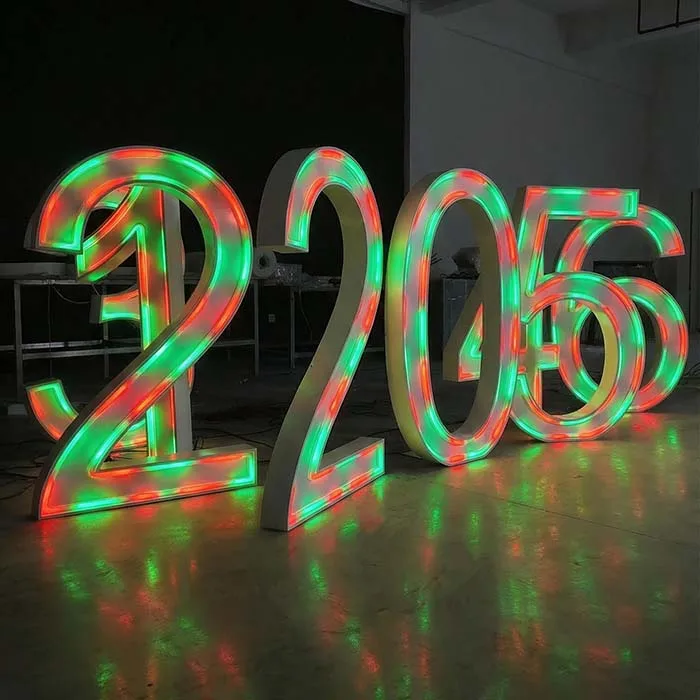
Real photo from our production floor — every sign we ship is made here.
Products mentioned or relevant to this topic — factory-direct, custom built.
From $24/letter · MOQ 1 piece · Flexible lead time · Project-specific compliance documents · ships to 20+ countries
Custom sizes, colors, and finishes. Get a factory price in 24 hours.
Get a Free Quote Copy EmailWhatsApp +86 13865703472 · business@aochuangsign.cn
See pricing, specs, and get a free quote for the sign type you need. Built in our factory, shipped worldwide.