The ugly truth is most sign buyers overpay by 200-400% because they don’t separate product cost from installation markup. A 4-foot channel letter set that costs $680 from our Lu’an factory often lands on a US storefront for $3,200. That’s not all installer greed — permits, bucket trucks, and union labor eat cash fast. But if you’re a contractor or business owner who can handle local install, buying direct changes the math completely.
I’ve been on the factory floor 16 years. I’ve seen cheap acrylic yellow in 14 months and watched a restaurant owner cry when his “waterproof” sign filled with mud after one storm. This guide won’t polish turds. I’ll tell you exactly what materials survive, what design choices backfire, and how to land a large outdoor sign that doesn’t embarrass you by year three.
Factory-direct pricing for large outdoor business signs runs $20 to $250 per square meter or per letter, depending on type. A 30-inch front-lit channel letter in stainless steel with acrylic face: $55-70 per letter. That same letter installed by a US sign company: $350-700. The gap is real. I see purchase orders every week proving it.
Here’s a blunt breakdown by product type, based on what we ship from Aochuang Sign:
Add shipping and tariff. Express air for a small box of letters: $30-100 and 7-10 days. Sea freight LCL (less than container load): $80-200 per cubic meter, about 65 days. A full 20-foot container: $1,200-3,000. Then US Section 301 tariff hits at roughly 30% of declared value. You need to factor that 30% into your landed cost, not pretend it doesn’t exist.
Let me give you a real scenario. A set of 12 front-lit channel letters, 24 inches tall, with stainless returns and 6500K white LEDs, packed for sea freight. Factory price: $780. LCL shipping to Los Angeles: $320. Tariff (30% of $780): $234. Landed cost before local install: $1,334. Compare that to $8,400 quoted by a US sign company. Yes, you still need installation and possibly an engineer’s stamp. But you’re $7,000 ahead before you even pick up a drill.
Look, not all stainless is the same, and not all acrylic lives outdoors. I’ve rejected entire sheets of 304 because the nickel content was light. Large outdoor business signs face UV, rain, thermal expansion, and occasionally a drunk guy with a ladder. Choose materials like your reputation depends on it.
Stainless steel 304: 10+ year outdoor life. 18% chromium, 8% nickel. Density 7.93g/cm³. We use 1.0mm to 3.0mm thickness; for letters above 2.5 meters tall, 1.5mm minimum or they’ll oil-can in wind. 304 is fine for 95% of locations. Here’s what nobody tells you: 316 stainless costs 20-30% more and contains molybdenum. You need that for coastal zones or industrial parks with chemical fallout. A strip mall in Ohio? 304 is overkill. Miami Beach? Pay for 316 or watch pitting start in 18 months.
Aluminum is a smart alternative if weight matters. It’s one-third the weight of steel, naturally rust-proof, and lasts 8-12 years with a decent powder coat. We use 0.040-0.063 inch (1.0-1.6mm) for flat-cut letters. Anodized or powder-coated finishes hold up well. Don’t use raw aluminum in salty air — it pits just like steel, just slower. If you want that brushed metal look near the ocean, go 316.
Acrylic faces are where I see the most lies. Factory specs say “outdoor-grade,” but there’s a canyon between Mitsubishi or Degussa acrylic and domestic Chinese sheet. Premium UV-resistant acrylic transmits 90-92% light and stays clear 5-8 years. Domestic sheet? You’ll see yellowing and microcrazing in 1-2 years, especially under constant sun. We stock 2mm, 3mm, and 5mm. For any letter over 2.5 meters, I insist on 5mm minimum. Anything thinner cracks at mounting points. If a supplier quotes you suspiciously low on a large light box, ask them to name the acrylic brand. If they hesitate, walk.
LEDs are the heart of an illuminated sign, and cheap modules murder your reputation. We use SMD 2835 LEDs, 100-150 lumens per watt, with an L70 rating of 50,000+ hours. Good modules from Samsung, Osram, or Chinese brand Lan Jing will run 5+ years of nightly use. Cheap no-name modules? I’ve seen them lose 30% brightness in 12-18 months and start flickering. The ugly truth is many sign manufacturers stuff in whatever’s cheapest because the client won’t know for two years. By then, the warranty period is dust. Our warranty is 2 years on LEDs, 1 year on the power supply. If you need longer, we’ll price an extended warranty using premium modules — just ask.
Here’s what nobody tells you: the biggest cost driver isn’t material. It’s design complexity that doesn’t add value. A custom logo with 47 tight-radius bends in 3-inch deep stainless might look cool, but every bend is a potential leak point and adds hours of TIG welding and polishing. Labor in our factory is skilled and fairly priced, but complexity still runs the meter.
I’ve seen this go wrong: a customer ordered 6-foot-tall front-lit letters with a 2-inch acrylic return trim. Looked clean, but the trim created a ledge that collected water and ice. In Wisconsin, that freeze-thaw cycle popped the acrylic right off the face. You design large outdoor signs to shed water, not to hold it. Slope the top edge, use seamless returns, and if you want that crisp rimless look, our rimless channel letters avoid the ledge entirely by mounting the acrylic nearly flush.
Color temperature matters more than most designers admit. Warm white (3000-3500K) makes a restaurant or boutique feel inviting. Neutral (4000-5000K) works for corporate lobbies and retail. Cool white (6000-6500K) screams “24-hour truck stop” and belongs on highways and industrial parks. Mixing temps on the same facade looks like a mistake, not intentional. Decide one CCT for the entire sign set and stick to it.
Wind load. If you’re putting up a 10-foot wide sign in a place that gets 90 mph gusts, you need an engineer to stamp the mounting. Our factory can provide weight and structural specs, but we don’t do US engineering stamps. You need a local PE. Don’t skip that step. A large outdoor business sign that peels off the wall doesn’t just destroy the sign — the liability can end a business.
Look, I’ve seen shipping quotes kill deals. A $900 sign order with $1,100 in air freight because the client needed it in 8 days. That’s why we push sea freight for anything over 30 kilos. LCL consolidation moves slow but steady. For a typical pallet of channel letters, you’re looking at $120-180 per cubic meter to the West Coast, slightly more to the East Coast. You can get full container load (FCL) if you’re ordering a whole store rollout; that runs $1,200-3,000 for a 20-footer and makes per-unit shipping laughable.
Here’s the timeline reality. Express (DHL/FedEx): 7-10 days, $30-100 for small bits. Air freight: about 10 days, $4-12 per kilo. Sea freight LCL: about 65 days port to port, plus customs clearance. I’ve had containers sit at Long Beach for an extra two weeks because customs decided to X-ray every tenth box. Plan a buffer. If your grand opening is September 1st, don’t order sea freight in mid-July and expect serenity.
US import duty is another rude awakening. The Section 301 tariff on many sign products from China is 30% on the declared value. Plus merchandise processing fee and harbor maintenance fee. You pay duty on the product cost, not the shipping. So a $5,000 order attracts roughly $1,500 in tariff. Use a customs broker, not a random freight forwarder who “knows a guy.” I’ve had clients try to self-clear and end up with storage fees eating any savings.
Let’s be dead honest: Aochuang Sign does not install signs overseas. I’m not going to pretend we dispatch a crew from Anhui to Arizona. You need local muscle. What we deliver is a sign that’s fabrication-complete, wired, tested, and crated. Every letter ships with a mounting template or stud map. Our detailed drawings give your installer hole locations down to ±1mm. For complex illuminated signs, we include a wiring diagram that any commercial electrician can follow.
Installation cost itself is a black box I can’t quote, but I’ve gathered enough contractor feedback. For a simple wall-mount with power already roughed in, budget $80-150 per letter for a bucket truck and two-man crew. For signs over 100 pounds each, you might need a crane and engineered attachment to structural steel. That quickly becomes $400-800 per letter. The smartest buyers get a local installer involved early. Send them our spec sheet before we cut metal. They might ask for thicker backplates or additional studs. We’ll accommodate — it’s cheaper to add mounts in the factory than to weld on site.
Certifications. CE and RoHS are table stakes — they cost us 20,000-50,000 RMB to get, and we retest. Ask to see the actual certificate with the factory’s name and today’s date. I’ve had competitors photoshop old certificates. Our ISO 9001 is real; our LED modules carry supplier certs. If a factory claims UL 48 listing for a standard price, be suspicious. UL 48 testing for a sign costs $4,000-15,000 and takes 4-9 months with quarterly audits. We can do it, but we’ll charge for the process and pass the audit costs through. ETL is a bit cheaper. For most commercial projects, UL isn’t mandatory unless the local authority requires it. Check your local codes.
IP ratings are another lie factory. IP65 means dust-tight and protected against water jets. It does NOT mean your sign survives being pressure-washed weekly or sitting in a flood. IP66 handles powerful jets and coastal spray. IP68 means it can be submerged, which nobody needs for a business sign. The biggest killer of outdoor illuminated signs is water getting into the LED raceway through poorly sealed joints. We use neutral-cure silicone and run an 8-12 hour continuous aging test on every sign before packing. That test catches leaks that a 5-minute QC check misses. If a factory can’t tell you their aging test procedure, they aren’t doing one.
Lead time matters. Our standard is about 5-15 days from design approval to crate. That’s honest. In peak season (September-November), it might push to 15-20 days. If a factory promises “any sign in 3 days,” they’re cutting corners on curing or bypassing aging tests. The silicone needs 24 hours to fully cure before it’s trustworthy outdoors.
We’re a 3,000 square meter facility in Lu’an, Anhui, with 50+ skilled workers. We ship worldwide. I’m proud of that, but I’m not going to tell you we’re the only factory that can do this. We’re the one that answers emails within a few hours, speaks plain English, and doesn’t pretend a domestic acrylic is Mitsubishi. Our MOQ is one piece. Most factories have a 10-piece minimum because setup costs eat profit; we’ve built efficient processes that make single custom letters viable. That’s rare.
We manufacture front-lit, back-lit, halo-lit, dual-lit, rimless, stainless, aluminum, brass, acrylic light boxes, and neon flex. You want a dual-lit channel letter that glows front and halo? We do that. Deep return brushed steel with a PVD gold finish? Done. A massive 2-meter tall fabricated logo with RGB LEDs? We’ll engineer and build it. Our CNC laser cutting holds ±0.1mm tolerance, and our TIG welders are artists.
Here’s what we can’t do: we can’t remove the need for a local installer and an engineer’s stamp. We can’t absorb the 30% tariff for you. We can’t magically cut sea freight to 2 weeks. We can’t guarantee that your city inspector won’t find some obscure code issue — but we’ll supply every specification document to help your installer pass inspection.
The ugly truth is buying factory-direct takes more project management on your end. You’ll need to coordinate shipping, customs, and install. If you want a turnkey white-glove service, there are US sign companies that do that beautifully. If you want to save 50-65% on the product and you’re willing to project manage, we’re your factory. I’d rather turn down an order than sell a sign that fails outdoors. Ask for samples. Ask for references. Ask about the LED binning. I’ll answer like the guy with burnt hands and a welding helmet who’s been doing this since 1998.

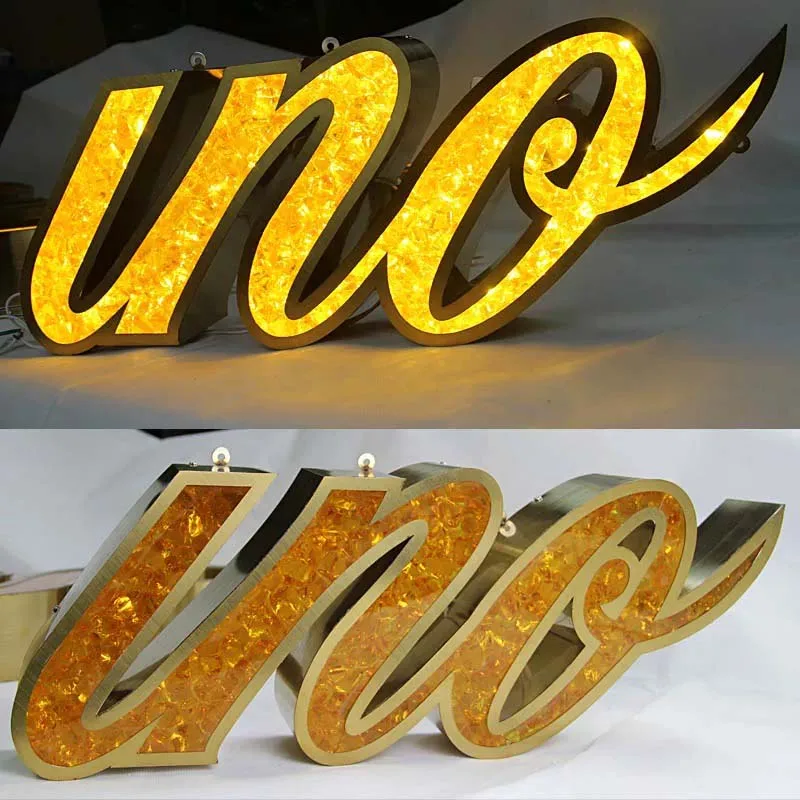
Real photo from our production floor — every sign we ship is made here.
From $24/letter · MOQ 1 piece · Flexible lead time · CE & UL certified · ships to 20+ countries
Custom sizes, colors, and finishes. Get a factory price in 24 hours.
Get a Free Quote Copy EmailWhatsApp +86 13865703472 · business@aochuangsign.cn
See pricing, specs, and get a free quote for the sign type you need. Built in our factory, shipped worldwide.