Just got off the phone with a sign shop owner in Texas at 11pm. He got burned by a local laser cutter. Edges that looked chewed, six-week lead time, powder coat flaking off in the first hail. Same story I hear every month.
Look, I've been on a factory floor since 2010. Not a desk. A floor. I've burned my hands on hot steel and argued with suppliers about cutting tolerances.
So let's talk about laser cut steel letters the way you actually need to hear it.
Clean edges. Repeatable precision. No hard tooling. If you need a single letter for a storefront or 500 for a campus wayfinding job, a laser cutter doesn't care. Our MOQ is 1 piece.
The ugly truth is a lot of sign shops still waterjet or plasma cut steel letters because the machine was cheaper to buy. Then they spend hours grinding off dross and hoping the customer won't notice the wavy edge. Laser cutting holds ±0.1mm. You send the same CAD file next year, you get the same letter. That matters when a client reorders and expects consistency.
I've seen this go wrong: a fabricator quoted a national fast-food chain with plasma-cut letters. Looked fine from 20 feet. Up close, the letterforms had rounded corners and burnt edges. Chain rejected the whole install. Don't be that shop.
Steel letters show precision. Cheap process errors show up as wavy edges. Laser hides nothing.
For storefront or lobby signage, stainless steel letters cut on a laser look like the drawing. That's the point.
Plasma is cheap and fast. It also leaves a heat-affected zone, more dross, and a kerf wide enough to lose fine detail. Fine for 4-foot industrial letters on a warehouse. Terrible for 6-inch lobby letters with a 3/8-inch counter.
Waterjet gives no heat distortion, but it's slow, messy, and the abrasive gets into everything. You're paying for cleanup.
CNC routing works on aluminum, but on steel it eats bits and leaves chatter marks. Cast metal gives you mass but costs a fortune in tooling for one-offs. Laser cutting is the sweet spot: tight kerf, minimal taper, fast turnaround. Our cut step is 1-2 days in a 7-15 day production window.
Here's what nobody tells you: a laser kerf isn't zero. Ask your factory for the kerf width on 16-gauge versus 10-gauge. If they can't answer, their machine is probably dialed in wrong. The tolerance on our cut path is ±0.1mm, but kerf compensation has to be set per material thickness or your letters come out undersized.
Plasma might cut your cost 20%, but you'll eat the difference in hand finishing. I'd rather pay for the laser. Worth it.
We mostly use 304 or 316 stainless. 304 is 18% chromium, 8% nickel, density 7.93g/cm³, and rated for 10+ years outdoors. That's your bread-and-butter for most signs. 316 adds 2-3% molybdenum, survives 15+ years in marine or industrial air, and costs 20-30% more than 304.
For a strip mall in Ohio, 304 is plenty. For a hotel on Miami Beach, pay for 316 or you'll be replacing letters in three years. I've seen that mistake cost a contractor $40,000.
Finishes? Brushed #4 is standard. Mirror polished #8 looks high-end but shows every fingerprint. PVD gives you brass or black without paint. Powder coating gives you any RAL color. For painted steel, look at baked paint letters—that finish bakes on at a high temp and won't peel like cheap spray.
The ugly truth is even 304 rusts if you don't seal the cut edges. The laser leaves raw steel exposed at every cut line. Moisture gets in, rust creeps under the paint. You need edge sealer, primer, and a proper powder coat. Or make the letters from solid 304 and clear coat. Don't trust a factory that says "stainless won't rust." They're lying. Stain-less, not stain-never.
For marine environments, 316 contains 2-3% Mo. That molybdenum is what fights salt. Without it, 304 gets pitting. And once pitting starts, you can't grind it off without thinning the metal. Want proof? Next time you're near a beach, look at the handrail brackets. If they're 304, they've got orange spots. If 316, they don't. That's your letter in two years.
Aluminum is 1/3 the weight of steel and naturally rust-proof, with an 8-12 year outdoor life. Steel is heavier, feels more permanent, and gives a sharper return edge. Choose aluminum for big letter sets where weight kills your wall anchors. Choose steel for storefront letters under a meter that clients can touch.
Steel letters come flat cut, fabricated with returns for depth, or formed. Flat cut from 1.0mm to 3.0mm sheet is the cheapest and works for wall-mounted letters with standoffs. Fabricated letters use a face plus a 20-50mm return, welded and ground smooth. That's what you want for storefront dimension.
Material thickness: 1.5mm (16-gauge) is standard for letters up to 600mm tall. Go to 3.0mm (11-gauge) for large exterior letters over a meter, second-story signs, or anything in a high-wind zone. Steel is dense—7.93g/cm³ for stainless—so a 3mm fabricated letter has real weight. Plan your wall anchors.
Mounting options are stud mount, pad mount, or standoff. Stud mount is cleanest: we weld threaded studs to the back, you drill the wall, bolt it on. Pad mount uses a clear acrylic pad behind the letter. Standoffs give a floating look. If you're doing metal perforated letters for a textured industrial look, use standoffs and backlight them for effect.
Here's what nobody tells you: if your design has counters—holes inside an 'O' or 'A'—check the minimum aperture. If the hole is smaller than the material thickness, the laser can blow it out or leave slag. That's why I ask for the vector file before quoting. Not to upsell you. To stop you from designing a 10-gauge 'O' with a 2mm hole.
You send a vector file. We confirm the design day 1. Then laser cutting—tolerance ±0.1mm, 1-2 days. Then bending and TIG welding if it's a fabricated letter. Then grinding and polishing to smooth the seams. Then edge sealing and primer, then powder coat or PVD.
The polishing step matters. A TIG weld seam is ugly. We grind it with progressive grit until you can run your finger over the return and feel nothing. Then we polish. If the shop skips the 400-grit step, your paint will show a ghost line.
For non-illuminated steel letters, we run a 100% QC check after finishing. No 8-hour aging test needed for raw steel—that's for LED. But we still inspect every letter for pinholes, color mismatch, or burrs. Then it goes into foam, carton, and a plywood crate if it's shipping sea.
We run a 3,000m² shop in Lu'an, Anhui with 50 people. We ship worldwide. ISO 9001, CE, RoHS. A full laser cut steel letter order leaves here in about 5-15 days. Not six weeks. Not "we'll get to it next month."
If you need stainless steel letters laser cut with polished returns, that's our daily work. Not a special project.
Factory-direct stainless steel non-lit letters run $15-40 per letter from our floor. Domestic US retail installed runs $200-700 per letter. Even with shipping and the Section 301 tariff of about 30%, you're saving 50-65% on product.
Lead time is about 5-15 days. Express shipping on a small letter set costs $30-100 and lands in about 5-15 days. Air freight is $4-12/kg, sea LCL is $80-200 per cubic meter and takes about 65 days. If you order a full container, expect $1,200-3,000 FCL.
I've watched sign shops pay $800 for a front-lit letter from a domestic fabricator. Same 304 stainless, same thickness. We ship that letter for $120 at factory price. Sure, you wait a week for express. But you just made $680.
Look, CE marking costs 20,000-50,000 RMB and takes 2-8 weeks. Most factories will say they have it. Ask for the certificate with today's date. Watch them sweat. Same with IP65 if you're adding LED to a perforated letter. IP65 means water jets from any direction. That doesn't mean your sign survives a Florida hurricane.
LCL sea freight: your crate gets handled 6-8 times between our dock and yours. Every touch is a chance for damage. That's not in the brochure. If you can afford express or air, do it for anything fragile or high-end.
If you're importing steel letters from China for the first time, don't forget the tariff. Section 301 is about 30% on fabricated metal signs. Add that to your landed cost. A $100 factory order becomes $130 before shipping and customs. Still cheaper than domestic, but don't quote your customer without it.
Q: What's your MOQ on laser cut steel letters?
One piece. I can ship you a single letter. But express shipping on one letter costs more than the letter. That's your call.
Q: Why did my steel letters rust after a year?
Because the cut edges weren't sealed, or you used 304 within three miles of salt water. Rust starts at the edge. Pay for edge seal and use 316 near the coast. The steel didn't do it.
Q: Do I need UL certification for steel letters?
If they're non-illuminated, no. UL 48 covers electric signs. If you add LED modules, you need an IP65 minimum and UL-listed power supply. Don't let a factory sell you UL on a plain steel letter. Paperwork theater.
Q: How fast can you really get them to me?
about 5-15 days production. Express about 5-15 days after that. Air about 10 days. Sea 50-70. If you keep changing the artwork, it's forever. I've had customers hold up orders for two months asking for one more revision. The factory isn't slow. You are.
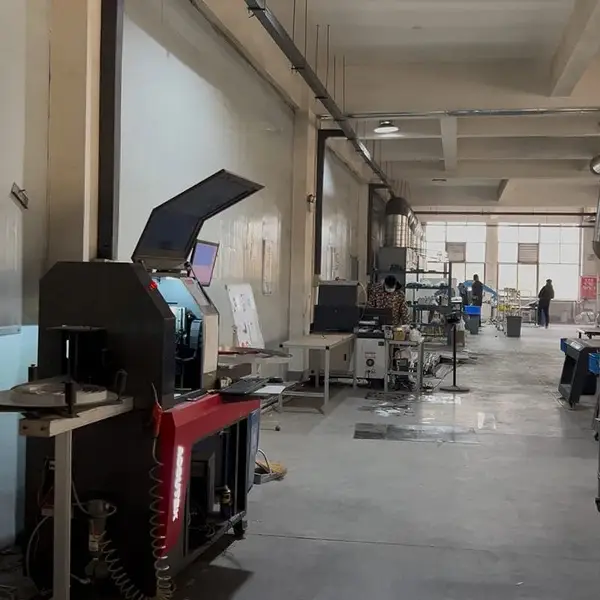
Real photo from our production floor — every sign we ship is made here.
Products mentioned or relevant to this topic — factory-direct, custom built.
From $24/letter · MOQ 1 piece · Flexible lead time · CE & UL certified · ships to 20+ countries
Custom sizes, colors, and finishes. Get a factory price in 24 hours.
Get a Free Quote Copy EmailWhatsApp +86 13865703472 · business@aochuangsign.cn