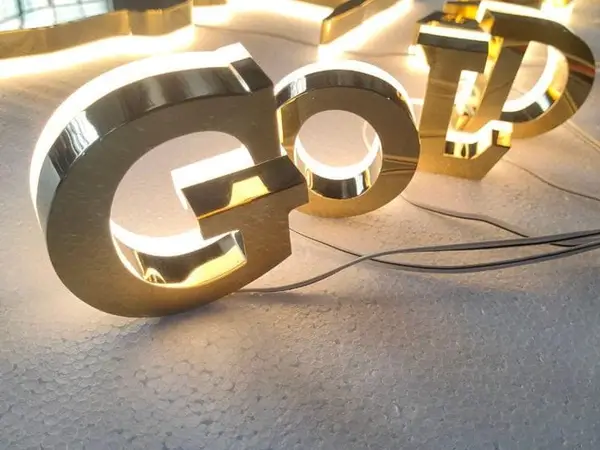
Before we compare machines, understand this: the metal choice is the foundation. The cutting method is just how you shape it. Our stainless steel letters are the industry standard for a reason — 304 grade contains 18% chromium and 8% nickel, giving it that 10+ year outdoor life. It's dense at 7.93g/cm³, which means it holds a sharp edge and resists bending. Aluminum is a third of the weight and naturally rust-proof, but it's softer — you'll see that affect cutting quality in a minute.
The ugly truth is most buyers obsess over the wrong spec. They ask about perfect 90-degree edges when they should be worried about thickness. For letters over 2.5 meters tall, that "cheap thin metal" deal you found online is going to flex and fail. We won't cut corners on gauge — and neither should you.
---Look, laser cutting is the default for sign letters for a reason. It uses a focused beam — either CO2 or fiber — to melt and vaporize the metal with a tolerance of ±0.1mm. That's surgical precision compared to the other methods. The kerf, or the width of material removed, is tiny. The heat-affected zone is minimal. You get a clean, squared edge that requires minimal grinding before finishing.
Here's the real-world scenario: You need a set of 40 stainless steel letters, each with sharp serifs and tight internal corners like the loop in an "R" or the counter in an "e." Laser cutting handles that easily. Plasma would leave slag. Water jet would struggle with the material thickness at that scale. For most channel letter fabrications between 100mm and 1.5 meters, laser is simply the best value.
At our 3,000m² facility in Lu'an, we run laser cutters daily. We cut 1.0-3.0mm stainless and 1.0-1.6mm aluminum for front-lit channel letters. The whole process — from MDF template verification to final trim — takes about 1-2 days for a typical batch. It's fast, it's precise, and it's the technology we recommend for 90% of our orders.
The problem with laser: it's a thermal process. It generates heat, and heat distorts thin metal. When you're cutting 1.0mm stainless in a design with lots of material removal, you can get micro-warping. It's usually invisible to the naked eye, but it becomes a problem when you're mounting large, flat letters flush against a wall. You'll see a slight bow in the center.
Also, laser cutting leaves a microscopic oxide layer on the cut edge. For outdoor signs that get direct exposure, this needs to be cleaned off before priming or powder coating. If the factory doesn't do this step — and many cheap shops skip it — your paint will peel within 18 months. This is a classic rookie mistake in this industry.
---Water jet cutting uses a high-pressure stream of water mixed with an abrasive garnet to erode the metal. No heat. Zero heat-affected zone. That means no micro-warping, no oxide layer, no discoloration on the cut edge. It's the only method that can cut multi-layered stacks of material in one pass, and it handles thick plates — up to 200mm — better than any laser you'll ever see in a sign shop.
Here's what the marketing materials won't tell you: water jet is slow. Slower than laser on thin sheet metal, and significantly slower on anything under 3mm. It's also messy. The abrasive garnet leaves a slightly rough, matte finish on the cut edge. Not bad, but it's not the smooth, glass-like edge of laser. And the taper — the slight angle on the cut wall — is more pronounced on thin materials.
We use water jet for specific jobs: when a client wants aluminum letters over 25mm thick with a solid, architectural look, or when we're cutting materials that are reflective or heat-sensitive. For the standard sign buyer, paying for water jet on a 2mm stainless letter set is a waste of money. You're paying for a premium feature you don't need. The speed difference alone would add 3-5 days to your lead time. We prefer to quote laser for most jobs and water jet only when the design demands it.
I've seen this go wrong: a client with a boutique hotel demanded "water jet cut, no exceptions" because they read it was "the best." They paid a 40% premium. The letters were beautiful... but they would have been identical with laser. Save your budget for better LEDs or thicker material. Water jet is a specialty tool, not a sign shop standard.
Unless your letters are massive — like 3 meters tall — or you need to cut thick, solid metal, skip the water jet. Laser will give you a cleaner edge at a lower cost and faster production. That's the truth.
---Plasma cutting uses an electrically conductive gas and a high-velocity jet of ionized gas to slice through metal. It's the brute force of the cutting world. A CNC plasma table can chew through 25mm steel like it's butter. It's dramatically faster than laser and water jet on thick plate. And the entry price for equipment is low — a decent plasma table costs a fraction of a comparable laser system.
But here's the catch: plasma edge quality is rough. You get a wider kerf, more dross (that hardened slag that clings to the bottom edge), and a significant heat-affected zone. The cut edge is often slightly angled — a condition called bevel. For sign letters, which are usually 1.0-3.0mm thick, plasma is the wrong tool. The edges require heavy grinding to smooth out, which adds labor time and reduces the crispness of the design. Sharp corners become rounded. Fine details get lost.
Plasma is a structural-steel tool, not a sign-shop tool. It's what you use to frame a building, not to make letters that sit on a facade. We don't use plasma for letters at our facility. If a factory proposes plasma cutting for your 2mm stainless channel letters, that's a red flag. They're either offering a hack solution or they're quoting from an automated system that doesn't understand material quality.
The only time I'd recommend plasma for signs is for large, industrial-type installations — think 4-meter-tall metal letters on a warehouse, or heavy-duty directional signs where the "letter" is really more utilitarian. In those cases, the rough edge is acceptable because it'll be covered by a thick coat of industrial enamel or left as an intentional "raw fabrication" aesthetic. But for standard storefront signage? No way.
---Let's break this down like a purchasing manager would. You're comparing three quotes. Here are the specs that matter:
Here's what nobody tells you about cost: the cutting method is maybe 5% of the total cost of your sign. The real money is in the dual-lit channel letters electronics, the acrylic faces, the installation. Choosing plasma over laser might save you $3 per letter on the steel... but it might cost you $10 per letter in grinding labor. Don't make a $200,000 equipment decision based on false savings.
The first lie is "(Insert cutting method) is the best, period." There is no universal best. There's only what's right for your specific design, your budget, and your timeline. The second lie is that expensive machinery guarantees quality. I've seen water jet cutters produce garbage because the operator didn't calibrate the abrasive flow. I've seen laser work go to scrap because someone rushed the nesting layout. The machine is a tool. The skill is the craftsman.
Ask your factory which method they recommend for your letter design. If they can't give a straight answer, or they push you toward the most expensive option without justification, walk away. A good factory will actively steer you away from an unnecessarily expensive process. We do it all the time — because a customer who trusts us with their budget is a customer who comes back.
The second lie is that "certifications mean everything." A factory can buy a CE mark. The real proof is in the aging test. Our standard production process includes an 8-12 hour burn-in test on every LED sign. We simulate 24 hours of "on" time before it ships. That catches the modules that would've died on your wall after 60 days.
---Look, all cutting technologies are not created equal when paired with different metals. Here's the straight dope:
Stainless 304 is the gold standard for signs. It laser-cuts beautifully, holds an edge, and with a #4 brushed finish looks professional from any angle. For our back-lit halo letters, laser is a no-brainer. The precise edges are essential for the acrylic return to fit flush.
Aluminum is soft and gummy. Laser cuts it well, too, but there's a trick: you need the right gas pressure. Too much and you get a fuzzy edge. Too little and the bottom re-solidifies. Choose a factory that knows this. When cut right, aluminum letters are lightweight, rust-proof, and ideal for interior signage or walls where weight is a concern.
316 stainless — that's the marine grade with 2-3% molybdenum — laser cuts just as well as 304, but it costs 20-30% more. If your sign is within 8-10 km of the ocean, it's worth the premium. If you're in a landlocked state, save your money. Choose 304.
---We run laser cutters. We don't operate a water jet or plasma for sign applications. We've evaluated the cost-benefit for both and found them lacking for our product line. This isn't an equipment deficiency — it's a strategic choice. If a sign calls for water jet cutting, we'll partner with a trusted local shop. But that's rare. Over 90% of the metal letters we produce are laser cut.
Our production process is standardized: Design confirmation takes about a day. Our CNC laser cuts with ±0.1mm precision for a day or two. Then our welders TIG weld and grind. We anneal, polish, and prep the surface. Next, the acrylic faces get CNC-cut. Our LED assembly team installs the modules. We seal everything with neutral silicone for waterproofing, age-test every sign for 8-12 hours, and do a 100% QC inspection before packaging. Total production time: about 5-15 days. That speed is possible because we stick to a reliable cutting method.
But we're also honest about what we can't do. We can't cut 100mm thick solid steel letters and promise they'll look perfect. We can't handle a custom design that would take 40 hours of welding without giving you a reality check on the cost. Instead, we'll show you how to get the same visual impact with a smarter design that fits your budget and our capabilities.
---Let's get down to real numbers. Our factory-direct pricing for laser-cut stainless steel letters in the non-illuminated category is $15-40 per letter. A full set of stainless steel letters for a storefront typically costs $300-800 wholesale. The average U.S. retail installed price is $200-700 *per letter* for front-lit channel letters. That's a massive margin because the contractor is paying for markup, labor, and local compliance.
That installed cost includes things we never see: permits, structural calculations, an electrician, a crane truck, and a crew of two installers. That's real. That's needed. But what you want to eliminate is the "brand tax" of buying through a middleman. When you import factory-direct, you capture that 50-65% product saving. The shipping is on top — $4-12/kg for air freight or $80-200/m³ for sea. And yes, the US Section 301 tariff on Chinese signs is about 30%. All in, you're still ahead of the US retail markup.
You should also expect this: a factory like ours has a MOQ of 1 piece. We can make one letter if that's what you need. But the pricing per unit drops dramatically at quantity because the laser setup cost and the LED module packaging scale. Ask us for a tiered quote at 10, 50, 100 pieces. That's where the smart money is.
---Don't ask "What's your cutting method?" — that's a basic question. Ask these:
For 95% of sign projects, laser cutting is the answer. It's precise, fast, and affordable. Water jet is a specialized tool for thick or heat-sensitive materials. Plasma is for structural steel, not display letters. If you're a sign shop owner or a contractor, partner with a factory that's honest about this and doesn't try to upsell you on unnecessary technology.
Here's what nobody tells you: the relationship with your factory is more important than the machine they run. A good factory will tell you when your design is over-engineered. They'll warn you when your color choice will fade in the Arizona sun. They'll recommend a cheaper alternative that looks identical. That honesty is worth more than the difference between a laser and a water jet.
We're Aochuang Sign. We've been fabricating signs since 2010 in Lu'an, Anhui, equipping 50+ skilled workers and exporting worldwide. We're not the biggest factory you'll find, and that's by design. We want to know your name, not just your PO number. When you're ready to get a quote for your project — whether it's a simple front-lit set or a complex double-sided acrylic light box — send us your design files. Ask us the hard questions. We'll give you straight answers, a fair price, and a sign that will outlast your lease.

Real photo from our production floor — every sign we ship is made here.
Products mentioned or relevant to this topic — factory-direct, custom built.
From $24/letter · MOQ 1 piece · Flexible lead time · CE & UL certified · ships to 20+ countries
Custom sizes, colors, and finishes. Get a factory price in 24 hours.
Get a Free Quote Copy EmailWhatsApp +86 13865703472 · business@aochuangsign.cn
See pricing, specs, and get a free quote for the sign type you need. Built in our factory, shipped worldwide.