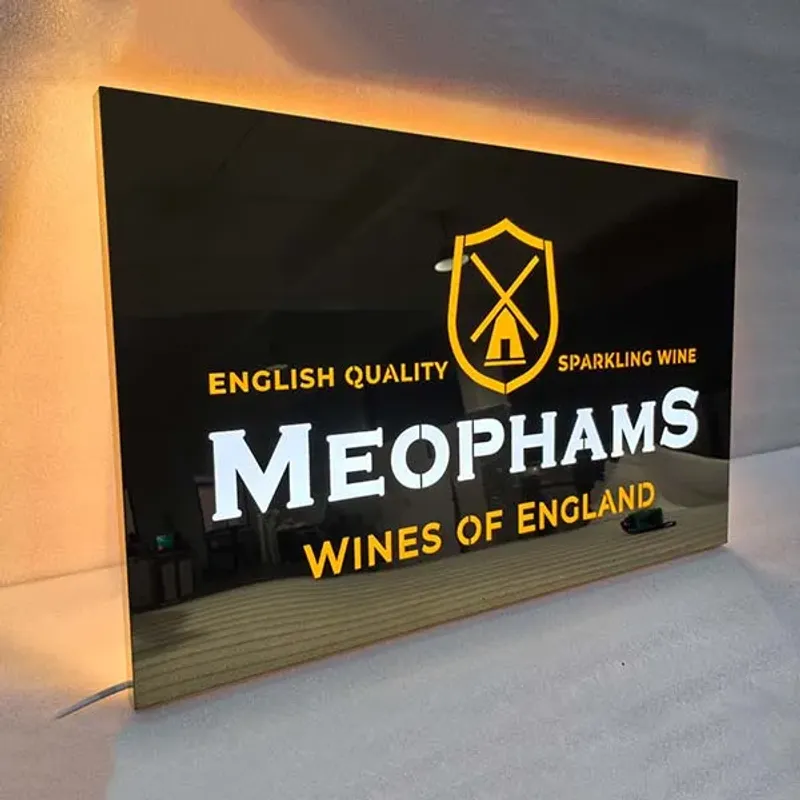
Eleven at night and I can still smell acrylic dust and solder fumes on my shirt. So here's the truth about LED backlit signs, straight from someone who's burned his hands on both the material and the promises.
Look, every backlit sign I've pulled apart in 15 years breaks down the same way: a light source, a diffusion face, and a housing that either kills heat or cooks the thing. When you order acrylic LED letters, you're really speccing three things: module quality, face transmittance, and heat escape.
The LED engines are SMD 2835 modules running 100-150 lumens per watt, with an L70 life of at least 50,000 hours. Fluorescent tubes flicker in cold weather, buzz after six months, and lose output because the phosphor degrades. LEDs don't care about any of that.
But they do care about the acrylic face, because that face is the only thing between a hot spot and a smooth, even glow. Good UV-resistant acrylic from Mitsubishi or Degussa gives you 90-92% light transmittance and lasts 5-8 years outdoors. Cheap domestic acrylic? You'll be pulling it off the wall in 1-2 years when it starts yellowing like an old tennis ball.
Here's what nobody tells you: face thickness is a cost lever, not a quality lever. A 3mm acrylic face cuts 92% light output. A 2mm face cuts 90%. Your customer won't notice the 2% difference, but they'll definitely notice the 40% cost bump on a large-format sign. For any face over 2.5 meters, use 5mm—not because it's brighter, but because it won't bow in wind.
The ugly truth is most sign shops spec the cheapest 2mm domestic acrylic and call it "premium" because the customer can't tell until it yellows in 18 months.
Look, the first question I ask any buyer is whether they want the face lit or the wall lit.
Direct backlit means LEDs sit behind the face, pumping light through the acrylic. Edge-lit means LEDs run around the perimeter and the face acts as a light pipe.
Direct backlit wins for large panels because you can space modules and get even, punchy illumination. Edge-lit is thinner, uses less power, and looks sharp in a shallow return. But edge-lit falls flat in the middle of a 10-foot sign. That's why our back-lit halo letters use a direct array behind the face plus a separate halo ring—two light paths, one sign.
If you really want to spec evenness, ask for an Lmin/Lmax ratio of 0.7 or better across the sign face. That means the dimmest spot measures at least 70% as bright as the brightest spot. You check it with a luminance meter at nine points, not by squinting and calling it good. Anything below 0.7 and you'll see hotspots through the acrylic, especially at night.
Edge-lit has its place—skinny letters, interior lobbies, shallow returns—but don't put it on a 10-foot storefront sign and expect it to punch through afternoon sun. I've replaced too many of those jobs.
I've seen this go wrong: a hotel in a salt-air zone specced 304 stainless steel for its 304 stainless steel letters, saved roughly 25%, and three years later the welds are bleeding rust because the chloride ate through the nickel layer.
Here's why material matters. 304 stainless has 18% chromium and 8% nickel, good for 10+ years outdoors in normal conditions. 316 stainless adds 2-3% molybdenum and costs 20-30% more, but it'll give you 15+ years in coastal or industrial exposure.
For a strip mall in Ohio, 304 is fine. For Miami Beach, pay for 316 or you're replacing letters in three years. Aluminum is another option—it weighs one-third of steel, naturally rust-proof, and lasts 8-12 years outdoors with a good powder coat.
Here's what nobody tells you: your power supply is the weak link, not the LED.
The modules might hit L70 at 50,000 hours, but a cheap driver will cook itself in 12 months. Quality LED modules from Samsung, Osram, or Blueview hold 5+ years in the real world. Cheap no-name modules? 12-18 months before you're renting a lift to fix a dead letter. We warranty LED modules for 2 years and power supplies for 1, and that difference isn't an accident.
Look, SMD 2835 modules run 100 to 150 lumens per watt. That's the industry standard for a reason.
SMD 5730 chips push 40-60 lumens per chip and are the highest brightness you'll find in commercial backlit signs, but they run hot, so thermal management matters. SMD 5050 is RGB-capable and fine if you're doing color-changing effects.
The ugly truth is lumens per watt is a lab number. On a 120°F rooftop in Phoenix, real output drops, and cheap modules degrade to 70% brightness in 18 months. Quality Samsung, Osram, or Blueview modules hold 5+ years before any visible dimming.
If a supplier says they have CE and UL, ask for the certificates with today's date.
CE marking costs 20,000-50,000 RMB and takes 2-8 weeks. UL 48 is $4,000-15,000 and 4-9 months with quarterly audits. ETL is a UL alternative that runs 10-30% cheaper. Most factories will show you a JPEG from 2019. That's not compliance, that's decoration.
For outdoor backlit signs in the US, you need NEC Article 600 compliance and a minimum IP65 rating. IP65 means dust-tight and protected from water jets from any direction. That rating won't save your sign from a Florida hurricane.
That's the second lie I hear every week, right after "CE is included."
Here's what nobody tells you: heat kills LEDs, not cold.
Every decent backlit sign uses an aluminum frame or extrusion to pull heat off the LED board. Aluminum weighs one-third of steel and naturally rust-proof, 8-12 years outdoor, common thickness 0.040-0.063 inches. If you bolt LED modules directly to a painted steel box with no thermal path, you've built an oven. The solder joints on good modules are shiny silver—proper lead-free. Dull gray joints mean the modules won't last 18 months. That's the quickest visual test I know.
IP ratings are not a waterproof guarantee. IP65 is dust-tight and water jets from any direction. IP66 is powerful jets, for coastal or washdown. IP68 is submersible, overkill unless your sign is mounted in a splash zone. For standard outdoor backlit signs, IP65 is the minimum.
Vibration is the forgotten killer. Large signs on poles flex in wind. I've seen this go wrong: a 20-foot lightbox shipped in bubble wrap and thin cardboard arrived with a bent return after a forklift "kissed" it. Four days of repair on a sign that cost $1,200. Use a plywood crate and interior foam.
And seal every seam with neutral silicone. Not acid-cure, not bathroom caulk. Neutral silicone. You'll thank me in year two.
Look, I've watched sign shops pay $800 for a front-lit letter from a domestic fabricator. Same 304 stainless, same Samsung LEDs.
We ship that front-lit channel letter for $120 factory-direct from Lu'an. Back-lit halo letters run $35-120 per letter factory, while US retail installed prices hit $400-1,000. That's 50-65% savings on product, not a rounding error.
But cheap factory-direct signs are cheap for a reason if you don't demand QC.
Here's what nobody tells you: real quality control isn't a checklist, it's a production process. You should require laser cutting at ±0.1mm, TIG welding, grinding and polishing, CNC acrylic face cutting, LED assembly, sealing with neutral silicone, an 8-12 hour aging test, 100% QC inspection, and export packaging in foam, carton, and plywood crate.
If a factory can't show you that 10-step process, walk.
The ugly truth is some "factories" are just trading companies with a laptop and a WhatsApp account. Ask for a video of the aging test room with today's date. No video. No deal.
Our MOQ is 1 piece and lead time is about 5-15 days. If someone promises fully UL-listed signs in 3 days, they're lying. Real production takes about 5-15 days, no matter how many cups of tea you buy. Warranty should be 2 years on LEDs and 1 year on the power supply. If someone offers 10 years on everything, ask whether they'll still answer your email in year three.
Three things I still get asked at 11pm:
Q: "Can you send a sample before I place a full order?" Yes, MOQ is 1 piece. Order one letter as a sample. You'll pay express shipping of $30-100 and wait about 5-15 days. If a factory won't send a sample, move on.
Q: "What's the difference between UL and ETL?" ETL is a UL alternative that runs 10-30% cheaper and is accepted by most US inspectors. Both require quarterly audits. But neither matters if you're installing a sign that an inspector hasn't approved. Check NEC Article 600 before you quote.
Q: "Can I use IP65 signs near the ocean?" IP65 handles dust and water jets. It does not handle salt fog. Use 316 stainless and IP66 minimum for coastal installs. I'm tired of explaining this.
Q: "Why is sea freight so much cheaper but slower?" Sea freight LCL costs $80-200 per cubic meter and takes about 65 days. Your crate gets handled 6-8 times between our dock and yours. Every touch is a chance for damage. Pay for the plywood crate or don't complain when it arrives dented.

Real photo from our production floor — every sign we ship is made here.
Products mentioned or relevant to this topic — factory-direct, custom built.
From $24/letter · MOQ 1 piece · Flexible lead time · CE & UL certified · ships to 20+ countries
Custom sizes, colors, and finishes. Get a factory price in 24 hours.
Get a Free Quote Copy EmailWhatsApp +86 13865703472 · business@aochuangsign.cn