You can sell $18 pasta all night, but if the sign on the strip mall is dead or flickering, you're invisible after dark. Restaurant facades aren't decoration. They're the handshake.
I've watched owners drop six figures on interiors and then argue over a $400 sign budget. That's backwards. The sign is the first thing a hungry driver sees. The food maybe gets them back. The sign gets them in the door the first time.
Here's the number that matters: a front-lit channel letter from our factory runs $20-80 per letter. A domestic shop charges $200-700 per letter for the same thing. That's a 50-65% product savings before you even touch installation.
When you're spec'ing a restaurant facade, you aren't choosing between "LED" and "neon." You're choosing between a sign that pays for itself in a month and one that becomes a maintenance line item forever. But not all LED channel letters are equal. And neon isn't dead—it's just been replaced by LED neon flex for 90% of restaurant work, for reasons I'll get into.
LED channel letters are basically metal cans—usually aluminum or 304 stainless—with an acrylic face and LED modules mounted inside. If you're ordering front-lit channel letters for a storefront, you're getting a sealed, self-contained unit. The face is 2mm or 3mm acrylic, which lets through 90-92% of the light. The returns are bent metal. The light comes from SMD 2835 modules, the industry standard, putting out 100-150 lumens per watt.
Here's what nobody tells you: the acrylic face thickness barely changes brightness. 3mm cuts 92% light output. 2mm cuts 90%. Your customer won't notice the 2%, but they will notice the 40% cost bump for thicker material. Use 5mm when the letter itself is over 2.5 meters tall, not because you want it brighter.
Real glass neon is a different animal: gas-filled glass tubes, high-voltage transformers, fragile as hell in shipping. What most restaurants mean when they say "neon" today is LED neon flex—a silicone or PVC tube with tiny LEDs inside, bent to look like the old glass stuff. We make LED neon flex signs for restaurants that want that script look without the transformer hum and the breakage.
Operation difference? Channel letters run on low-voltage DC drivers. Neon flex runs on 24V drivers too, usually. Real neon runs at 3,000-15,000 volts and needs a transformer that can kill you if you're stupid. Guess which one your local health inspector likes better.
Look, if you're buying five or six letters for a bistro, factory-direct LED channel letters will run you $100-400 total from China. Domestic fabricated? Same letters, $1,000-4,200 installed. That's not markup. That's labor and overhead and three middlemen. We ship with a 2-year LED warranty and a 1-year power supply warranty, and the lead time is about 5-15 days. MOQ is 1 piece.
Neon flex wall art runs $30-200 per sign from the factory, depending on size and complexity. Real glass neon from a local shop? Easily $150-600 for a simple script, plus a transformer box you have to hide somewhere code-compliant.
Installation is where neon dies. Real glass neon needs a high-voltage electrician in most jurisdictions. Channel letters need a low-voltage run and a driver tucked into a raceway. If you're retrofitting a facade, back-lit halo letters actually hide the power supply behind the letter itself—cleaner install, no ugly conduit.
The ugly truth is most restaurant owners forget UL/CE until the fire marshal shows up. UL 48 certification runs $4,000-15,000 and takes 4-9 months. ETL is cheaper by 10-30%. Our factory has CE and RoHS, and we can build to NEC Article 600 for the US. Ask any supplier for the certificate with today's date. If they sweat, walk.
Freight matters too. Sea LCL runs $80-200 per cubic meter and takes about 65 days. Air is $4-12/kg and lands in about 10 days. Express for small stuff: $30-100 and about 5-15 days. US Section 301 tariff tacks on roughly 30%. When a domestic shop quotes you $800 a letter, that's the installed price, not the product. Factory-direct product price for front-lit is $20-80. Do that math.
Here's what nobody tells you: a 6-letter channel sign with 60 SMD 2835 modules might pull 35-60 watts. That's less than a bathroom vanity bulb. A real neon sign the same visual size can pull 300-600 watts because the transformer itself loses energy as heat, and the tubes aren't efficient.
Do the math. 50 watts, 12 hours a day, 365 days: 219 kWh a year. At $0.15/kWh, that's $32.85. A 500-watt neon sign: 2,190 kWh, $328.50. That's a tenfold difference. Over five years, the LED sign pays for itself on energy alone, twice over.
LED neon flex is closer to channel letters—maybe 60-100 watts for a typical window script—but real glass neon is an energy pig. The driver in an LED sign lasts 3-5 years and costs $15-40 to replace. A neon transformer lasts 2-4 years and costs $80-200, plus a service call because nobody stocks them locally anymore.
I've seen this go wrong: a taco joint in a humid strip mall bought real glass neon because the owner loved the "authentic look." Eighteen months later, the tubes had cracked, the transformer rusted, and the sign buzzed louder than the exhaust fan. Cost to repair: $900. We replaced it with stainless steel letters and front-lit faces for $210 and it's still running four years later.
Quality LED modules—Samsung, Osram, Blueview—have an L70 rating of ≥50,000 hours. That's 11 years at 12 hours a day. Cheap modules? 12-18 months before they flicker and die. Look at the solder joints. Dull gray = won't last 18 months. Shiny silver = proper lead-free solder. I check this first when a "factory" sends me samples.
Grease is the silent killer. It coats the driver vents, traps heat, and kills power supplies in 2 years. Restaurant facades are greasy by nature—exhaust fans blow a fine film onto everything above the roofline. That's why you spec sealed drivers and clean the sign at least twice a year.
Driver replacement is a $15-40 part. But the labor to get a bucket truck out there is a whole different line item. High-access service calls are where sign maintenance budgets go to die. That's why you don't buy cheap modules to save $8 per letter. Wrong move.
Neon flex has a real lifespan of 3-5 years outdoors. The silicone yellows, the PVC hardens, the LEDs start failing at stress points. Channel letters with UV-resistant acrylic from Mitsubishi or Degussa go 5-8 years before the face even thinks about yellowing. Domestic acrylic? 1-2 years and it looks like a smoker's teeth.
Weather durability: stainless 304 letters have a 10+ year outdoor life. If you're within five miles of salt water, upgrade to 316 stainless—it has 2-3% molybdenum and costs 20-30% more, but you won't be replacing letters in 3 years. For Miami Beach, pay for 316. For Ohio, 304 is fine. And IP65 is the minimum outdoor rating. That rating means water jets from any direction. It doesn't mean your sign survives a Florida hurricane.
Look, a steakhouse wants warm, 3000-3500K light. A fast-casual burger place wants 4000-5000K neutral. A highway-facing seafood shack might want 6000-6500K cool so it cuts through fog. Channel letters let you dial the color temperature to the brand. Neon flex also comes in colors, but real glass neon has that specific glow that's hard to replicate.
Most customers can't tell the difference between real neon and good LED neon flex from across the street. What they do notice is consistency. Channel letters with 2835 modules give uniform light across the face. Cheap neon flex gives hot spots at the bends.
For a high-end restaurant, I'd spec back-lit halo letters before either. They throw light onto the wall behind the letter—classy, architectural, works with masonry and wood. For a fun, playful bistro script? LED neon flex is the right call, but treat it like a 4-year consumable, not a forever sign.
Don't forget the facade itself. If you're mounting on a decorative surface, check the weight. Aluminum returns weigh a third of steel. Stainless letters weigh 7.93 g/cm³ and look premium, but you need proper anchors. I've seen a 40-pound sign pull out of drywall because nobody hit a stud.
Choose LED channel letters when you want a permanent, low-maintenance, code-compliant sign for a storefront that needs to look sharp for 8-10 years. They're the workhorse. They don't care about grease, rain, or the occasional power surge. They're also the only choice if you're in a jurisdiction that enforces NEC Article 600 strictness—most do for exterior commercial signs.
Choose neon—really LED neon flex—when the brand needs that script, bendy, vintage feel, or when the application is decorative and the sign isn't the primary identifier. A window sign, a patio accent, a "Cocktails" script inside the bar. It's cheaper up front for small stuff, but it's not a 10-year asset.
Real glass neon? I'll say it once. If you're not running a historic restoration or an art installation, don't. The maintenance alone will eat your profit. The transformer hum, the breakage, the high-voltage inspection. Most sign shops stopped making it except for specialty work for a reason.
If you're sourcing factory-direct, specify this: 304 stainless returns (or 316 for coastal), 3mm acrylic face if letters are over 2.5m, Samsung or Osram LED modules, IP65 minimum, neutral silicone sealing, and an 8-12 hour aging test before shipping. Our factory does all that for $20-80 a letter. That's not a sales pitch. That's what it costs when there are no middlemen.
Is LED neon flex as bright as real glass neon?
No. Real neon has a specific luminous tube glow that flex approximates. For a window sign, nobody notices. For a facade 30 feet from the road, use channel letters. They'll outshine both.
Do I need UL certification for a restaurant facade sign?
In most US jurisdictions, yes, or ETL. The inspector wants a listed sign, not a CE-only import. UL 48 runs $4,000-15,000 and takes months. Don't buy from a factory that can't provide a cert with today's date.
How long before I have to replace the LEDs?
Quality modules: 50,000 hours, roughly 10-11 years at restaurant hours. Cheap modules: 12-18 months. If the quote looks too good, someone put junk LEDs in the letters.
Can I install LED channel letters myself?
If you're licensed and know low-voltage wiring, maybe. If not, hire a sign contractor. The high-access work and the power connection get people hurt, not the letters.

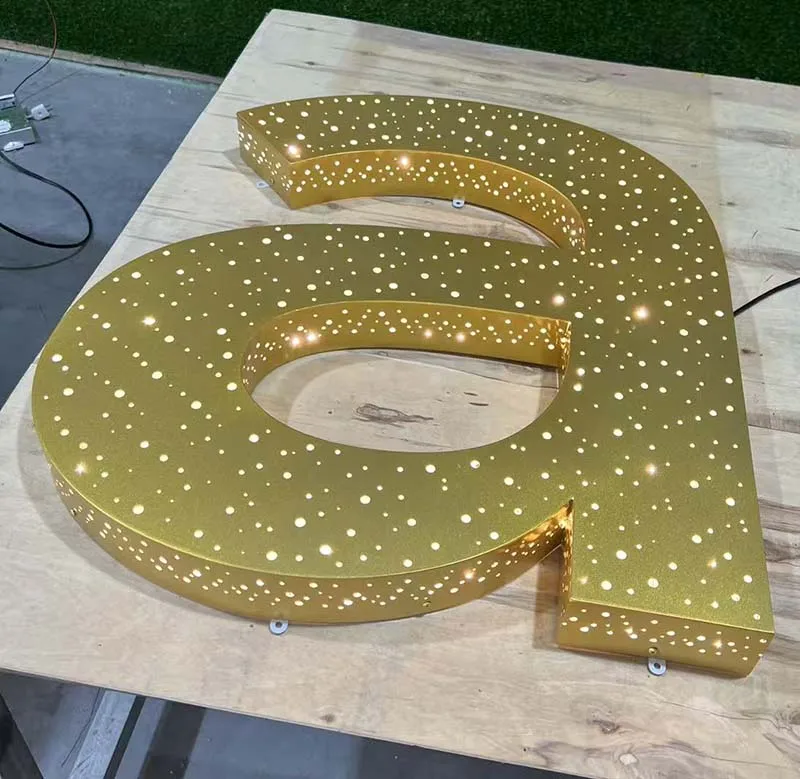
Real photo from our production floor — every sign we ship is made here.
Products mentioned or relevant to this topic — factory-direct, custom built.
From $24/letter · MOQ 1 piece · Flexible lead time · CE & UL certified · ships to 20+ countries
Custom sizes, colors, and finishes. Get a factory price in 24 hours.
Get a Free Quote Copy EmailWhatsApp +86 13865703472 · business@aochuangsign.cn