I've been in this trade since before LED modules were even a thing. I've watched guys rip out perfectly good neon and replace it with cheap LEDs because some sales rep told them the energy savings would be "massive." Then the modules died in 14 months, and they were back paying for a whole new sign.
The ugly truth is: LED energy savings are real, but they aren't magic. A standard front-lit channel letter sign with white LEDs uses about 30-50 watts per letter. Compare that to a neon sign that can pull 100-200 watts per foot of tube. Yeah, you save. But it's not "pay off your sign in six months" territory unless your utility rates are insane or you're running 50 signs 24/7.
So let's cut the crap. I'll walk you through the actual math, the hidden costs, and the shortcuts that will turn your ROI into a loss. You're a business owner. You need numbers, not hype.
Look, most people start with the wrong question. They ask "how much will I save?" without knowing what they're spending now. Here's what nobody tells you: a typical LED channel letter uses SMD 2835 modules running between 100-150 lumens per watt. That's the industry standard chip. For a letter that's 18 inches tall, you're looking at 8-12 modules per letter, each drawing about 0.24 watts. So a 10-letter sign with a transformer and some losses probably pulls 150-200 watts total.
Compare that to a neon version of the same sign – each foot of neon tube burns around 20-30 watts just for the tube, plus transformer inefficiency. A 10-foot run of neon can draw 300-500 watts. The LED sign uses half the power, easy.
But here's the real trick: the difference only matters if the sign is on a lot. If you're a mom-and-pop shop that turns the sign off at 10 PM, your annual electricity for that LED sign is about $150-200 at $0.12/kWh. Neon would be $350-500. You save $200-300 a year. On a $3,000 sign, that's a 10-12 year payback from energy alone. No business owner buys a sign that takes a decade to break even on electricity.
The ROI comes from two other places: maintenance and lifespan. And that's where most people get burned.
Here's what nobody tells you: cheap LED modules have a real lifespan of 12-18 months. Not the "50,000 hours" printed on the box. That's L70 rating – meaning after 50,000 hours, the light output drops to 70% of original. But cheap modules? They die completely long before that. Bad solder joints, no conformal coating, no surge protection. I've seen whole signs go dark in two years.
I've seen this go wrong: a car dealership buys a big LED sign from a local fabricator who used bottom-barrel modules. Three years later, half the letters are flickering or dead. They call the installer, who quotes $2,000 to re-lamp the whole thing. That just wiped out any energy savings they thought they had.
Quality matters. Samsung or Osram LED modules with proper drivers will easily run 5+ years. Yes, they cost 30-50% more upfront. But you don't pay a $2,000 service call. That's the math most people skip.
Also – your power supply. A cheap Mean Well clone might last 2 years in a hot sign cabinet. A real Mean Well or quality Chinese brand (like those from well-known factories) should run 6-8 years. Warranty: most good factories give 2 years on LEDs, 1 year on power supplies. If someone offers 5 years on a cheap sign, ask to see the certification. Watch them squirm.
I've watched sign shops pay $800 for a front-lit stainless steel letter from a US fabricator. Same 304 stainless, same Samsung LEDs. We ship that letter for $120 from our factory in Lu'an, China. We've been doing this since 2010 – 3,000 square meters, 50+ workers, exports worldwide. CE, RoHS, ISO 9001 certified. Not a fly-by-night operation.
Here's the breakdown: US retail installed runs $200-700 per letter for front-lit, $400-1,000 for halo-lit. Factory direct from us: $20-80 per letter for front-lit, $35-120 for halo. That's 50-65% savings on the product cost. Add shipping – air freight about $4-12/kg, sea about $80-200 per cubic meter LCL. Lead time about 5-15 days. Section 301 tariff adds about 30%, but even after that, you're paying less than half of domestic.
The ugly truth is: you can land a 10-letter stainless halo sign for around $1,500-2,000 (including shipping and tariff) versus $6,000-10,000 from a local shop. That's a real ROI – not from energy savings, but from upfront procurement.
Stop using online calculators that ask for "total watts" and assume you know. Here's the manual method:
Example: 10 letters, 10 modules per letter at 0.24W = 24W. Plus 20% = 28.8W. Run 4,380 hours = 126 kWh/year. At $0.12/kWh = $15.12 per year. That's it. For a whole sign. If you're replacing neon, you save about $15-30 per year per letter. Not life-changing.
But if you're a franchise with 50 locations and each sign saves $300/year on electricity and $500/year on maintenance because you used quality LEDs and stainless steel? That's $40,000 a year. Now you're talking.
Here's what nobody tells you: the biggest energy savings come from using a timer or photocell. Most signs run all night when the parking lot lights are already enough. Shut it off at midnight, save 50% of your electricity cost with zero equipment change.
Acrylic: Mitsubishi or Degussa acrylic gives 90-92% light transmittance and stays clear 5-8 years. Cheap domestic acrylic? Yellow in 1-2 years. You'll be ripping that face off in 3 years. For letters over 2.5 meters tall, you need minimum 5mm thickness or the face bows.
Stainless: 304 is fine for most of the US – inland, dry climate. 316 (marine grade, 2-3% molybdenum) is for coastal areas or industrial. Costs 20-30% more. For a strip mall in Ohio, 304 is overkill. For Miami Beach, you need 316 or those letters will pit in 3 years.
LED chips: SMD 2835 is workhorse, 100-150 lm/W. SMD 5730 is brighter but runs hotter – use only for large channel letters where you need extra punch. SMD 5050 is for RGB color. Don't let a supplier upsell you on "ultra-bright" unless you actually need it for highway visibility.
IP rating: IP65 means it can take rain from any angle. It does NOT mean beach or hurricane. For coastal, you need IP66 or IP68. And that's not just the housing – the sealant has to be neutral silicone, not that cheap polymer that dries out in 2 years.
Do I really need UL certification for my sign?
If you're in the US and an insurance adjuster ever looks at your sign after a fire, yes. UL (or ETL, which is 10-30% cheaper) is required by code in most jurisdictions. A UL listing costs $4,000-15,000 and takes 4-9 months. A lot of Chinese factories don't have it – we don't for every product because it's expensive. We offer CE, RoHS, ISO 9001. But for US electrical inspection, you need UL. Don't let anyone tell you CE is enough – it's not a substitute.
Can I just buy cheap LEDs from Alibaba and save more?
Sure, if you like replacing your sign every 18 months. I've seen "500,000 hour" modules that died in 11 months. Look at the solder joints – dull gray means lead-free solder but low quality. Shiny silver is proper. Cheap modules use low-grade chips and no surge protection. You'll spend the savings on service calls. Buy from a factory with a real warranty and references. Ask for a CE certificate with today's date – if they can't produce it, they're full of it.
My local sign contractor says factory-direct signs are risky. Should I listen?
Of course he says that – he doesn't want to lose your business. Yes, shipping a sign from China has risks. LCL freight means your crate gets handled 6-8 times. Damage happens. But a reputable factory uses foam + carton + plywood crate, and they'll compensate you if it's damaged. The real risk is dealing with a factory that disappears after payment. We've been in business since 2010, 50+ workers, 3,000 sqm. We export worldwide. Ask that contractor: "Can you match the price and quality of a 2mm acrylic face with Mitsubishi material and Samsung LEDs for half the cost?" No, he can't.
Is IP65 good enough

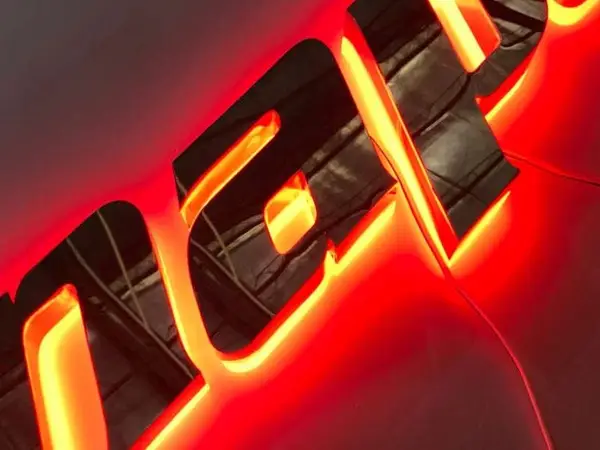
Real photo from our production floor — every sign we ship is made here.
Products mentioned or relevant to this topic — factory-direct, custom built.
From $24/letter · MOQ 1 piece · Flexible lead time · CE & UL certified · ships to 20+ countries
Custom sizes, colors, and finishes. Get a factory price in 24 hours.
Get a Free Quote Copy EmailWhatsApp +86 13865703472 · business@aochuangsign.cn
See pricing, specs, and get a free quote for the sign type you need. Built in our factory, shipped worldwide.