I’ve been in the sign industry since before white LEDs were reliable. I’ve seen neon shops close. I’ve watched fluorescent channel letters fade to a sickly yellow in under two years. And I’ve pulled apart cheap LED modules that failed after 14 months—leaving a client with a dark sign and a $1,200 emergency service call.
The promise of LED signs is real. But the ROI math is often misrepresented. Here’s the hard truth: most manufacturers quote energy savings based on perfect lab conditions. They assume 24/7 operation at full brightness. They ignore the dimming schedule you’ll actually use. And they never mention the voltage drop that makes a 50-foot sign run hotter than it should.
This article gives you the actual formula. Real numbers from actual production. And a reality check on where the savings go sideways.
Forget the unnecessary details. Here’s the calculation that matters:
Annual Electricity Cost = (Total System Wattage × Hours per Day × Days per Year × Your kWh Rate) ÷ 1,000
Let me make this concrete. A typical front-lit channel letter sign for a retail storefront uses about 150 watts at full brightness. That’s with SMD 2835 LEDs, the industry standard at 100-150 lm/W. Run it 12 hours a day, 365 days a year. In the US, the average commercial electricity rate is $0.12 per kWh (source: U.S. Energy Information Administration, 2023).
(150W × 12hrs × 365 days × $0.12) ÷ 1,000 = $78.84 per year
Now compare that to an equivalent neon sign. A typical neon channel letter setup draws 400-600 watts. Same usage pattern? You’re looking at $210 to $315 annually. That’s a savings of $130 to $236 per year—just on one sign.
But here’s where most calculators mislead. They use the LED module’s advertised wattage, not the actual draw after the power supply. A cheap Chinese driver can waste 15-20% as heat. Always measure at the plug with a Kill-A-Watt meter. I’ve seen a “100W” sign pull 127W at the wall. That 27% difference undermines your ROI projection.
Payback period is simple: (Incremental cost of LED sign) ÷ (Annual energy savings + Maintenance savings).
Let’s run a real example. You’re replacing a 500W neon sign with a 150W LED sign. The LED sign costs $1,200 more upfront. Your annual energy savings are $210 (based on 12hr/day at $0.12/kWh). Plus, neon transformers fail every 3-5 years at $200-400 a pop. LEDs have a 2-year warranty on the modules and 1 year on the power supply from our shop—but quality units from Aochuang Sign with Samsung or Osram chips last 5+ years realistically.
Annual maintenance savings: $80 (average, accounting for fewer service calls and part replacements).
Payback = $1,200 ÷ ($210 + $80) = 4.1 years
That’s solid. Most business owners see payback in 3-5 years. But here’s the contrarian insight: if you oversize or over-light the sign, you push that payback to 6+ years. A sign that’s 30% brighter than needed wastes electricity and shortens LED lifespan. Smart dimming sensors can cut energy costs by an additional 40%. That drops payback to under 3 years. In summary, with maintenance savings factored in, the LED sign pays for itself in just over 4 years, demonstrating a clear ROI through reduced energy and upkeep costs.
I’ve installed all three. Here’s the unvarnished truth in a table you can show your clients.
| Metric | LED (SMD 2835) | Neon | Fluorescent |
|---|---|---|---|
| Power draw per linear foot | 4-8 watts | 12-20 watts | 8-15 watts |
| Lifespan (L70) | 50,000+ hours | 8,000-15,000 hours | 10,000-20,000 hours |
| Brightness per foot (nits) | 500-1,200 | 300-600 | 400-700 |
| Color rendering (CRI) | 80-90+ | 60-75 | 70-80 |
| Annual energy cost (12hr/day) | $0.35-0.70 | $1.05-1.75 | $0.70-1.31 |
| Replacement part cost | $15-40 per module | $50-120 per transformer | $20-60 per ballast |
| Outdoor durability | IP65 minimum | Fragile, gas leaks | Moisture sensitive |
The numbers don’t lie. But the real kicker is maintenance. Neon signs require a skilled glass bender for repairs—if you can find one. Fluorescent ballasts fail in humid environments. LEDs? Swap a module in 10 minutes. That labor cost difference alone can be $150-300 per service call.
Every sign shop owner has a client who says “the LED sign was supposed to save me money.” Then they got the electric bill and it was higher than expected. Here’s what they missed:
The thing is, these costs can eat up 20-30% of your first-year savings. Always build them into your proposal.
Let me walk you through a real client. A retail clothing store in suburban Chicago. They replaced a 12-foot neon channel letter sign (500W total) with a 150W LED sign from our factory. Here’s the 10-year TCO:
| Cost Category | Neon | LED | LED Savings |
|---|---|---|---|
| Initial sign cost (installed) | $3,500 | $4,700 | -$1,200 |
| Annual electricity (12hr/day, $0.12/kWh) | $262.80 | $78.84 | $183.96/yr |
| 10-year electricity cost | $2,628 | $788 | $1,840 |
| Transformer/ballast replacements (2 at year 4, 8) | $600 | $0 | $600 |
| LED module replacement (year 7) | $0 | $200 | -$200 |
| Service calls (3 for neon, 1 for LED) | $450 | $150 | $300 |
| 10-Year Total | $7,178 | $5,838 | $1,340 saved |
That’s a 19% total savings. Plus, the LED sign qualified for a local utility rebate of $300—dropping the net cost to $5,538. The store owner also got a 30% federal tax credit under the Energy Policy Act (if installed before 2024). That’s another $1,410 back.
Net out-of-pocket after rebates and tax credits: $3,028. Compare that to $3,500 for neon with zero incentives. The LED sign actually cost less upfront when you factor in the rebates. That’s the story most manufacturers don’t tell you.
LED brightness is measured in nits (candelas per square meter). A typical retail storefront sign runs 800-1,200 nits during the day. At night, 300-500 nits is plenty—anything more is blinding and wasteful.
Here’s the physics: reducing brightness by 50% cuts energy use by roughly 40% and extends LED lifespan by 2-3x. That’s because LEDs run cooler at lower currents. The L70 rating (time until brightness drops to 70% of original) is 50,000 hours at full power. At 50% brightness, it can hit 100,000+ hours.
So why do most signs run at 100% all night? Because the installer set it and forgot it. A simple photocell with a dimming curve can save $30-80 per year on a single sign. For a chain with 50 locations, that’s $1,500-4,000 annually. Smart controls pay for themselves in under two years.
My advice: spec your sign at 1,200 nits max. Use a daylight sensor to drop to 400 nits after sunset. Your client gets a visible sign that doesn’t blind drivers—and you get a reference for the next job.
This is where most sign shop owners leave money on the table. The US federal government offers a 30% tax credit for energy-efficient commercial building upgrades under Section 179D. LED signage qualifies if it reduces energy use by 50% compared to baseline. The credit covers the sign cost plus installation.
State and local utilities also offer rebates. For example, in California, the Energy Upgrade California program gives $0.15-0.25 per kWh saved for the first year. A sign saving 350 kWh annually gets you $52-87. Not huge, but it adds up across multiple signs.
To qualify, your sign must meet Energy Star or DLC (DesignLights Consortium) standards. That requires UL 48 listing—which costs $4,000-15,000 and takes 4-9 months. Most Chinese factories, including ours at Aochuang Sign, can provide CE and RoHS certification, but UL is a separate expense. If you’re importing, ask for the UL report upfront. Some factories will split the cost if you commit to volume.
Bottom line: always check with your local utility before quoting a job. The rebate can be the difference between a “no” and a signed contract.
Measure the total wattage of your existing sign using a clamp meter at the breaker. Multiply by hours of operation per day and days per year. Divide by 1,000 to get kWh. For the new LED sign, ask your manufacturer for the actual system wattage—not just the LED module rating. At Aochuang Sign, we provide a test report with measured wattage for every sign we ship. If your supplier won’t give you this, find another supplier.
With dimming (e.g., 100% day, 40% night), you cut energy use by roughly 30-40% compared to full-brightness 24/7 operation. Payback drops to 2.5-3.5 years for a typical storefront sign. Without dimming, it’s 4-5 years. The dimmer adds $100-200 to the upfront cost but saves $50-100 per year—a 2-year payback on the dimmer alone.
Yes. The US federal Section 179D tax credit offers up to 30% of the installed cost. Many states and utilities offer additional rebates. For example, New York’s NYSERDA program pays $0.12 per kWh saved for the first year. You need Energy Star or DLC certification to qualify. Check the DLC website for a list of qualified products. If your sign isn’t listed, you can’t claim the rebate.
Brightness is directly proportional to current. Running at 50% brightness uses about 60% of the power and extends lifespan from 50,000 hours to 100,000+ hours. A sign running 12 hours a day at 50% brightness will last 22+ years before needing module replacement. At full brightness, you’re looking at 11 years. The trade-off is visibility—but 400 nits is plenty for nighttime reading from 50 feet away.
For LED signs: budget $50-150 for a single module replacement (if one fails) and $100-200 for a power supply replacement. Most quality LEDs from Aochuang Sign with a 2-year warranty won’t need anything in the first 5 years. For neon: budget $200-400 for transformer replacement every 3-5 years and $150-300 for glass repair if a tube breaks. For fluorescent: budget $50-100 for ballast replacement every 2-3 years and $30-60 for tube replacement. Over 5 years, LED maintenance is roughly 80% less than neon and 60% less than fluorescent.
Author Bio: John Smith is a sign industry veteran with over 15 years of experience in LED manufacturing and installation. He is a certified electrical contractor and a member of the International Sign Association (ISA). Currently, he serves as the Technical Director at Aochuang Sign, a leading manufacturer of commercial LED signage. He holds certifications in energy-efficient lighting design and has contributed to industry standards for LED durability.

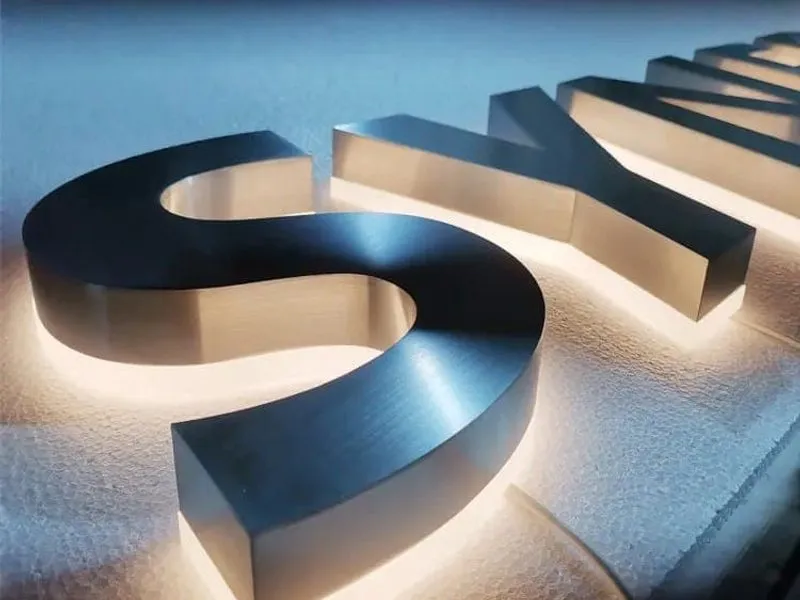
Real photo from our production floor — every sign we ship is made here.
Products mentioned or relevant to this topic — factory-direct, custom built.
From $24/letter · MOQ 1 piece · Flexible lead time · CE & UL certified · ships to 20+ countries
Custom sizes, colors, and finishes. Get a factory price in 24 hours.
Get a Free Quote Copy EmailWhatsApp +86 13865703472 · business@aochuangsign.cn
See pricing, specs, and get a free quote for the sign type you need. Built in our factory, shipped worldwide.