Eleven at night, I'm still wiping aluminum dust off my arms. A dealer forwarded a quote for a storefront sign — $14,000 installed. I priced the same letters from our floor at $3,200. Somebody's making a boat payment off that job.
LED signs aren't fragile little Christmas lights. They're semiconductor arrays. Build them right, or they fail fast.
Look, a basic LED module is a diode on a board, run by a driver, sealed in silicone. Heat kills. Moisture just makes it worse. Cheap boards use thin copper traces and dull solder joints. I've opened failed signs after nine months and watched the solder look gray and pitted — that's oxidation eating your connection.
Here's what nobody tells you: SMD 2835 modules rated at 100-150 lumens per watt are industry standard for channel letters. They're not exotic. The actual diode inside matters more than the sticker. Samsung, Osram, and Blueview modules run five years or more. No-name modules last 12-18 months before letters start flickering one by one. That's your sign telling customers you bought junk.
SMD 5050 handles RGB, SMD 5730 gives you 40-60 lumens per chip when raw brightness matters. Brightness has to punch through the acrylic face. A 2mm face passes around 90% of light, a 3mm face around 92%. Your customer won't feel that 2%, but they'll feel the 40% cost bump if you overspec to 5mm on a small sign. Don't upsell face thickness for no reason.
Color temperature sets the whole vibe. 3000-3500K warm for hospitality, 4000-5000K neutral for corporate and retail, 6000-6500K cool for industrial and highway. Spec it wrong and you'll make a nice restaurant look like a gas station.
Sealing matters more than you'd think. We run neutral silicone on every letter and an 8-12 hour aging test before boxing. That catches infant failures here on the floor, not at your customer's storefront.
Channel letters are your bread and butter. They're dimensional, legible, and they last.
If you're ordering front-lit channel letters for a storefront, factory prices run $20-80 per letter. Installed retail in the US? Often $200-700 per letter. That gap isn't all labor. Somebody's paying for local mistakes and markup.
Back-lit halo letters run $35-120 factory, $400-1,000 installed. If the architecture calls for cleaner, you want back-lit halo letters. They glow against the wall. They'll also hide a sloppy mounting job if you don't plan conduit first.
Lightboxes are different. Cabinets run $80-250 per square meter from the factory. But don't assume a lightbox is simpler. If you don't use embedded lightbox designs with proper venting, you'll cook modules by August. Heat's the enemy.
Message centers and video walls are display systems, not signs. You're buying pixel pitch and driver architecture more than metal and acrylic. If you treat them like a static sign, the service calls will eat your margin alive.
Neon flex fills the gap when someone wants old neon looks without the 15,000-volt headache. Factory costs run $30-200 per sign, and maintenance is a tenth of real neon.
If you're buying a video wall, pixel pitch determines how close a viewer can stand before the image breaks up. Get it wrong, and your customer sees glowing chicken wire. Refresh rate doesn't matter until someone videos the sign. Then banding shows up and you look incompetent.
Brightness isn't just lumens on a spec sheet. Lumens through the face matter more. Nobody mentions this: SMD 2835 modules at 100-150 lm/W are useless if you pair them with low-transmittance plastic. UV-resistant acrylic from Mitsubishi or Degussa holds 90-92% light transmittance for 5-8 years before yellowing. Domestic acrylic might yellow in 1-2 years and choke your output.
Color temperature is a spec clients ignore. The ugly truth? It's often more important than brightness. 3000-3500K warm works for hospitality. 4000-5000K neutral fits corporate and retail. 6000-6500K cool belongs on industrial and highway signs. Put 6500K on a steakhouse and you'll make it look like an operating room.
For outdoor signs, IP rating matters. IP65 means you're dust-tight and can take water jets from any direction. That's minimum. IP66 handles powerful jets, IP68 is submersible. But rating means nothing if your installer leaves a junction box open.
Upfront cost is a distraction. Total cost is what kills you.
Look, neon and fluorescent bring ballasts, transformers, gas tubes, and breakable glass. LED modules run L70 at 50,000 hours or more. Quality modules last 5+ years. Cheap modules die in 12-18 months, and then your service truck visits at $150 an hour. You didn't save money — you financed someone else's junk.
Your supplier won't print this part: the power supply is the weak link. Factory warranties cover LEDs for 2 years, power supplies for 1 year. That's not a typo. The driver burns out before the diodes, especially when voltage spikes. Waterproof, decent drivers cost more for a reason.
Compare to neon: you also have to figure disposal costs for mercury and broken glass. LED has solid-state boards and aluminum backing. That's where 304/316 stainless steel letters or aluminum housings earn their keep — 10+ years outdoors for 304, 15+ for marine-grade 316 at a 20-30% cost premium.
For a typical storefront, factory-direct LED letters save 50-65% on product versus US retail installed. That's before a local electrician, but it changes the math on a 5-letter sign from "maybe next year" to "order now."
LEDs run cool and efficient. Don't believe every sustainability brochure. SMD 2835 at 100-150 lumens per watt is good, but if you're using domestic acrylic that yellows in 18 months, you'll replace the face before the LEDs pay for themselves. That's not sustainable, that's landfill.
Check with your local utility. Many offer retrofit rebates for LED signs. The paperwork's annoying, but worth it because the energy savings on a small channel letter set add up, especially if old neon was running hot.
Material choice matters. Aluminum is naturally rust-proof and weighs a third of steel, with an 8-12 year outdoor life. That's easier on the wall structure and the install crew. Stainless 304 lasts 10+ years, 316 lasts 15+ near salt. Pick the cheaper material for a coastal install and you're a rookie — in Miami Beach, 304 letters start pitting in about three years.
I've seen this go wrong: a building owner insisted on the cheapest quote. Two years later, yellowish acrylic, rust bleed, two dead letters. The replacement cost three times the original. That's not sustainability, that's waste.
Installation isn't after the sale. That's where signs fail.
For the US, NEC Article 600 governs electric signs. Know it. UL 48 certification runs $4,000-15,000 and takes 4-9 months with quarterly audits. ETL is a cheaper alternative, 10-30% less, but some inspectors play favorites. Don't assume your factory's CE mark covers local code — it doesn't.
ADA tactile signs have their own rules: mount between 48-60 inches, non-glare finish, Grade 2 Braille. If you're doing a wayfinding job, don't wing it.
Nobody tells you this: LCL sea freight crates get handled 6-8 times between the factory dock and yours. Every touch is a chance for damage. That's why we pack with foam, carton, then plywood crate. We don't do it because we like wood.
Maintenance is mostly cleaning. Dirt, bird droppings, and water spots cut light output faster than LED degradation. Build your signs with a clear service path — removable face or accessible driver. If a service tech has to rip off trim to change a power supply, you've designed a ticking bomb.
Our factory floor in Lu'an, Anhui has been running since 2010. 3,000 square meters, 50-plus skilled workers. Our MOQ is one piece. Seven to fifteen day lead time for most orders. That's not marketing. That's the schedule we hit because the process is ten steps: design confirmation, laser cutting at ±0.1mm, TIG welding, polishing, CNC acrylic, LED assembly, neutral silicone sealing, 8-12 hour aging test, 100% QC inspection, then export packaging.
The ugly truth is a lot of factories say they have CE, RoHS, ISO 9001. CE marking costs 20,000-50,000 RMB and takes 2-8 weeks. Most will say they have it. Ask to see the certificate with today's date. Watch them sweat. That's not paranoia. You'll avoid paying for a fake safety file.
Quickest way to spot bad LED modules? Look at the solder joints. Dull gray means lead-free solder is already oxidizing; it won't last 18 months. Shiny silver is proper solder. I check this on every incoming reel, and if a supplier sends dull joints, I send the reel back.
Shipping is where the math goes sideways. Express runs about 5-15 days, $30-100 for small packages. Air cargo about 10 days, $4-12 per kilogram. Sea freight about 65 days, $80-200 per cubic meter LCL or $1,200-3,000 for a full container. US Section 301 tariffs add roughly 30%. If your factory-direct price doesn't still save you 50-65% after freight and tariff, something's wrong.
Yes, for most places. IP65 means dust-tight and can take water jets from any direction. That's not a hurricane rating. IP66 for coastal pressure, IP68 for submersible. But ratings don't survive open junction boxes. Install is half the rating.
Quality modules from Samsung, Osram, or Blueview run 5+ years real-world. The L70 number is 50,000 hours, but power supplies usually fail first. That's why the warranty is 2 years on LEDs, 1 year on drivers. Read that again and plan for it.
Yes. Our MOQ is one piece. I know, some factories want a full container. We'd rather sell one good sign and earn the next job than make you buy a shipping container of problems.
Because US retail installed front-lit letters run $200-700 per letter. Factory direct runs $20-80 per letter. Freight, tariffs, and a local electrician eat some of that, but not 50-65% of it. Somebody's charging you for the convenience of not dealing with an overseas factory. Fine, but don't pretend it's all labor.

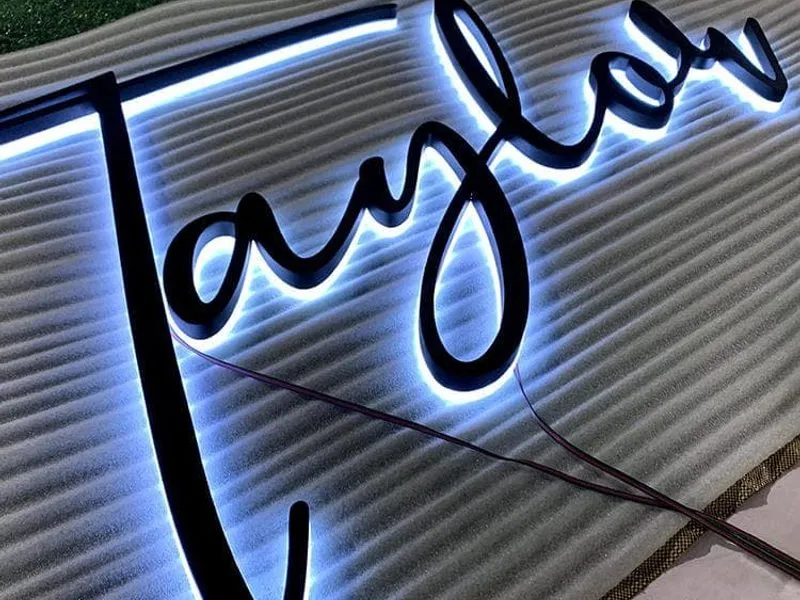
Real photo from our production floor — every sign we ship is made here.
Products mentioned or relevant to this topic — factory-direct, custom built.
From $24/letter · MOQ 1 piece · Flexible lead time · CE & UL certified · ships to 20+ countries
Custom sizes, colors, and finishes. Get a factory price in 24 hours.
Get a Free Quote Copy EmailWhatsApp +86 13865703472 · business@aochuangsign.cn