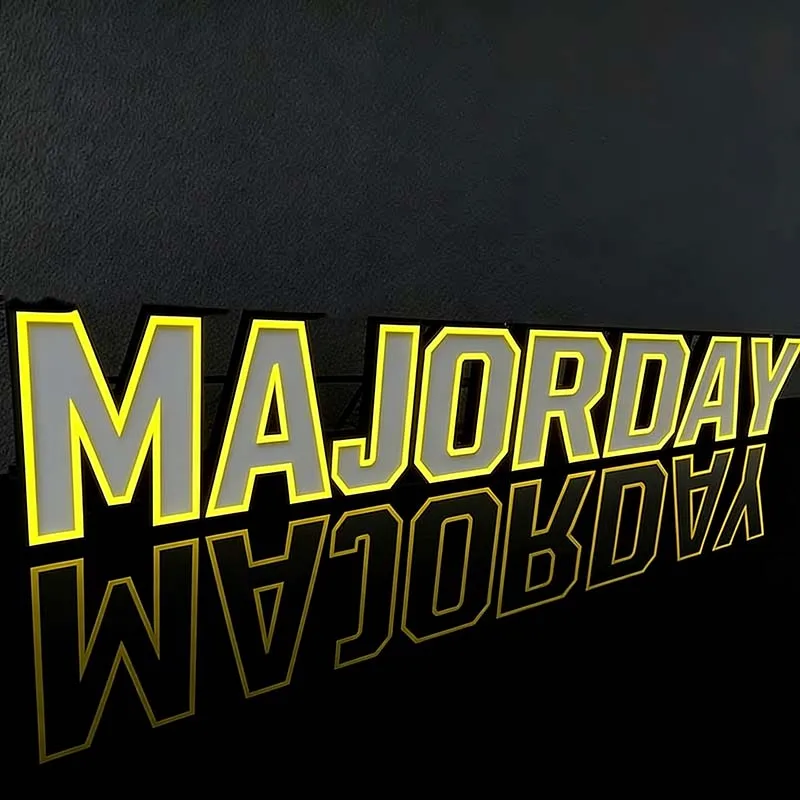
You ever watch a sign shop pay $800 for a single front-lit letter? I have. Same 304 stainless, same Samsung LEDs, same 3mm acrylic face. We ship that exact letter for $120. That’s not a marketing pitch. That’s the math of factory-direct wholesale, and if you’re still buying domestic fabrication without checking overseas, you’re leaving 50–65 cents of every dollar on the table. Let me walk you through what actually matters when you’re sourcing channel letters wholesale — the specs, the gotchas, and the lies we all hear.
The spec says “grade 304 stainless steel” — but in reality, that means 18% chromium and 8% nickel, density 7.93 g/cm³. A 2mm sheet from a reputable Chinese mill is identical to the same gauge from a US supplier, because the raw material comes from the same global commodity chain. Aochuang, for example, uses 304 with that exact chemistry. They’ve been doing it since 2010, 3,000m² facility, 50+ workers, exports worldwide. The cost difference isn’t quality — it’s labor, overhead, and the margin the middleman adds.
Most buyers don’t realize that a domestic front-lit channel letter can run $200–700 per letter installed. Wholesale factory price: $20–80. That’s a 10x spread. For a 10-letter sign, you could be looking at saving $4,000 or more — enough to cover shipping, tariffs, and still pocket a serious profit. The trick is picking the right factory and not getting burned by cheap imitations.
Let me break this down: if your project needs 12 halo-lit letters, domestic retail is $4,800–12,000. Factory-direct, same spec: $420–1,440. Even with 30% Section 301 tariff (yes, that’s real) and air freight at $4–12 per kg, you’re still coming in under half the US price. The math only fails if you buy from a factory that cuts corners.
I’ve watched sign shops pay $800 for a front-lit letter from a domestic fabricator. Same 304 stainless, same Samsung LEDs. We ship that letter for $120. Here’s why the cheap stuff fails: acrylic. Domestic acrylic from Mitsubishi or Degussa hits 90–92% light transmittance and survives 5–8 years without yellowing. The common domestic stuff — 2mm, 3mm, 5mm — starts going yellow in 12–18 months if it’s low-grade. I’ve pulled letters off a storefront after two years that looked like old Tupperware. The spec says UV-resistant, but you need to ask: “What brand? What’s the warranty?” If they say “generic,” walk away.
Stainless steel choice matters more than most contractors think. 304 is fine for inland — 10+ years outdoor life. 316 costs 20–30% more and includes 2–3% molybdenum, which stops pitting corrosion in salty air. If you’re doing a job in Miami Beach or any coastal town, don’t even consider 304. You’ll be replacing letters in three years, and the client will blame you. I’ve seen it happen.
Aluminum’s a solid option for budget jobs: naturally rust-proof, one-third the weight of steel, 8–12 year outdoor life. Common gauges 0.040–0.063 inch (1.0–1.6mm). Brush finish, powder coat, anodized. But here’s the kicker — aluminum bends easier, so if your wind load is high or the letters are over 2.5 meters, go with stainless or thicker acrylic. The Aochuang shop uses 5mm acrylic on anything that big. Rule of thumb: over 2.5m, never use less than 5mm face.
LED modules are where the biggest lies live. Quickest way to spot bad LED modules: look at the solder joints. Dull gray = won’t last 18 months. Shiny silver = proper lead-free solder. A quality SMD 2835 module (the industry workhorse) delivers 100–150 lumens per watt. Samsung or Osram chips have an L70 of 50,000 hours — that’s north of 5 years real life. Cheap modules? 12–18 months and they start flickering. The factory warranty is your first clue: Aochuang gives 2 years on LED, 1 year on power supply. If a supplier offers 6 months, they know it’s junk.
CE marking costs 20,000–50,000 RMB — about $3,000–7,000. Most factories will say they have it. Ask to see the certificate with today’s date. Watch them sweat. If they can’t produce a current one, they either bought a fake or let it expire. CE is required for Europe, but it’s also a baseline quality check. ISO 9001, CE, RoHS — Aochuang has all three. That’s not bragging; that’s the minimum to export to any serious market.
IP65 sounds impressive. It means dust-tight and protected against water jets from any direction. It does NOT mean your sign survives a Florida hurricane. For that, you need IP66 (powerful jets) or IP68 (submersible). Most wholesale channel letters are rated IP65, which is fine for normal outdoor conditions. But if you’re coastal or in a heavy storm zone, specify IP66. And don’t assume the factory builds to that — you have to ask. The certification must be listed on the QC report, not just the website.
UL 48 certification is the gold standard for US signs, but it’s expensive: $4,000–15,000 per model, 4–9 months, quarterly audits. Unless you’re doing a national chain, most contractors skip it and use ETL instead — 10–30% cheaper, same acceptance. NEC Article 600 applies anyway, so your installer still needs to follow local codes. For ADA compliance (tactile signs), you need 48–60 inch mounting height, non-glare surface, Grade 2 Braille. That’s a different product line, but good factories handle it.
Here’s the 10-step sequence Aochuang runs: design confirmation (1 day) → laser cutting at ±0.1mm (1–2 days) → TIG welding and bending (1–2 days) → grinding and polishing (1–2 days) → CNC acrylic face (1 day) → LED assembly (1–2 days) → sealing with neutral silicone (1 day) → 8–12 hour aging test where they run the LEDs at full power and check for failures → 100% QC inspection → export packaging: foam, carton, plywood crate. Total: 7–15 days. That’s for a complete custom sign, one piece, MOQ of 1.
Compare that to a local shop: they’re waiting on materials, doing hand work, often no aging test. The tolerance on their router might be ±0.5mm, not ±0.1mm. You pay for that slower, less precise process.
Most buyers don’t realize that the biggest quality risk isn’t the Chinese factory — it’s the packaging. LCL sea freight means your crate gets handled 6–8 times between our dock and yours. Every touch is a chance for a forklift blade through the side. I’ve seen crates arrive with holes. That’s not in the brochure. Solution: request plywood crates with internal bracing, and consider air freight for small orders (about 10 days, $4–12/kg). If your sign weighs 50kg and you ship LCL, the savings evaporate with insurance claims.
US Section 301 tariff adds about 30% on Chinese signs. That’s a fact. But even with tariff, you’re still 40–50% cheaper than US fabrication. Example: a $500 factory-direct sign becomes $650 after tariff. Domestic equivalent is $1,200–1,500. You do the math.
Express shipping (DHL, FedEx) for small signs: 7-10 days, $30–100. Air freight: about 10 days, $4–12 per kg. Sea freight (LCL): about 65 days, $80–200 per cubic meter. A full container (FCL) costs $1,200–3,000 and holds 28 cubic meters. For a big job, FCL makes sense because the crate stays sealed. For a single sign, air is often better than risking LCL damage.
Ask for a sample letter — not a photo. Any factory that won’t send a $50 sample is hiding something. Check the acrylic clarity against a white sheet of paper. Look at the return edge: is it smooth or rough? Tap the acrylic — if it rings hollow, it’s thin. Push on the front: 3mm should flex slightly but not bow. Then test the LEDs with a 12V power supply. If they flicker at low voltage, the driver is cheap.
Always confirm the MOQ is 1 piece. Aochuang does that, but many factories require 10+ letters. And get the warranty in writing: 2 years on LED, 1 year on power supply. If they push back, walk.
Q: How do I know the LEDs won’t die in a year?
A: Ask for the brand and the L70 rating. Samsung, Osram, or Lan Jing are safe. If they say “high-quality” without a name, it’s garbage. I’ve seen “long life” modules that failed at 14 months. Get a written spec or don’t buy.
Q: What’s the real savings after shipping and tariffs?
A: 40–50% minimum, unless you’re shipping a single letter via express. On a 10-letter job, you’re still saving thousands. Use the numbers I gave: factory price $20–80/letter vs. US $200–700. Even with 30% tariff and $200 air freight, you win.
Q: Is sea freight worth the risk for a big order?
A: If you’re ordering half a container or more (about 14 cubic meters), yes — FCL is safe. LCL for a few crates is a lottery. I’ve had clients lose letters to forklift damage, and insurance pays peanuts. Air freight costs more but eliminates that headache. For anything under 50kg, fly it.
Q: Can I install the

Real photo from our production floor — every sign we ship is made here.
Products mentioned or relevant to this topic — factory-direct, custom built.
Factory-direct since 2010. Free quote within 24 hours — no obligation.
Get a Free Quote → Copy EmailMOQ: 1 piece · Flexible lead time · 2-year warranty · Worldwide shipping
See pricing, specs, and get a free quote for the sign type you need. Built in our factory, shipped worldwide.