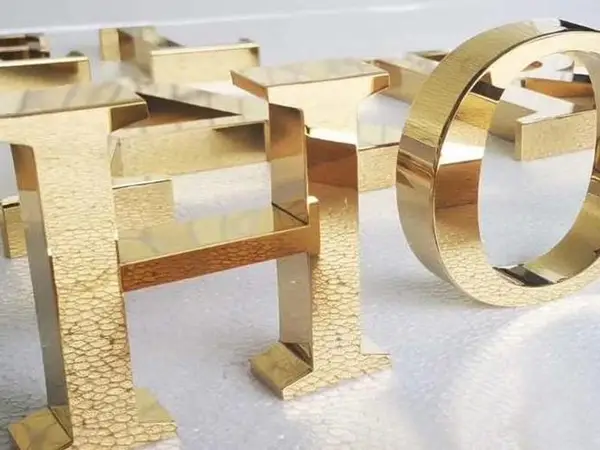
I've watched sign shops hand over $800 for a front-lit letter from a domestic fabricator. Same 304 stainless. Same Samsung LEDs. We ship that same letter for $120.
That's not a flex. That's the math after 15 years on a factory floor in Lu'an, Anhui, exporting to every continent. The money doesn't vanish because Chinese labor is cheap. It vanishes because most buyers don't know what actually drives cost in a metal letter. They pay for a brand name on the invoice and a middleman's boat payment.
I wish someone handed me this guide in 2010. No fluff.
Look, if a factory can't tell you their laser cutter tolerance in millimeters, hang up. Ours cuts at ±0.1mm. That's the difference between a letter that fits the pattern and a letter that looks like it was cut by a guy with a grinder and a hangover.
Ask three questions before you send a PO. What's your MOQ? What's your lead time? Show me a photo of your aging test rack. If they hesitate on any of those, you're not talking to a factory. You're talking to a trading company. A real factory comes back with "1 piece MOQ, 7 to 15 days, and I'll send you a video of our 12-hour aging room." We do. Aochuang Sign: 3,000 square meters, 50-plus workers, ISO 9001 since day one.
Nobody tells you this: 80% of "manufacturers" on Alibaba are just resellers with a nice website. They take your money, call a factory like ours to make the letters, and mark it up. You'll spot them fast because their technical answers get vague around material grades and weld types.
Ask them to explain TIG welding versus MIG. Our shop uses TIG on stainless. Cleaner beads, less warping, no spatter. Then ask about their silicone. Acid-cure silicone on metal letters will corrode that finish inside six months. We use neutral silicone. That one answer tells you if they've ever built for exterior use.
Aluminum weighs a third of steel and lasts 8 to 12 years outdoors without rust. It's the budget pick. For most strip malls in Ohio, that's fine. We cut it from 1.0mm to 1.6mm, then anodize or powder coat. It won't flake like cheap paint, but it dents if a kid throws a rock.
304 stainless steel letters are the workhorse. 18% chromium, 8% nickel, density 7.93 grams per cubic centimeter. Ten-plus years outside with zero maintenance. Common thickness runs 1.0 to 3.0mm. Brushed #4 is my default for corporate facades. Mirror #8 looks high-end until a fingerprint wrecks the whole illusion.
The ugly truth: 316 stainless costs 20 to 30 percent more than 304, and 90% of buyers never need it. That extra molybdenum — 2 to 3% — only matters if you're within salt spray distance of an ocean or an industrial cooling tower. Miami Beach? Pay for 316. Phoenix? You're wasting money. I've watched fabricators upsell 316 to a landlocked dentist office because the client didn't know the difference. That's a lie by omission.
Brass and copper letters are for architectural projects where patina is the point. They're dense, a pain to machine, and they tarnish unevenly unless you lacquer them every few years. I only recommend brass indoors or under a canopy. Copper exterior letters develop that green crust, which some architects love, but it eats the substrate if you don't seal the backside.
Cast aluminum or bronze gives you a solid, substantial feel that fabricated letters can't match. The casting process adds 30 to 50 percent to the price per letter and doubles the lead time. For a monument sign or university seal, it's the only choice that doesn't look hollow.
Corten steel is a fashion statement. It bleeds rust onto the wall unless you install a drip edge. I've refused jobs for clients who wanted Corten on white marble. Rookie mistake.
Laser cutting, bending, TIG welding, grinding, polishing. That's the backbone. Each step adds a day. A 10-step process runs from design confirmation to export packaging in 7 to 15 days. Design confirmation, one day. Laser cutting, one to two. Welding, one to two. Polishing, another day or two. Then QC and aging test. That's the honest schedule.
Finish durability is where most factories cut corners. Powder coating on aluminum lasts 8 to 10 years if the pretreatment is zinc phosphate. Skip that pretreatment and the powder flakes off in 18 months. Electroplated gold or chrome looks fancy for about two years, then the plating starts lifting at the edges. Outside, mirror polished letters are a maintenance nightmare. Every rain spot shows unless you clear coat them. And clear coat yellows under UV.
Nobody tells you this: a brushed finish hides scratches. A mirror finish magnifies them. If your client has a landscape crew with weed whackers, don't sell them mirror #8 letters. You'll be back in 6 months with a buffing wheel.
Baked paint letters can hit any RAL color and hold up 5 to 8 years if you use polyester powder. Liquid spray paint on metal letters? A scam for exterior use. I've watched letters stripped to bare metal by two Michigan winters.
Metal letters don't light themselves. If you want illumination, spec LED modules separately. SMD 2835 runs 100 to 150 lumens per watt and is the industry standard. An L70 rating of 50,000 hours means light output drops to 70% after 5.7 years of continuous run. Quality modules from Samsung, Osram, or Blueview give you 5-plus years real lifespan. Cheap modules die in 12 to 18 months. Look at the solder joints on the LED board. Dull gray means lead-free solder that wasn't heated correctly and won't last. Shiny silver is what you want.
Mounting patterns are where real failures happen. Stud-mounted letters with welded studs can shear off if the stud length is too short for the substrate. EIFS walls need a backer plate behind the foam. Otherwise, the weight of a 3mm stainless letter slowly compresses the insulation and cracks the finish. Brick needs sleeve anchors, not tapcons. ACM panels need a through-bolt to the structure behind, not just a screw into the 3mm skin.
I've seen this go wrong: a client mounted 60cm stainless letters with silicone only. The letters fell off a school entrance in July. Silicone is a sealant, not an adhesive. Anyone who tells you otherwise is selling you a liability.
ADA tactile metal letters for interior signage have their own spec. Mounting height 48 to 60 inches to the tactile characters. Non-glare finish. Grade 2 Braille. Don't ask a metal fabricator to "just add Braille" unless they have a pattern for spacing. It's a 0.1mm tolerance game.
Here's our pricing at the factory in Anhui. Stainless steel non-lit letters run $15 to $40 per letter, depending on height and thickness. Aluminum letters cost $10 to $25. Cast bronze can hit $120. Meanwhile, US retail installed pricing for a front-lit channel letter runs $200 to $700 per letter. That's not a 10% savings. Factory-direct cuts 50 to 65% off the product price before shipping and the 30% Section 301 tariff.
Shipping from China adds time, not mystery. Express for small samples takes 7 to 15 days and costs $30 to $100. Air freight for medium orders takes 10 to 20 days at $4 to $12 per kilogram. Sea freight LCL takes 50 to 70 days at $80 to $200 per cubic meter. Full container load runs $1,200 to $3,000. On LCL, your crate gets handled six to eight times between our dock and yours. Every touch is a chance for damage. That's not in any brochure.
Cost drivers are dead simple. Material thickness. Finish complexity. LED type if lit. Letter height over 2.5 meters pushes you from 3mm acrylic to 5mm-plus acrylic or solid metal backing. And weld count. A script font with 40 weld joints costs more to build than a block sans with 12.
Look, if a quote says $8 per letter for 304 stainless, you're not buying 304. You're buying 201 stainless with 3.5% nickel and less chromium. It'll rust in two years. Ask for the mill certificate.
We run every letter through an 8 to 12 hour aging test with the LEDs powered on before inspection. Then 100% QC. Every single letter, not a sample batch. Then export packaging: foam wrap, carton, plywood crate. If your factory skips the aging test, the first power surge in the field will expose a cold solder joint.
Certifications: CE marking costs 20,000 to 50,000 RMB. Most factories will say they have it. Ask to see the certificate with today's date. Watch them sweat. UL 48 for the US costs $4,000 to $15,000 and takes 4 to 9 months with quarterly audits. ETL is a valid alternative and 10 to 30 percent cheaper. ISO 9001 is a quality management cert, not a product cert. It tells you they have a process. It doesn't tell you that process makes good letters.
IP ratings matter for exterior LED signs. IP65 means dust-tight and survives water jets. IP66 is better for coastal wind-driven rain. IP68 is submersible — you don't need it on a wall sign, no matter what the spec writer thinks. I've seen a Nevada casino spec IP68 for letters mounted under a soffit. That's an architect with a checklist and no field experience.
Warranty terms: we give 2 years on LED modules, 1 year on power supplies. That's realistic. Anyone offering 5 years on LEDs is betting you won't file a claim, or they're using under-driven modules that are brighter on paper than in the field. Check the fine print on lumen depreciation — L70 threshold is the only one that matters.
Last year, a GC in Texas needed 140 brushed stainless steel letters across three buildings. Six different sizes, 12 to 36 inches, all non-lit. Domestic fabricator quoted $98,000 with a 6-week lead. The client balked.
He sent us the PDF drawings. We quoted $34,000 FOB Shanghai. 304 stainless, 2.0mm thickness, #4 brushed finish, welded studs with a pattern drawing. Lead time: 12 days. Sea freight LCL added 55 days and $2,100. Customs broker added $4,800. Section 301 tariff was roughly 30%, so another $10,200. Total landed at the job site: $51,100. He saved $46,900 and got letters that weighed 20% more per unit because we didn't skimp on the backer plate.
Here's the real factory-direct risk: it isn't quality. It's communication. If your drawings don't call out stud placement, finish direction, and weld allowance, you'll get shiny letters with studs in the wrong spot. We send a 3D PDF and a physical sample photo before cutting. It adds a day. It saves a $50,000 reorder.
I've been building signs since 2010. I've burned my hands on hot acrylic. I've argued with LED suppliers about bin codes. The factories that survive are the ones that treat a $15 letter with the same attention as a $15,000 order. That's the only manufacturer you should trust.
Do I need 316 stainless for an outdoor sign in Chicago? No. Chicago isn't a saltwater coast. 304 will last 10-plus years unless you're mounted above a salted roadway that splashes for four months a year. Even then, a clear powder coat fixes it cheaper than 316.
Can't I just buy metal letters from a local shop faster? Sure, if you don't mind paying 2 to 4 times the factory price for the same laser file. Local shops have rent and a guy who answers the phone. Their 2-week lead is usually 4 because they're buried. We ship express in 7 days if you're that desperate.
What's the minimum order at your factory? One letter. MOQ is 1 piece. That doesn't mean one letter is cheap. Shipping and setup amortize over volume. But if you need a replacement letter to match an existing sign, we'll do it.
Why do powder coated letters cost more than bare stainless? Because powder coating adds a pretreatment step, a spray booth, and an oven cure. Bare stainless is just cut, weld, brush, ship. Powder doubles the labor per letter. Next question.

Real photo from our production floor — every sign we ship is made here.
Products mentioned or relevant to this topic — factory-direct, custom built.
From $24/letter · MOQ 1 piece · Flexible lead time · CE & UL certified · ships to 20+ countries
Custom sizes, colors, and finishes. Get a factory price in 24 hours.
Get a Free Quote Copy EmailWhatsApp +86 13865703472 · business@aochuangsign.cn