You've been burned before. I get it.
Some guy on Alibaba quoted you $45 a letter, you wired a deposit, and three months later you got a crate of bent tin with flickering LEDs and a dog-eared "CE" certificate that looked like it was printed in somebody's basement.
Here's what nobody tells you: the channel letter industry runs on smoke and mirrors. But it also runs on 304 stainless steel, SMD 2835 chips, and TIG welds done by people who've been doing this since before your iPhone was a sparkle in Steve Jobs' eye.
I've been on the factory floor for 16 years. I've argued with suppliers about LED binning, sent back acrylic sheets that yellowed too fast, and watched hundreds of crates leave my floor worldwide. So let's cut through the bullshit and talk about what actually happens when you order custom channel letters online, factory-direct.
Your local shop charges $200 to $700 per letter for front-lit channel letters, installed. We ship the same thing factory-direct for $20 to $80 per letter. That's not a trick. That's the difference between a shop with a $6,000/month lease and a building in Lu'an, Anhui that's been paid off since 2015.
The savings are real because you're removing three margins: the manufacturer's export margin (which is fair), the importer's margin (which is sometimes fair), and the local sign shop's markup (which is usually a racket).
Here's what nobody tells you: a cheap price from a factory isn't a bargain. It's a red flag. If someone quotes you $12 a letter for a double-sided, 3mm acrylic, back-lit channel letter, they're going to use 1mm aluminum, domestic acrylic that'll yellow in 18 months, and LEDs that'll start strobing before your warranty card arrives.
The ugly truth is that the factory-direct game isn't about finding the cheapest quote. It's about finding a factory that's honest about what they can and can't do, and what their materials actually cost.
The first thing I ask every customer: what's the environment? Not "what color do you want?" — that's the second question. The environment determines your materials, and materials determine your price.
Let's break this down simply.
For a dry, inland climate like Phoenix or Denver, you're fine with 304 stainless steel or powder-coated aluminum. The 304 has 18% chromium and 8% nickel. It'll last 10+ years outdoors without breaking a sweat.
For coastal areas like Miami or Charleston — places with salt in the air — you need 316 stainless steel. It's got 2-3% molybdenum, which is the secret sauce for marine environments. It'll cost you 20-30% more than 304, but it'll survive 15+ years where 304 would start pitting in five.
Here's what nobody tells you: most of the "marine grade" signs you see from cheap factories are actually 304 with a clear coat. The clear coat wears off. The salt eats the steel. You get rust streaks running down your nice white wall, and you're on the hook to replace it.
If you're a sign shop contractor ordering for a strip mall client in Ohio — save your client the money and go with 304. If you're ordering for stainless steel letters on a beachfront building — pay for 316. Your reputation depends on it.
The acrylic you choose will make you look like a hero or a fool.
Mitsubishi and Degussa acrylic will hold up 5-8 years outside. UV-resistant, 90-92% light transmittance, still clear when the sun's been hammering it for half a decade. Domestic acrylic? Yellowing starts in 1-2 years. That's not an opinion. That's chemistry.
I've seen this go wrong so many times: A customer gets a quote that's 30% cheaper than the competition. They assume the cheaper factory is using better sourcing. Then a year later, their white front-lit acrylic light boxes look like they've been smoking two packs a day.
Ask your factory who makes their acrylic. If they can't tell you the brand, run. If they say "imported" but can't tell you whether it's Mitsubishi or Degussa, run faster.
For letters over 2.5 meters, you need 5mm acrylic, not 3mm. The 3mm will flex, warp, and create gaps where water gets in. Water in a channel letter means dead LEDs and rusted returns.
I've watched factories swap Samsung or Osram LEDs for cheap Chinese modules and pocket the difference. It's the oldest trick in the book.
Quality modules from Samsung, Osram, or our domestic Blueview brand will last 5+ years at 12 hours a day. They're rated L70 at 50,000 hours, which means they'll still be at 70% brightness after five-plus years of continuous operation. Cheap modules? Twelve to eighteen months, then you're sending your client back to a dark storefront on a Friday night.
Our standard is SMD 2835 chips, running 100-150 lumens per watt. That's industry standard for good reason. SMD 5730 is brighter per chip — 40-60 lumens — but runs hotter and requires better thermal management. SMD 5050 if you're doing color-changing.
Here's what nobody tells you: color temperature matters more than brightness. 3000-3500K for hospitality — warm, inviting. 4000-5000K for corporate or retail — neutral and clean. 6000-6500K for industrial or highway — bright, cold, serious.
A 6,500K sign on a coffee shop is going to look like a car dealership. A 3,000K sign on a warehouse is going to look dim and dingy. Get your color temperature right before you worry about lumens.
I'm going to be honest with you about limitations, because if you want a supplier that tells you what you want to hear, there are plenty of factories in Shenzhen that will happily lie to your face.
We can't do UL certification in 2 weeks. UL 48 takes 4-9 months and costs $4,000-15,000, plus quarterly audits. If you need UL for a US installation, plan ahead. If you need it faster, ETL is a UL alternative that's 10-30% cheaper, but still takes time.
We can't fix your installation if you screw up the wiring. We'll ship you a sign with the right components, and we'll provide diagrams. But we can't inspect your electrician's work.
We can't offer a 5-year warranty on LEDs. We offer 2 years on LEDs and 1 year on power supplies. Anyone offering 5 years on LEDs is either overcharging you to cover the risk or planning to ignore your emails.
The ugly truth is that most failures in channel letters happen from bad installation, not bad manufacturing. If you install a sign correctly, it'll last. If you've got water pooling in the bottom, cracked conduit, or a power supply that's baking in the sun — no warranty in the world will save you.
When you order from us, here's exactly what happens.
Day 1: Design confirmation. We convert your vector file to cutting paths and record your material and color choices. One day for mistakes that would have taken weeks to notice later.
Days 2-6: Laser cutting at 0.1mm tolerance. Then TIG welding and bending for the returns. Then grinding and polishing the edges. Then CNC routing the acrylic faces.
Days 7-9: LED assembly. We install the modules, wire the power supply, and test every single connection. Look, this is where most factories cut corners. They'll "sample test" one letter out of ten. We test all of them.
Days 10-11: Sealing with neutral silicone. Not the acid-cure stuff that eats your wiring over time. Neutral silicone, the kind that doesn't corrode copper or degrade LED contacts.
Day 12: Every sign gets an 8-12 hour aging test. That means we run the LEDs continuously on a hot afternoon and a cool evening to see if any modules fail early.
Days 13-14: 100% QC inspection. Then foam, carton, plywood crate packaging. Not the cheapest packaging. No, the right packaging.
Express shipping from Lu'an takes about 5-15 days to most of the world. Air freight about 10 days at $4-12 per kilogram. Sea freight about 65 days, which is fine if you're patient and paying $80-200 per cubic meter for LCL. If you need a full container, $1,200-3,000 for FCL.
The Section 301 tariff on Chinese imports to the US is about 30% right now. That's not my policy, and it's not my pricing. But it's a reality you need to factor into your comparison.
Express shipping for small orders runs $30-100 for samples or single letters. Air freight runs $4-12 per kilogram and takes about 10 days. Sea freight for LCL is $80-200 per cubic meter and takes about 65 days. A full container runs $1,200-3,000.
Here's what nobody tells you: the tariff is calculated on the declared value, and if you're importing $500 worth of signs and paying $900 in freight, the tariff number keeps shrinking in real terms. But you still need to budget for it.
Also, consider that sea freight sounds cheap until you're waiting 10 weeks for a sign that could have been on a plane for $500 more. If your client has a grand opening in six weeks — pay for air. If you're a bigger company stocking inventory — sea is fine.
I've seen this go wrong: a customer saved $1,200 on sea freight and lost the contract because the sign wasn't installed by grand opening. False economy.
If you're ordering dual-lit channel letters that work in daylight and at night, or rimless channel letters for a clean modern look — the process is the same.
Send us your vector file in AI, PDF, or CDR format. Include your dimensions, material spec, color preferences, and LED color temperature. We'll respond within 24 hours with a quote and a production timeline.
Here's what nobody tells you: the more specific you are, the better your price. If you send us "3mm acrylic, 304 stainless steel, 4500K, front-lit" — that's a coffee order with no room for misinterpretation. If you send us "just make it look nice" — you're going to get spec'ed something you didn't ask for, at a price you didn't expect.
We produce a digital proof that shows the design, dimensions, and material specs. You approve that. Then we cut metal. That's the point of no return.
For brass or copper letters, expect a premium price and a longer lead time. It's softer metal, requires more careful handling, and oxidizes beautifully or terribly depending on the finish. We'll guide you through the options.
Not every factory is honest. That's not a secret.
But here's what you should actually do: order one letter first. Not a 50-letter storefront. One letter. Pay the express shipping. Check the quality. Test the acrylic, the LED brightness, the weld quality, the paint finish. Then order the full sign run.
This approach costs you maybe $200 and a week of time. It saves you from installing 40 garbage letters and having to redo the whole job on your own dime.
I've seen this go wrong: a contractor ordered 30 letters from a new factory, saved $900, and paid $4,000 in extra labor because the letters didn't match the profile drawings and none of the brackets lined up with the standoffs. Don't be that guy.
Order one letter. Check every measurement. Then scale up.
That's what a professional does with 16 years of experience behind them. It's not glamorous, but it works. And it's exactly what we'd tell you to do — even if you end up buying from someone else. Because at the end of the day, the sign industry is small, and good work gets remembered..

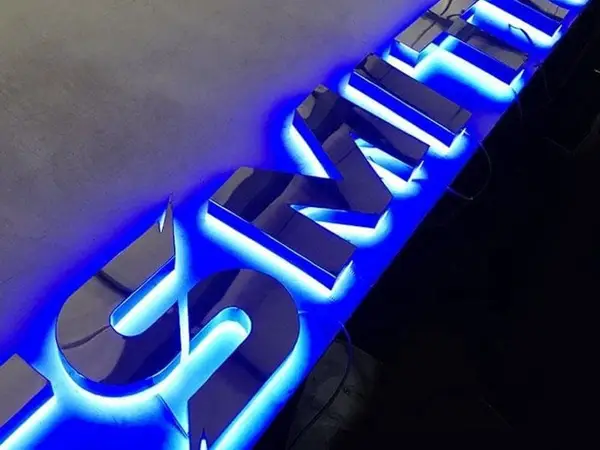
Real photo from our production floor — every sign we ship is made here.
Products mentioned or relevant to this topic — factory-direct, custom built.
From $24/letter · MOQ 1 piece · Flexible lead time · CE & UL certified · ships to 20+ countries
Custom sizes, colors, and finishes. Get a factory price in 24 hours.
Get a Free Quote Copy EmailWhatsApp +86 13865703472 · business@aochuangsign.cn
See pricing, specs, and get a free quote for the sign type you need. Built in our factory, shipped worldwide.