Every week, some shop in Ohio calls me asking which mount to use. They've got a photo of a brick wall and a panic in their voice. Here's the short answer, and then we'll dig into the long one: flush mount on a flat facade, direct mount on a raceway when you have no choice, and never let anyone talk you into something fragile on a steel beam.
The ugly truth is most sign shops overthink this. They're not selling the mount — they're selling the light. But get the mount wrong and you'll be back on that job site in eighteen months with a warranty claim and a very unhappy customer. I've built and shipped thousands of letters from this factory floor, and I've watched installers screw up all three methods in creative ways you wouldn't believe.
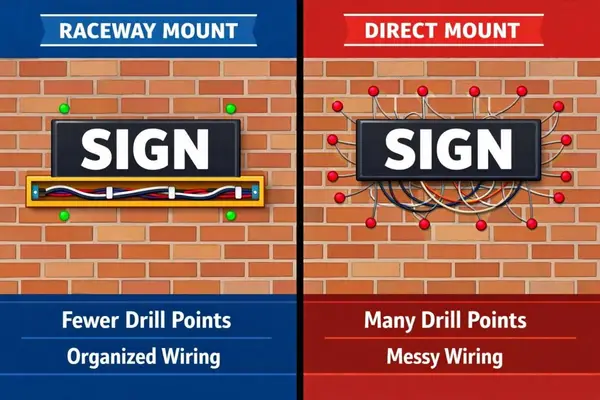
Look, let's start with the one that confuses everyone: raceway mount. A raceway is a metal channel that hides the wiring and the transformers. It mounts to the wall, and your channel letters mount to the raceway. Simple concept, but it's the workhorse of the industry for a reason.
Raceway mount is what you use when the wall surface is impossible. Think corrugated metal on a warehouse, brick that crumbles when you drill it, or stucco that's really just a thin shell over chicken wire. You can't mount letters directly to that crap and expect them to hold. So you bolt a steel channel to the building's structural members, and that channel becomes your mounting surface. The letters sit on it, the wiring runs through it, and the whole assembly looks clean from the street.
Here's what nobody tells you: raceways are a massive sign that you're on a budget, and that's fine. They create a dark shadow behind the letters that's visible during the day. If your customer cares about aesthetics — and they should, because their storefront is their brand — then a raceway is a compromise you negotiate, not a feature you sell. But it's also the most reliable method I know for tricky surfaces, and it cuts installation time by hours because the wiring is done before the letters even go up.
The cost difference is real. A raceway adds $15 to $40 per foot of material and labor, depending on whether you're using aluminum or galvanized steel. Compare that to a direct mount where you're drilling individual holes and running wires between every letter. In the factory, we build raceway sets as single units, and we ship them pre-wired. That's a 30% savings on install time right there. If you're ordering our
stainless steel letters, a raceway is a smart choice for exposed brick or any surface with irregular texture.
Now, direct mount is the purist's method. The ugly truth is every letter gets mounted individually to the wall, one by one, with its own set of anchors and a hole drilled behind it for the wire. No channel, no conduit, no visible metal. Just letters floating on the facade like they grew there.
The first time I saw direct mount done right, I was in Shanghai looking at a hotel sign with LED letters glowing against a black granite wall. No raceway, no brackets, nothing — just pure light and metal. I asked the installer how long it took. He said four days for eighteen letters. That's when I understood the reality of this method: it's beautiful, but it's slow, and it demands a perfectly flat surface.
I've seen this go wrong with direct mount more times than any other method. The letter tilts slightly because the wall has a high spot you didn't notice. The wires don't align because the holes were punched at factory spec and the wall has shifted. Or the worst one — the anchor fails because someone used a plastic wall plug on a commercial building instead of a proper wedge anchor. In the factory, every letter is drilled to precise ±0.1mm tolerances. That precision means nothing if the wall behind it is garbage.
Direct mount requires a mechanical connection to the building structure, not just the surface finish. You're looking at anywhere from $25 to $60 per letter in hardware and installation labor beyond what we charge for the sign itself. And if the wall has any deviation over 5mm across the letter's width, you'll see the shadow gap change from top to bottom. That's the tell-tale sign of an amateur install. The pros use shims — thin stainless steel spacers that match the letter's standoff distance — and they adjust every single letter until the gap is uniform within 1mm.
Here's what nobody tells you about direct mount: it's a maintenance nightmare when you stack the letters on top of each other. We sell
dual-lit channel letters that have lights on the front and the back. They're gorgeous. But if you direct mount those, the wiring has to snake through holes in the wall, and when a transformer dies — and it will, after 4-5 years based on real-world LED lifespan — someone has to crawl behind the wall or through the store to reach it. On a raceway, you just pop the face off and swap the driver in ten minutes.
Flush mount is the third option, and it's the one people confuse with direct mount. Flush means the back of the letter sits directly against the wall — almost no gap at all. The wires exit through a single hole in the back of the letter, not through a long tube or standoff. This is the cleanest look imaginable, but it only works on certain wall types.
The rule is simple: flush mount is for flat, hard surfaces. Concrete blocks that have been skim-coated, drywall on steel studs, smooth metal panels — those all work. The letters sit tight against the surface, and the gap is so small it reads as zero from the street. For our
rimless channel letters, this is the only mount I'd recommend — no visible trim, no standoffs, just the letterform and the light. It's the closest thing to a sign that disappears during the day and appears at night.
But here's the brutal part: flush mount amplifies every flaw in the wall and every flaw in the letter. A slight curve in the metal back, a paint drip on the wall, a bulge in the drywall — they all show up as a gap or a shadow. In our factory, we flatten every back panel before CNC routing. That's a step many factories skip because it doesn't show until the sign is on the wall and it's too late. I've seen cheap letters from other shops bow by 3-4mm in the center, and the customer blames the installer instead of the manufacturer. Don't be that installer.
The cost of flush mount is the lowest on hardware — you're looking at $10 to $20 per letter in anchors, silicone, and labor — but it's the highest on wall prep. Expect to pay a contractor to grind and level the surface if it's not perfect. That can run $200 to $500 for a typical storefront. And if you're mounting to a wall that's not plumb, flush mount is a non-starter. The letters will follow the lean, and people will notice.
Let's talk about the elephant in the room: which method should you actually order? The answer depends on the building, not on what looks cool on Instagram. If you've got concrete block, poured concrete, or a perfectly flat commercial facade, order flush mount or direct mount. If you've got brick, stucco, metal siding, or any textured surface, order a raceway and don't apologize.
Look, we make the letters. We don't install them, and I'll be straight with you about that. What we do is build the letters and the raceway to spec, pre-wire everything in the factory, and ship it to your installer. The
front-lit channel letters we ship are ready for raceway or direct mount, and the back panel settings in our CNC files are already correct for either method. But if you order without telling us the mount, we can't adjust the back panel depth, and you'll have a gap or a bulge. That's a $50 mistake on a $400 order.
Now let me give you the numbers that matter. Front-lit channel letters run $20 to $80 per letter from our factory. A raceway adds maybe $15 to $40 per foot of assembly, and in the US, you'd pay $200 to $700 per letter installed if a shop does it for you. The product itself is only 35 to 50% of what your customer pays. The mount and the labor are the rest. So when you're comparing quotes, don't just look at the letter price — look at what the installer is charging for the mounting method.
There's one more thing I need to say about wind load. A raceway creates wind resistance because the letters sit in front of a solid channel. Direct mount lets wind pass through the gaps — that's why it's better for exposed, coastal, or high-rise locations. We use 304 stainless for coastal areas, but if you're in a hurricane zone, we'll recommend 316 — it costs 20-30% more, and it's worth every cent when the salt spray comes. 304 will last 10 years outdoors. 316 goes 15 plus.
NEC Article 600 applies in the US, and that means your disconnect switch and wiring need to match the installation method. A raceway has internal wiring accessible through a panel. Direct mount needs individual disconnects or a common disconnect within sight. Your local inspector will fail you if you mix it up. That's not a factory problem — that's an install problem — but I've seen it kill projects for a week while the electrician re-runs wire.
Here's what nobody tells you about flush mount: it's a death trap for LED drivers. The driver sits inside the letter or behind it in the wall, and without a raceway to dissipate heat, the temperature inside the letter rises by 10-15 degrees Celsius. Heat is what kills LEDs. Our quality modules from Samsung or Osram rate L70 at 50,000 hours, but you'll only hit that if the driver and the LED have room to breathe. On a flush mount, the driver is sandwiched between the letter back and the wall. It runs hotter, and it dies sooner. That's physics, not marketing.
The cheapest raceway I've ever seen is from a factory in Shenzhen that uses 0.8mm galvanized sheet. They bend it, punch holes, and ship it — no gaskets, no drain holes, no powder coating. We use 1.0mm aluminum with anodized finish or powder coat after bending. That adds 2-3 days to our 7-15 day lead time, and it costs $5-10 more per foot. Nobody sees the difference until the sign leaks water or rusts in year three. By then, I've shipped 200 more signs and you've lost a customer.
I've seen more install failures from bad wall anchors than from bad letters. A channel letter with a light output of 150 lumens per watt is heavy — maybe 15 to 25 pounds for a 24-inch letter. That's not much, but multiply it by eight letters and factor in wind load on a highway sign, and you need anchors that are rated for the pull-out force, not just the weight. Use stainless steel wedge anchors rated for at least 200 pounds each, and use at least four per letter on raceway mounts. If a manufacturer tells you two anchors will do, they've either never seen a real install or they want to lose your customer's business.
The ugly truth is that mounting methods are where the industry hides its margin. The letter itself — the acrylic face, the LED modules, the stainless steel housing — that's all fairly standard. But the raceway, the standoffs, the wire management, the anchors, the brackets — that's where the money is. We ship the whole system, and if you buy from us, you know exactly what's in the crate. We'll send you the technical drawings with every anchor point marked. We'll even do remote video walkthroughs with your installer to get the wall mounting dimensions right before we laser cut.
So what do you actually order? If you're working on a retail storefront with a flat facade, flush mount is the cleanest answer. If you're on a budget or the wall is ugly, raceway mount is the pragmatic answer. And if you're doing a premium architectural job with perfect walls and an unlimited timeline, direct mount is the purist answer. But whichever one you choose, tell your factory at the ordering stage. Don't surprise them after the letters are cut.
We build all three mount types every week in our 3,000 square meter workshop. We export worldwide, and we've seen installers in Dubai, Chicago, and London make the same mistakes. The one thing that never fails is communication — send us a photo of your wall, a sketch of the dimensions, and a note about the material. We'll tell you which mount we'd use, and we'll price it accordingly. If you need to talk through the options, we're here. Just don't call me at 2 AM Beijing time asking why your flush mount letters are crooked. That one's on the installer.