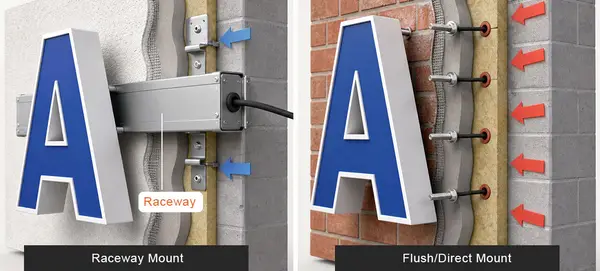
You're getting ready to order channel letters and now you're staring at a mounting decision. Raceway? Direct? Flush?
Here's what nobody tells you: the mounting method determines how much your wall preparation costs, how long the install takes, and whether your sign survives its first windstorm. It's not the most glamorous part of the sign business, but it's the one that gets called back when things leak, sag, or fall.
I've been in the sign industry since 2010, and I've watched veteran installers argue with architects about mounting boxes, seen cheap raceways rust out on coastal jobs, and pulled direct-mounted letters off walls that were nothing but stucco over chicken wire. Let me break this down so you don't learn the hard way.
---
What These Three Mounting Methods Actually Are
Before we get into the weeds, here's the plain-language version:
**Raceway mount** (also called channel mount mounting). A rectangular metal box—usually aluminum or steel—gets anchored to the building. The channel letters are then pre-wired onto that box. One power hookup, one set of mounting holes, clean service access. The raceway becomes the backbone of the sign. It's technically a "sign raceway mount" or "channel mount" depending on who's selling it.
**Direct mount** (also called individual letter mounting or through-wall). Each letter is mounted separately, directly to the building surface. This means drilling individual holes for each letter, running a separate conduit between letters, and often pulling wires through the building wall. It's a beautiful floating appearance—you don't see a can, just the letters.
**Flush mount** (for face-mounted signs, typically acrylic or metal panels). The sign panel sits tight against the wall. No standoffs, no gap. This is common for light boxes and flat signs. Sometimes the term "recessed mount" gets thrown in, but that usually means a sign set into a framed opening in the wall.
Now here's the kicker: these aren't competing products. They're different installation strategies, and the best choice depends on the wall you're dealing with, your budget, and the sign itself.
Look, I've seen this go wrong more times than I can count. A contractor buys premium halo-lit letters for a brick storefront, then assumes direct mounting works. It does. But they didn't check whether the brick was structural or just 25mm veneer. Three months later, a letter catches wind and torques out.
---
The Raceway Mount: The Workhorse
A sign raceway mount is basically a metal channel that carries the electrical wiring and provides a flat mounting surface for each letter. The letters mount onto the raceway instead of the building. You see this constantly on older strip malls, multi-tenant buildings, and large format signage where the wall isn't flat or clean.
**Why choose a raceway:**
- Installation speed. The raceway goes up first—generally 4-6 mounting points handle the whole weight. Letters and wiring are then installed onto the raceway. You're not drilling 20-30 holes into the facade.
- Electrical access. If you need to service a transformer or LED power supply, you open the raceway cover instead of pulling letters off the wall.
- It creates a flat plane. If you're mounting on a brick wall that's uneven or stone veneer that's far from flat, the raceway bridges those gaps.
- Retrofit friendly. Old signs with obsolete mounting patterns can be upgraded with a raceway that covers the previous holes.
**The honest trade-offs:**
Raceways add a visible "can" behind the letters. It's not as clean as direct mounting. On premium architectural projects—think corporate headquarters with
back-lit halo letters—the client will sometimes flat-out reject the visible box.
Installers hate this, but the cheap aluminum raceways shipped from China weather okay, but they dent easy. If an installer clamps down on the bolt torque, they mar the finish. You'll see the dimple.
For the factory side, the cost difference is real. A standard raceway assembly runs $40-80 extra on a set of letters—not huge, but it's there. That includes pre-drilling the raceway to match the letter mounting studs.
The ugly truth is that raceway mounts are perfect for ugly walls. And most commercial walls are exactly that—cinder block, uneven brick, deteriorating stucco.
---
Direct Mount: The Showpiece
Direct mounting gives you the illusion that letters are floating on the wall. No visible mounting rail, just the letter faces and their halo glow at night. This is where projects get showcased. It's also where installers become white-haired.
**The real work of direct mounting:**
Each letter gets 2 to 5 mounting studs depending on size. For a typical 45cm letter, expect 3 studs. Those studs land in the letter body via welded standoffs (through the returns, not the faces). The installer marks the hole locations, drills into the wall, sets anchors, then mounts each letter individually.
Then comes the interesting part: the wiring.
The letters need to connect to power somehow. That means either:
1. **Through-wall wiring.** You drill a hole behind each letter, feed the wire into the building, and wire everything in the interior. Clean look. Costly to maintain.
2. **Conduit between letters.** You run a small conduit tube between letters to pass wires. The conduit is usually painted to match the wall. It's technically visible if you're looking for it, but it's subtle.
3. **Sealed junction boxes behind letters.** The wire exits the letter via weatherproof connector and enters the building through a single point. Premium and marine-grade.
**When direct mounting makes sense:**
If you're putting
stainless steel letters on a granite composite panel, limestone, or glass curtain wall—the raceway would look like a dumpster on a sports car. Direct mounting preserves the material.
The problem is the wall itself. You can't direct mount into EIFS (exterior insulation and finish system) or thin composite panels without backup structure. The installer needs to know exactly what's behind the skin. I've encountered walls where the only structural backup was a metal stud 60cm away from where the letter needed to go. That meant adding angle brackets behind the panel. The cost of the install jumped.
**Direct mount cost reality:**
Watch this: the letters themselves are the same price from a factory. But the installation can easily run $60-100 per letter. And for touch-ups, if an installer mangles the mount, you're paying for the call-out.
For importers buying direct from a Chinese factory, the direct mount option means you need to specify the exact stud locations and sizes at design review. Nobody wants to explain to a client that the 20cm spacing pattern is wrong because nobody told the factory to verify the mounting surface.
---
Flush Mount: The Wysiwyg Sign
Flush mounting is the simplest, most literal approach. The sign sits directly on the wall, flush—no standoffs, no gap. This is how you'll see most
acrylic light boxes installed, and plenty of flat cut-out letters.
**When to flush mount:**
- Light boxes and menu boards. They have a box frame or a pre-fabricated mounting rail already. You attach it to the wall, wire it up, and done.
- Flat face signs on interior walls. This is a staple for office lobbies and wayfinding.
- Metal letters on a solid flat surface where you don't want a halo effect.
For exterior channel letters, "flush mount" often just means the letters are mounted tight enough that you can't fit a finger between the letter and the wall.
The catch? The sign's back is touching the wall. That means any water that gets between the sign and the wall has nowhere to drain. You WILL get water stains and corrosion at the bottom edge of the letters unless the installer leaves weep holes.
**The flush mount trap:**
Here's what nobody tells you: flush mounting doesn't mean zero clearance for a 15cm deep channel letter. It means the letter sits flat against the wall, but the wiring still goes through the building. It's direct mount with no air gap. If you have a letter with a transformer that needs ventilation, flush mounting reduces airflow and shortens LED life. Ask about that before you settle on flush mounting for large volume letters.
Also, flush-mounted signs are the worst in buildings with temperature expansion. The building panels shift. The letters are fixed. Over time, cracks appear in the silicone or caulk seam.
---
Comparing the Three Methods Side by Side
Let me be direct with you.
| Feature | Raceway Mount | Direct Mount | Flush Mount |
|---------|--------------|--------------|-------------|
| Installation time | Fastest | Slowest | Middle |
| Material cost | Low (aluminum rail) | Nothing extra (but labor heavy) | Low |
| Labor cost | $$ | $$$$ | $$ |
| Wall requirements | Any flat surface | Needs adjustable anchors, hidden structure | Flat, clean surfaces |
| Electrical access | Excellent | Difficult | Moderate |
| Aesthetics | Visible box | Clean floating look | Minimal profile |
| Retrofit/concealment | Hides old holes | Makes old holes visible | Hides old holes |
| Typical use | Strip malls, retrofit | Corporate, premium | Light boxes, flat panels |
Here's the practical math. A set of 9 channel letters at 50cm each, direct mounted with through-wall wiring, will cost you 30-50% more in labor than a raceway job. If the wall is concrete with a 25mm insulation layer, the through-wall work adds another 15%.
When importers ask me what they should sell to American sign shops, I always steer them to raceway kits and direct mount hardware kits. Why? Because with raceway, you save the installer time. Time is money. With direct mount, you charge a premium for the finish.
---
What a Factory Actually Does vs. What's On-Site
This is where I'm going to be brutally honest with you.
Our factory in Lu'an makes the signs. We cut, bend, weld, paint, wire the letters, and mount them onto pre-drilled raceways or weld mounting studs onto the letters. That's all we can do. We cannot control the wall you're mounting to, and we shouldn't pretend to.
Here's what nobody tells you: we can drill the mounting holes for you, we can verify the stud spacing, and we can test the raceway for levelness. But we can't tell you whether your wall is structural masonry or hollow block with decorative veneer. That's an on-site judgment call. Don't let anyone—including us—tell you otherwise.
For importers: when you order
front-lit channel letters, specify the mounting method. If you're unsure, order the raceway kit. It's the safest choice—both structurally and for installation. You avoid the headaches of on-site wall preparation, and your customer doesn't have to coordinate electricians for through-wall wiring.
---
Installation Methods & the Real Cost to Deliver
Let's talk about price differences from the factory side.
- Raceway mounts: $20-40 per linear foot of raceway, plus letters. You're paying for the aluminum, the pre-drilling, and the wiring channel. This is economical.
- Direct mount kits: These are just studs and mounting hardware welded to the letters. They add $5-15 per letter in material, but the on-site cost can be triple that if steel studs have to be put in the wall behind the letters.
- Flush mount: The cheapest to buy, but the strictest wall requirements.
Then have a look at the electrical. It's not just aesthetics. Through-wall wiring requires a licensed electrician in most jurisdictions. A raceway keeps the installation in the general contractor's wheelhouse. This is a big cost difference on a project.
---
Making Your Decision: A Simple Cheat Sheet
Ask yourself these questions. They'll tell you what to buy.
**Choose raceway mount if:**
- The wall surface is not perfectly flat (brick, CMU, stucco, composite panels).
- You need quick installation to minimize on-site labor.
- The sign is large and heavy—six or more letters.
- It's a retrofit or the wall has existing holes.
- You're buying for a national account with multiple locations onto different wall surfaces. Standardizing on raceway saves you headaches.
**Choose direct mount if:**
- The wall is a premium material and you can't hide a raceway.
- The sign is halo-lit and the premium look is part of the brand value.
- The building has a structural backup you can anchor into.
- You have full control over the install schedule and electrical rough-in.
**Choose flush mount if:**
- It's a light box or a flat panel sign on a covered, interior, or protected wall.
- The letters are non-illuminated, and the wall is smooth.
- There's no depth requirement and no need for ventilation.
---
Ah, one more thing about wind loads
Nobody wants to calculate wind load, but here's the ugly truth: raceway mounts, because they create a solid back panel, catch more wind. A direct-mounted letter allows wind to pass around the letter, reducing stress. This is why direct-mounted letters are the standard for big free-standing channel letters exposed to open areas.
At 150 km/h wind, a 60cm letter with a flat back experiences roughly 165 N of force. For a 10-letter sign, that's significant. Direct mount spreads that force across individual anchors. Raceway concentrates everything on the anchored box. Flush mounting is generally fine unless you're in a hurricane zone and the letters are deep channel.
Now, get this: if you're shipping to Miami or any hurricane zone, you should be specifying 316 stainless steel brackets and marine-grade anchors. Not 304. Not coated aluminum. That 30% extra cost is insurance against a wall-mount failure. I can't make this any clearer.
---
Now, For the Importers & Sign Shops Ready to Order
Let me speak to the actual buyer. You've compared prices. You've read about
dual-lit channel letters for day-night visibility. You know the housing and the wiring are done in the factory.
Here's what nobody tells you: if you are importing, the factory's responsibility ends once the sign is crated. The mounting hardware is your issue.
I'm telling you this because I want you to order with your eyes open. When you call us, or another factory, ask the salesperson "Is that quote with a raceway or as bare letters?" and "What amount of on-site adjustment did you estimate for the mounting studs?" If they can't answer, find a factory that can.
Our factory ships worldwide. We can handle your production, but we need your input on the following:
1. **Mounting surface type.** Is it block, brick, pre-cast concrete, steel, or studs? We'll weld the right anchors based on this.
2. **The dimension of any sign cabinet/raceway.** If you need one, tell us the wall's flatness tolerance. If the wall is out 20mm, a raceway is your only option.
3. **Access to power.** Do you have a single conduit point or do you need per-letter wiring? This affects how we wire the letters internally.
Also, when we quote, we include the 10-step process: design confirmation, laser cutting (± 0.1mm), TIG welding, grinding, CNC acrylic, LED assembly, silicone sealing, aging test, 100% QC, and export packaging. We don't cut corners on the back end because that's what makes mounting a sign a 30-minute job instead of a 5-hour fight.
---
The Role of Code Compliance
Don't ignore the local code. For US installs, NEC Article 600 requires specific wiring methods for signs.
Here's the problem: direct mount with through-wall wiring is a "dry" install. You're pulling wires into the building. But if the building is a steel-frame commercial building, the electrician needs a permit and a point of connection. Raceway mounts simplify this because the wiring is self-contained in the raceway. It's not considered a building wiring method to the same extent.
Look, I've had clients pass UL-listed letters through local inspectors and fail because the raceway wasn't UL 48 listed. The letters had UL listing from our factory, but the metal raceway was standard stock material. The inspector wanted to see the whole sign assembly certified. The lesson? When a factory says "UL 48 available," ask if the raceway is part of the certification. Ours is.
---
The Shipment & Logistics Hell Most People Forget
Raceway-mounted signs ship as more compact units. The raceway itself is flat and can pack tightly.
Direct-mounted letters ship individually with loose hardware. That's fine. But you risk the mounting studs bending during transit. We've seen it too many times: a letter shows up with a stud angled at 15 degrees. It's unsightly and it's a pain to straighten on-site without damaging the finish.
Here's my suggestion for importers: ask the factory to add foam inserts around the letters, or custom foam specifically cut to protect the standoffs. It adds $20 to the crating cost, but it saves you from a blown install timeline.
---
The Final Verdict (From Someone Who's Seen It All)
If I had to choose one method to recommend to the widest range of sign shop owners, it would be the raceway mount. It's forgiving, it's lightweight, and it's easier to install. Nothing about a raceway is a point of pride, but nothing about it fails either.
Direct mount is what you sell to architects and clients who want "clean." But understand what you're getting into—chasing the drywall, coordinating with an electrician, and asking for a maintenance schedule.
Flush mount is for cabinets, but not channel letters. Don't use it for deep dimension letters on exterior walls unless you've got a solid weatherproofing plan.
And remember, a sign is not decoration. It's a machine. It takes the blame for a failed mount and haves to survive rain, snow, UV, and gravity. Make the right choice from the start, and your work life gets a lot simpler.
If you've got a project and you're not sure what your wall can handle, send us the details. We'll shoot straight with you about what we can do (fabricate, assemble, test, pack) and what we can't (inspect your building). It's that simple.