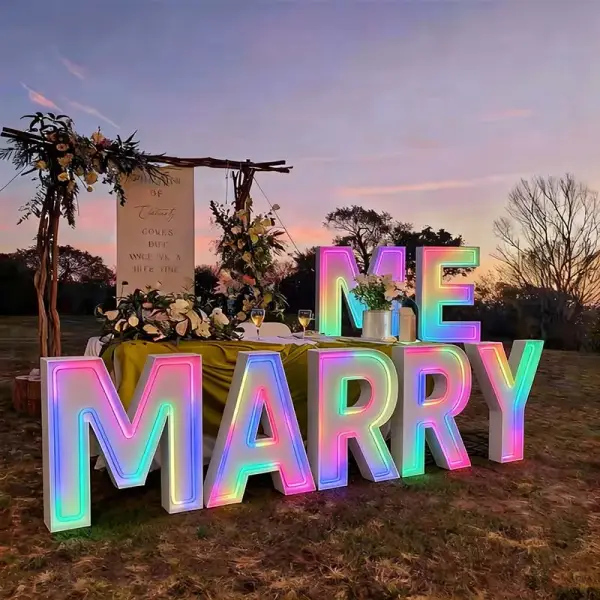
Look, I've watched sign shops pay $800 for a front-lit letter from a domestic fabricator. Same 304 stainless, same Samsung LEDs. We ship that letter for $120. That's not a sales pitch. That's the difference between buying retail signage from a middleman and buying it from a factory floor in Lu'an, Anhui.
Here's what nobody tells you: retail signage isn't a cost. It's a revenue driver. A storefront without a visible sign is a storefront that doesn't exist. US shops charge $200–700 per letter installed for front-lit channel letters. The factory product cost runs $20–80. Even after 30% Section 301 duty and freight, you're still 50–65% below retail hardware.
That margin is the difference between winning the bid and eating ramen.
I've seen this go wrong: a client bought cheap non-lit acrylic letters to save $200. Three months later the letters yellowed because they used domestic acrylic rated for 1–2 years. UV-resistant Mitsubishi or Degussa acrylic lasts 5–8 years. Replacing them cost three times what they saved. Cheap signage is the most expensive signage.
For a strip mall storefront, front-lit channel letters are the workhorse. They light the face, they're legible from the parking lot, and they run $20–80 per letter from our floor. US retail installed? $200–700 per letter. Nobody is getting rich at those installed prices except the installer.
If the client wants to look like a law firm or a boutique hotel, go with back-lit halo letters. They cast a soft glow onto the wall behind the letter. Factory cost is $35–120 per letter. Retail installed runs $400–1,000. That's a premium look, and you should charge for it.
The ugly truth is most retail buyers over-spec the sign type because a competitor has something flashy. A dentist office doesn't need RGB chasing edges. A nail salon doesn't need 316 stainless. Match the sign to the business. That's all.
Lightboxes at $80–250 per square meter from the factory work fine for storefront box signs. Neon flex at $30–200 per sign gives the neon look without glass tubes and 15kV transformers.
For a non-illuminated look, fabricated stainless steel letters run $15–40 per letter, 3D fabricated $40–120, and aluminum $10–25. If the building already has a sign band and you just need letters, don't pay for lighting.
Here's a fact nobody likes to admit: material choice matters more than LED lumen count. Stainless steel letters in 304 last 10+ years outdoors. 316 lasts 15+ years in coastal salt air because it has 2–3% molybdenum. But 316 costs 20–30% more. For a strip mall in Ohio, 304 is fine. For Miami Beach, pay for 316 or you're replacing letters in three years.
Aluminum weighs a third of steel and won't rust. For 8–12 year outdoor life, 1.0–1.6mm aluminum with a powder coat does the job at $10–25 per letter from a factory.
Acrylic face thickness is where rookies waste money. For standard acrylic LED letters, a 3mm acrylic face transmits 92% of the light. A 2mm face transmits 90%. Your customer won't notice the 2% difference, but they'll notice the 40% cost bump. For any letter over 2.5m, bump to 5mm+ for structural stiffness.
Stainless finishes: brushed #4 hides fingerprints, mirror #8 reflects sunlight into the neighbor's windows. PVD and powder coat give you color without paint. All of them cost more than raw 304, but they're cheaper than replacing a sign that rusted because someone spec'd cheap paint over bare aluminum.
LED quality is a silent killer. SMD 2835 modules push 100–150 lumens per watt and last L70 ≥50,000 hours. Quality modules from Samsung, Osram, or Blueview run 5+ years real world. Cheap no-name modules? 12–18 months before half the diodes flicker. Quickest way to spot bad LED modules: look at the solder joints. Dull gray means it won't last 18 months. Shiny silver means proper lead-free solder.
UL 48 certification costs $4,000–15,000 and takes 4–9 months. ETL is 10–30% cheaper and accepted in most US jurisdictions. If you're sourcing from China and the factory says "we have UL," ask for the file number and the quarterly audit reports. No file number, no sign.
CE marking costs 20,000–50,000 RMB and takes 2–8 weeks. Most factories will say they have it. Ask to see the certificate with today's date. Watch them sweat.
IP65 sounds impressive. It means dust-tight and protected against water jets from any direction. It does not mean your sign survives a Florida hurricane. For coastal environments, IP66 handles powerful jets. For extreme weather, IP68 is submersible. Minimum for outdoor is IP65.
ADA tactile signs require mounting between 48 and 60 inches, non-glare finish, and Grade 2 Braille. NEC Article 600 governs US electrical signage. Forget that and your inspector will red-tag the whole storefront before you've opened the box.
Permits vary by city, but the sign itself isn't the bottleneck. Our fabricator can build a sign in 7–15 days. Your local permit office can take 30. Start the permit before you finalize the font.
Color temperature makes or breaks a retail sign. 3000–3500K warm white belongs in hospitality. 4000–5000K neutral works for corporate and retail. 6000–6500K cool is for industrial and highway. A bakery with 6500K LEDs looks like a gas station. Nobody can articulate why they don't trust the store, but they don't.
Readability is about contrast, not just size. Light transmittance through a 2mm acrylic face is 90%. A 3mm face is 92%. The human eye won't register that 2% drop. But it will register letter spacing that's too tight or a font that gets lost against a busy facade.
Stop overengineering the face thickness and start obsessing over contrast ratio.
For signs over 2.5 meters, bump to 5mm+ acrylic. Under that, 2mm or 3mm is fine. The real cost driver is the LED density, not the plastic. Use SMD 2835 modules at 100–150 lm/W. More lumens don't help if the sign is aimed at the wrong angle.
I've seen a storefront with 12-inch channel letters at 6000K cool white. The owner wondered why foot traffic dropped after dark. The sign looked like a police cruiser. 4000K neutral would have been readable and inviting. Color temperature is free. Getting it wrong costs you customers.
A static front-lit channel letter is readable 24/7 and won't annoy the landlord. A RGB chasing edge is a nightclub move. SMD 5050 modules are RGB capable. SMD 5730 chips push 40–60 lumens per chip for highest brightness. If the business is a coffee shop, static warm white wins. If it's a hookah lounge, go RGB.
The ugly truth is most "digital signage" in retail is just a static sign with a programmable RGB controller bolted on. DMX programming gives you animated shows. IoT smart signs let you change colors from an app. But unless the business changes promotions weekly, that's a toy, not a tool.
Match the tech to the traffic. A grocery store doesn't need a light show.
I've been on this factory floor since 2010. Aochuang Sign runs 3,000 square meters with 50+ workers and we'll sell you one letter. MOQ is one piece. Lead time is 7–15 days after design confirmation. That's not a brag. That's the math of a 10-step process that runs laser cutting, TIG welding, CNC acrylic, LED assembly, and an 8–12 hour aging test before anything ships.
Factory-direct sourcing cuts 50–65% off the product cost compared to US retail installed. Express shipping runs $30–100 for small parcels and takes 7–15 days. Air freight is $4–12 per kilogram and takes 10–20 days. Sea freight LCL costs $80–200 per cubic meter and takes 50–70 days. Full container runs $1,200–3,000. Add the US Section 301 duty of about 30%.
The ugly truth is sea freight LCL changes hands 6–8 times between our dock and yours. Every touch is a chance for damage. That's not in the brochure. We pack in foam, carton, then plywood crate because we know what happens on the dock at 2am.
Quality control here isn't a slogan. Every sign goes through an 8–12 hour aging test and 100% QC inspection before export packaging. The LED warranty is 2 years. Power supply 1 year. If the supplier won't show you the QC checklist, walk.
We hold CE, RoHS, and ISO 9001. But certificates expire. Ask for the certificate number and verify it. Then ask about the warranty on the power supply separately.
A client ordered 50 channel letters without an aging test from another factory. Six months later half the LEDs flickered. The power supply died at month 10. The factory warranty was 90 days. Ours is 2 years on LED, 1 year on power supply. Read the warranty. Then read it again.
We do one piece. Custom size, custom finish, custom LED color temperature. That's the point of buying factory-direct.
Do I really need UL certification for a small strip mall sign? If it's hardwired and inspected, yes. UL 48 costs $4,000–15,000 and takes 4–9 months. ETL is 10–30% cheaper and accepted most places. Show up with an uncertified sign and the inspector won't smile.
Why is 316 stainless so much more expensive than 304? Because 316 has 2–3% molybdenum and survives 15+ years in salt air. In Ohio, use 304 and save 20–30%. In Miami Beach, pay for 316 or replace everything in three years.
How long does sea freight actually take? 50–70 days. Plus your crate changes hands six to eight times. Pack it like it'll be dropped, because it will. We do.
What's the real difference between 2mm and 3mm acrylic? Light transmittance drops from 92% to 90%. Your customer won't notice. Stop spending 40% more on material. I can't believe I still have to explain this.

Real photo from our production floor — every sign we ship is made here.
Products mentioned or relevant to this topic — factory-direct, custom built.
From $24/letter · MOQ 1 piece · Flexible lead time · CE & UL certified · ships to 20+ countries
Custom sizes, colors, and finishes. Get a factory price in 24 hours.
Get a Free Quote Copy EmailWhatsApp +86 13865703472 · business@aochuangsign.cn