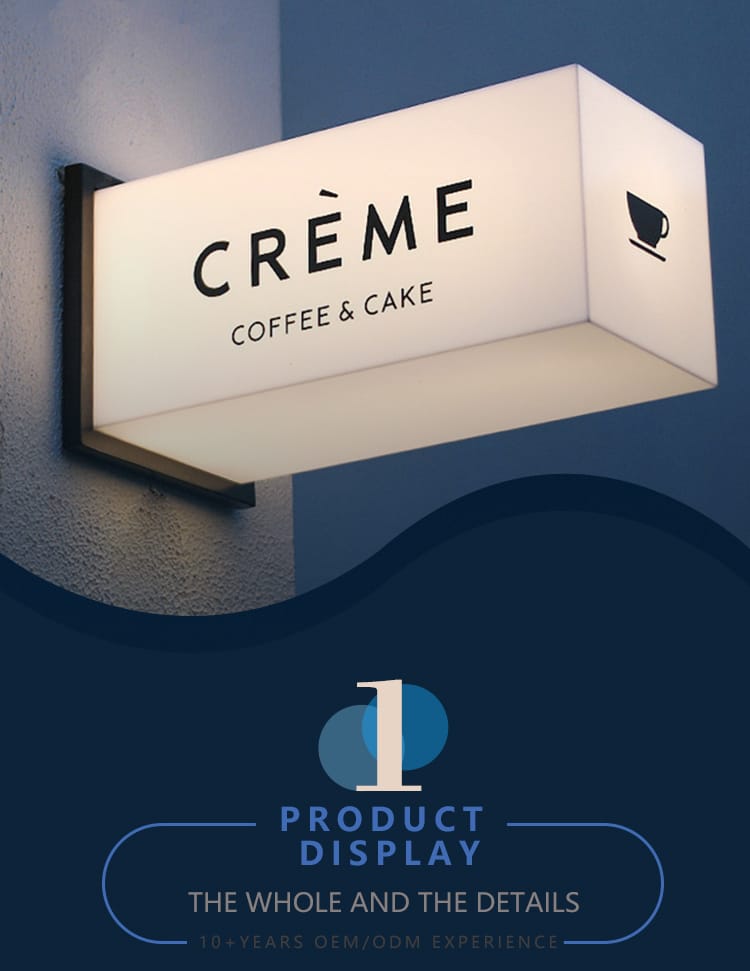
Reverse lit channel letters are the closest thing this industry has to a magic trick. Light hits the wall, the wall makes the sign legible, and nobody knows how it works until they install one wrong.
Look, after 15 years on the factory floor, I've bent more aluminum returns and wired more LED modules than I can count. I've also watched contractors pay $800 for a front-lit letter from a domestic fabricator. Same 304 stainless, same Samsung LEDs. We ship that letter for $120. So if you're quoting a halo job, don't guess. Know what you're building.
Here's what nobody tells you: a reverse lit channel letter isn't a front-lit letter turned around.
The face is solid aluminum or stainless. The back is a translucent acrylic panel. LEDs sit inside, aimed at the wall. You mount the whole thing 1.5 to 2 inches off the surface, and the light spills around the edges to create that soft halo. That's why they're also called back-lit halo letters.
Materials matter more than your client thinks. The return can be aluminum, which weighs 1/3 of steel and naturally won't rust, or stainless.
I push 304 stainless steel letters for most exterior jobs because 304 has 18% chromium and 8% nickel, and it'll sit outside for 10+ years without degrading. If you're 300 yards from the ocean, step up to 316. It adds 2-3% molybdenum and costs 20-30% more, but salt spray eats 304 alive.
The back panel is usually 2mm or 3mm acrylic. Acrylic transmits 90-92% of light, but not all acrylic is equal. UV-resistant material from Mitsubishi or Degussa lasts 5-8 years before it starts to haze. Domestic acrylic can yellow in 1-2 years. That's a warranty claim waiting to happen.
LED selection decides whether your halo looks like a halo or a cop car chase.
SMD 2835 modules are the industry standard. They run 100-150 lumens per watt. For most reverse lit channel letters, I space 2835 modules on 3-inch centers. On a narrow stroke under 1.5 inches, I drop to 2 inches. If you don't, the light bunches up and you get bright spots, not an even halo.
Need more punch? SMD 5730 chips push 40-60 lumens per chip, highest brightness in the catalog. But they also dump more heat. Heat kills. I've seen cheap modules fail in 12-18 months because the solder joints get baked inside a sealed letter. Quality modules from Samsung, Osram, or Blueview will run 5+ years. L70 rating on paper is 50,000 hours. The cheap stuff never gets there.
Color temperature follows the job. 3000-3500K warm for hospitality, 4000-5000K neutral for corporate and retail, 6000-6500K for industrial parks and highway-facing signs. Don't mix color temps on one sign. The client won't notice the difference on day one, but you'll see it every night for the next five years.
The ugly truth is most clients want the halo look but only have a front-lit budget.
Front-lit letters punch light straight through an acrylic face. They're workhorses, and factory-direct they run $20-80 per letter. But they don't give you the wall glow. Front-lit channel letters are fine for a strip mall.
Halo-lit letters cost more because the fabrication is more precise. Factory-direct, back-lit halo letters run $35-120 per letter depending on size and finish. US retail installed prices? Try $400-1,000 per letter. That's why everyone suddenly starts importing.
Combination or dual-lit letters do both. They have a lit face and a lit halo. Dual-lit channel letters are gorgeous, but they double your LED runs and your potential failure points. I only recommend them for banks, law firms, and people who don't blink at maintenance budgets.
I've seen this go wrong: a shop ordered 8-inch letters with 1-inch returns and expected a full halo. The letters went up, and the wall looked like a flashlight beam through a keyhole.
Return depth is not decorative. For a reverse lit letter, I won't go under 1.5 inches. Two to 3 inches is standard. The deeper the return, the softer the halo. But deeper returns also catch more wind. If you're in a hurricane zone, specify stud mounting through the wall, not just silicone and standoffs. Silicone fails. Exactly when you don't want it to.
Laser cutting gets tolerances to ±0.1mm. That matters because a sloppy return means the light gap is uneven. We TIG weld the returns, grind, polish, then CNC the acrylic back panel. The 10-step production process runs design, cutting, welding, grinding, CNC, LED assembly, sealing, an 8-12 hour aging test, 100% QC, then export packaging.
Seven to 15 days total. If a factory skips the aging test, you'll find out when half the letters go dark on the truck.
Don't let anyone sell you 5mm acrylic for a small reverse lit back panel. It's a waste of money. Over 2.5 meters wide? Yes, go 5mm+ for structural integrity. But a 2mm or 3mm panel diffuses the halo just fine and keeps the weight down.
Here's what nobody tells you: UL listing isn't a law. Your local inspector cares about NEC Article 600.
UL 48 certification costs $4,000-15,000 and takes 4-9 months, with quarterly audits. ETL is a legit alternative and runs 10-30% cheaper. If your supplier claims UL, ask to see the certificate with today's date. Watch them sweat.
CE marking costs 20,000-50,000 RMB, and every factory will say they have it. Ask for the actual certificate, not a photo of a logo.
For outdoor reverse lit signs, IP65 is the minimum. That means the enclosure is dust-tight and can take water jets from any direction. That doesn't mean your sign survives a Florida hurricane. IP66 handles powerful jets, and IP68 is submersible. If a salesman tells you IP65 is 'waterproof,' he's never been on a roof during a nor'easter.
Wiring is where rookies blow it. Use the correct power supply. A 1-year power supply warranty is standard on factory-direct orders, but a cheap supply will nuke your 2-year LED warranty. Match the supply to the total wattage of the modules. Don't daisy-chain 40 letters on one run and wonder why the last five are dim.
Factory-direct back-lit halo letters run $35-120 per letter. US retail installed prices sit at $400-1,000 per letter. That's a 50-65% savings on product, even after shipping and tariffs.
Section 301 tariffs add roughly 30% on Chinese signage, and sea freight takes about 65 days. Air freight is about 10 days at $4-12/kg. Do the math before you promise a two-week install.
Energy use is a rounding error. SMD 2835 modules run 100-150 lumens per watt, so a typical storefront halo sign pulls very little power. A 10-letter sign with quality modules might sit under 200 watts. At commercial electric rates, your client won't even see it on the bill.
The real ROI is the 5+ years of LED life from Samsung or Osram modules versus the 12-18 months from cheap ones.
The ugly truth is the lowest quote almost always hides a cheaper material and a garbage LED module.
You need a QC checklist before you send money. First, ask for photos of the solder joints. Dull gray solder means cheap. Shiny silver is proper lead-free solder.
Second, confirm the LED module brand. Samsung, Osram, and Blueview modules last 5+ years. No-name modules last 12-18 months. Third, ask for the material certificate on the stainless. 304 should show 18% chromium and 8% nickel. If they can't produce it, it's probably 201 stainless with a nice Instagram filter.
Sea freight LCL is where signage gets destroyed. Your crate gets handled 6-8 times between our dock and yours. Every touch is a chance for damage. That's why we pack with foam, carton, and plywood crate, and why you should inspect before signing the delivery receipt. Hidden costs: tariff, customs bond, port fees, and the electrician who has to fix a wire that pulled loose in transit.
Before your order ships, it should run an 8-12 hour aging test and pass 100% QC inspection. If the factory can't show you the test log, walk away. I've watched factories skip the aging test to hit a 7-day lead time. The customer gets a sign that works for two weeks, then half the modules die.
Do reverse lit letters use more power than front-lit? No. The LEDs don't care which direction they're pointing. Halo letters often use fewer modules because the wall reflection does some work for you.
Can I put a reverse lit sign outside in a coastal area? Use 316 stainless returns and IP66-rated power supplies. 304 with powder coat doesn't survive salt spray without eventual pitting. Pay the 20-30% premium now or replace the letters in three years.
What's the minimum letter height for a decent halo? If the stroke width is under 1 inch, forget it. Go 12 inches tall or accept that the halo will be uneven. Small letters with narrow strokes are a design problem, not a fabrication problem.
Why does my quote say UL 48 is optional? Because UL 48 isn't required by law. Inspectors enforce NEC Article 600. UL listing costs $4,000-15,000 and takes months. If a supplier claims they have it, ask for the certificate with today's date. The silence tells you everything.

Real photo from our production floor — every sign we ship is made here.
Products mentioned or relevant to this topic — factory-direct, custom built.
From $24/letter · MOQ 1 piece · Flexible lead time · CE & UL certified · ships to 20+ countries
Custom sizes, colors, and finishes. Get a factory price in 24 hours.
Get a Free Quote Copy EmailWhatsApp +86 13865703472 · business@aochuangsign.cn