Look, I've spent fifteen years on a factory floor in Lu'an, Anhui. I still get emails from sign shop owners asking if Chinese letters will melt in the rain.
They won't. But buy from the wrong factory and you might wish they had. I've seen it all. Cheap acrylic that yellows in 18 months. LED modules with solder joints so dull they look like somebody used a lighter. Crate after crate that shows up looking like it lost a fight with a forklift.
This isn't a listicle. It's what I'd tell you over a beer if you asked whether buying from a signage manufacturer in China is worth it.
Most people think all Chinese signage comes out of one massive building in Shenzhen. It doesn't.
Factories cluster where raw materials are cheap and floor space doesn't eat you alive. We're in Lu'an, Anhui. That's not Shanghai, and that's the point. Our facility runs 3,000 square meters with 50+ skilled workers. We've been at this since 2010 and hold CE, RoHS, and ISO 9001.
What matters isn't the city. It's whether the factory actually exports and whether they'll show you the production floor on video before you wire a dime.
Here's what nobody tells you: the difference between a front-lit channel letter that lasts five years and one that dies in 18 months is the LED module, not the acrylic face.
Factory-direct pricing for front-lit channel letters runs $20 to $80 per letter. Want a letter that'll make the architect nod? That's back-lit halo letters at $35 to $120 per letter. Stainless non-lit letters go for $15 to $40. Aluminum runs cheaper at $10 to $25.
But the material specs are where you either win or get hosed.
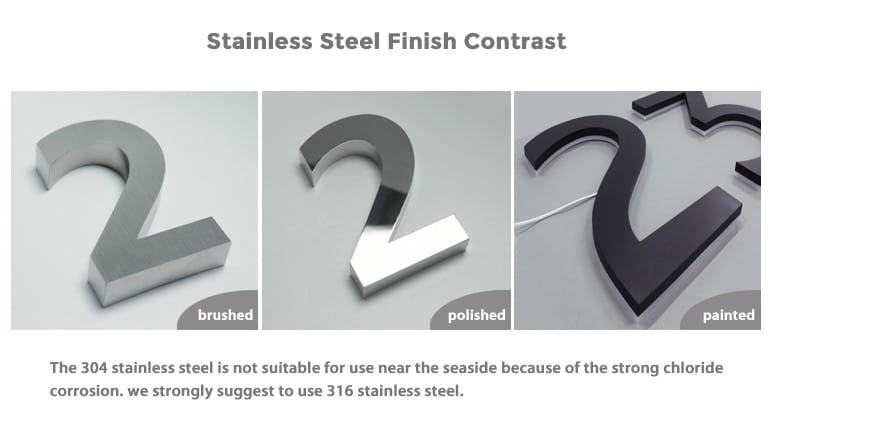
For stainless steel letters, 304 is 18% chromium and 8% nickel. That gets you 10+ years outdoors in most places. 316 adds 2-3% molybdenum and costs 20-30% more. Use 316 for Miami Beach or an industrial park with acid rain. Don't pay for it in Ohio.
Aluminum weighs a third of steel, won't rust, and holds up 8-12 years outside. Typical thickness runs 0.040 to 0.063 inches—1.0 to 1.6mm.
Acrylic light transmittance is 90-92%. UV-resistant acrylic from Mitsubishi or Degussa holds up 5-8 years before yellowing. Domestic acrylic? 1-2 years. If the sign is over 2.5 meters, spec 5mm+ thickness. Don't let a factory quote 2mm on a four-foot letter.
LEDs: SMD 2835 puts out 100-150 lm/W and is the industry standard. SMD 5730 gives 40-60 lm per chip and the highest brightness. Quality modules from Samsung, Osram, or Blueview last 5+ years in the real world. Cheap no-name modules? 12-18 months before your client calls you screaming.
Color temperature matters more than most clients think. 3000-3500K is warm and works for hospitality. 4000-5000K is neutral for corporate and retail. 6000-6500K is cool for industrial and highway signs.
When a restaurant wants LED neon flex, budget $30 to $200 per sign factory-direct. It's not real glass neon, but it won't shatter in shipping and doesn't need a neon guy to fix it.
The ugly truth is most US sign shops charge retail installed prices of $200 to $700 per front-lit letter and $400 to $1,000 per halo-lit letter. That's fine. You have labor, rent, insurance, trucks.
But when you buy direct from a factory like ours, you're paying 50-65% less on the product itself. Not because the product is worse. Because you skipped three middlemen and a domestic fabricator's overhead.
Here's the benchmark sheet I hand clients. Front-lit channel letters: $20-80/letter. Back-lit halo: $35-120/letter. Stainless non-lit: $15-40/letter. 3D fabricated: $40-120/letter. Aluminum: $10-25/letter. Light boxes: $80-250 per square meter.
I've watched sign shops pay $800 for a front-lit letter from a domestic fabricator. Same 304 stainless, same Samsung LEDs. We ship that letter for $120.
That math isn't complicated.
I've seen this go wrong plenty: a buyer gets a quote, asks for photos, sees a clean shop, wires money, and then the letters arrive with pinhole welds and no drain holes.
Quality control isn't a sticker. It's a process. Ours runs ten steps: design confirmation in one day, laser cutting at ±0.1mm tolerance for one to two days, TIG welding, grinding and polishing, CNC acrylic face, LED assembly, neutral silicone sealing, an 8-12 hour aging test, 100% QC inspection, then export packaging in foam, carton, and plywood crate.
When you audit a factory, don't ask "Do you do quality control?" Ask: "Can you send a video of the aging test running right now? What tolerance does your laser hold? What solder do you use on the LED modules?"
The quickest way to spot bad LED modules: look at the solder joints. Dull gray means it won't last 18 months. Shiny silver means proper lead-free solder.
If they can't show you the aging test? Walk away.
Look, certifications matter. But only if they're real.
UL 48 certification costs $4,000 to $15,000 and takes 4 to 9 months, plus quarterly audits. ETL is a legitimate UL alternative and runs 10-30% cheaper. CE marking costs 20,000 to 50,000 RMB and takes 2 to 8 weeks. RoHS is part of that electronics conversation.
CE marking is where factories lie most. Most will say they have it. Ask to see the certificate with today's date in the photo. Watch them sweat.
IP65 means dust-tight and protected against water jets from any direction. That's the minimum for outdoor signs. IP66 handles powerful jets for coastal spots. IP68 is submersible. Overkill unless you're mounting a sign in a waterfall.
For US installs, the sign has to meet NEC Article 600 electrical requirements. ADA tactile signs need a mounting height of 48-60 inches, non-glare finish, and Grade 2 Braille.
Warranty: we give 2 years on LEDs and 1 year on the power supply. If a factory offers 5 years on cheap modules, they're either lying or pricing to replace them twice.
Look, the factory price is not your landed cost. If you forget that, you'll blow your margin.
Shipping options: Express takes about 5-15 days and runs $30-100 for small orders. Air freight takes about 10 days at $4-12 per kilo. Sea freight is about 65 days. LCL runs $80-200 per cubic meter, and a full container costs $1,200-3,000.
Express is fine for samples and small orders under 20 kilos. Air freight works when the client's deadline moved up. Sea freight is the only rational choice for a full storefront package.
Then US Section 301 tariffs add about 30% on top of the product value. You've also got customs broker fees and local delivery, but the big three are product, freight, and tariff.
Here's the landed-cost model I use: Factory unit price + freight + 30% tariff = landed cost before local handling. A $40 front-lit letter with $3 in freight becomes roughly $55 before it hits your warehouse.
LCL sea freight: longshoremen will handle your crate six to eight times between our dock and yours. Every touch is a chance for damage. Nobody puts that in the brochure.
Look, the worst deals I've seen all started with a price that was too good to be true. If someone quotes $8 per front-lit letter, they're not giving you a deal. They're giving you 1mm domestic acrylic and no-name LEDs.
Red flags: a CE certificate that's older than my work boots. No video of the production line or aging test. A sales rep who can't tell you the difference between 304 and 316. A quote that doesn't specify material thickness, LED brand, and IP rating.
Negotiation isn't about squeezing the last dollar. It's about locking specs. Our MOQ is one piece and lead time runs about 5-15 days. You don't have to order 400 letters to test a factory. Order one sample letter. If they can't get one letter right, they won't get 40 right.
Contract red flags: vague warranty language, no stated lead time, no tolerance spec, and no clause for what happens when the crate arrives looking like it fell off the forklift twice.
I don't care how cheap the quote is. If the factory won't give you the spec sheet before you pay, you're buying a surprise.
Q: Is buying from a China signage manufacturer actually cheaper? Yes, 50-65% cheaper on product versus US retail installed. But if you don't account for freight and the 30% tariff, you'll think the savings vanished. They didn't. You just didn't do the math.
Q: Can I trust the CE certificate? CE costs 20,000-50,000 RMB and takes 2-8 weeks. Most factories have it if they export. Ask for a photo of the cert with today's date. If they get cagey, move on.
Q: What's the minimum order quantity? One piece. At least with us. If a factory tells you MOQ of 500 letters, they're not a custom signage manufacturer. They're a middleman who orders from someone else.
Q: How long will my sign actually last? Depends entirely on materials. 304 stainless, UV-resistant acrylic, and Samsung/Osram/Blueview LEDs: 10+ years for the metal, 5-8 years for the acrylic, 5+ years for the LEDs. Cheap domestic acrylic and no-name modules: 12-18 months before you're replacing it.
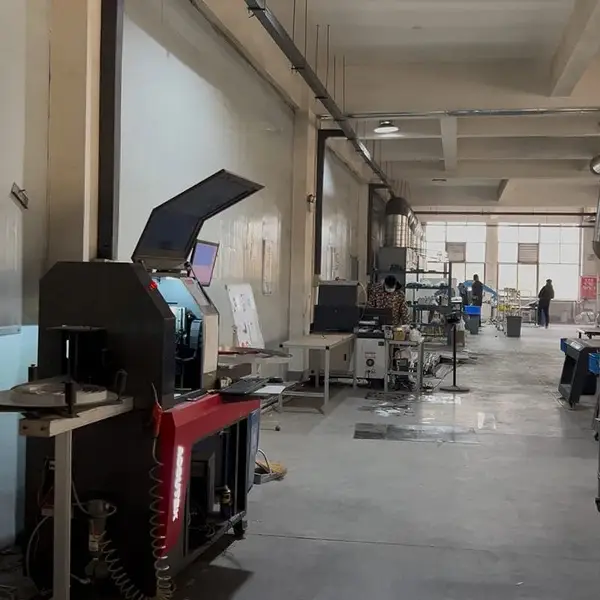
Real photo from our production floor — every sign we ship is made here.
Products mentioned or relevant to this topic — factory-direct, custom built.
From $24/letter · MOQ 1 piece · Flexible lead time · CE & UL certified · ships to 20+ countries
Custom sizes, colors, and finishes. Get a factory price in 24 hours.
Get a Free Quote Copy EmailWhatsApp +86 13865703472 · business@aochuangsign.cn