You’ve seen it. The hometown team scores in overtime, the crowd erupts, and for a split second every camera pans to the giant 40-foot logo on the stadium’s east face. That sign has maybe three seconds to communicate “we’re here, we’re sponsored, and we’re legitimate.” If it flickers, bows, or worse — falls — it’s not just an embarrassment. It’s a liability. I’ve been inside the fabrication bays that build these monsters. Here’s what your spec sheet isn’t telling you.
Most buyers don’t realize that the raw materials — the stainless, the LEDs, the acrylic — account for maybe 30% of the total installed price. The rest is engineering, installation, and the hidden burden of tariffs. Let me break this down: a single front-lit channel letter at stadium scale can be 6 feet tall. Retail pricing for that in the US runs $200–700 per letter. A 12-letter nameplate is $2,400 to $8,400 before you hang it. But the factory-direct cost for that same letter? $80–120. That’s a 60–65% margin that goes to middlemen and local fabricators who don’t do the volume or have the tooling.
Now add Section 301 tariffs. If you’re importing from China — and most large stadium signage is, because few US shops can handle 3,000m² facilities with CNC lasers and TIG welding bays — you pay a ~30% duty on the landed cost. That’s not a surprise. That’s the price of getting a 10-year outdoor warranty on a sign that sees rain, snow, and 100°F temperature swings. The cheap route? Buy domestic but use painted aluminum with acrylic faces that yellow in 18 months. I’ve watched sign shops pay $800 for a single letter from a local shop. Same 304 stainless, same Samsung LEDs. We ship that letter for $120. The math is brutal.
The spec says “304 stainless steel, 1.5mm thickness.” But in reality, 304 has 18% chromium and 8% nickel. That gives it about 10 years of outdoor life in a normal climate. On a stadium roof in Ohio — where road salt drifts up with wind and rain — you’ll start seeing pitting around year 7. 316 stainless (2–3% molybdenum) costs 20–30% more but pushes that to 15+ years. If the stadium is within 10 miles of the coast, 316 is non-negotiable. I’ve seen 304 letters in Miami Beach look like rusted wrecks after 3 years. That’s not an opinion. That’s metallurgy.
Aluminum? Great for weight. At 1/3 the density of steel, it’s easier to hoist onto a 150-foot truss. But its outdoor life is 8–12 years before the powder coat fades and starts checking. For permanent stadium branding, aluminum is a compromise you only make for cost. The real workhorse is laser-cut stainless with a brushed #4 finish, then powder-coated with a UV-stable polyester. That finish, if applied correctly, can last 20 years. Here’s the brutal truth: most stadium signs use a domestic brand of aluminum composite panel (ACM) bonded to a steel frame. That ACM is basically two thin aluminum skins with a polyethylene core. In fire? It burns. In a hailstorm? It dents. And it delaminates after 5 years in direct sun. Stadium-grade is a marketing term. Real grade is 316 stainless or thick 5mm acrylic with UV-resistant cladding.
Here’s the math: a single SMD 2835 LED module today delivers 100–150 lumens per watt. For a 6-foot tall letter, you need roughly 60–80 modules per letter to get uniform illumination that reads on a 4K broadcast. That’s 4,800 lumens per letter — about the same as six 60W incandescent bulbs, but at 40W actual draw. But brightness isn’t the problem. The problem is color temperature. Stadium signage that looks white to the naked eye comes across as yellowish under daylight-balanced stadium lights. So you spec 6000–6500K (cool white) for most exteriors, or 4000–5000K for retail areas inside the concourse. And you demand LEDs from Samsung or Osram, no knockoffs. The cheap modules from Shenzhen? They hit 100 lm/W at first, but their solder joints are dull gray — no proper lead-free alloy. I’ve pulled those apart after 14 months. The joints had cracked open from thermal cycling. Quickest way to spot bad modules: look at the solder joints. Shiny silver = proper lead-free. Dull gray = won't last 18 months.
IP65 sounds impressive. It means water jets from any direction. It does NOT mean your sign survives a Florida hurricane. For stadium roofs exposed to 100+ MPH winds, you need IP66 at minimum — that’s powerful jets, not just spray. And the gasketing has to be silicone, not EPDM rubber that hardens in UV. One rookie mistake I see over and over: contractors spec IP65 thinking it’s enough, then six months later they’re replacing modules that got moisture inside because the sealant didn’t bond to the aluminum frame. We seal every junction with neutral-cure silicone. That stuff doesn’t shrink.
If the sign is on a flat roof 80 feet up, the wind load equation changes everything. A 40-foot wide channel-letter sign mounted on a roof parapet can catch wind like a sail. The standard engineering assumption in most U.S. codes is 90 mph basic wind speed, but many stadiums are in hurricane zones (Florida, Texas, Gulf Coast) where the load factor pushes to 150 mph gusts. Your mounting brackets need to be TIG-welded stainless steel, with breaking strength rated to 5–10x the static weight of the sign. That means each bracket should handle at least 2,000 pounds of pull-out force if the sign weighs 400 pounds. I’ve seen a 12-foot aluminum box sign rip off a concrete wall because the anchors were galvanized bolts into brick veneer — not through-bolts into the structural steel. The fix is expensive: a custom subframe of 1/4-inch wall aluminum square tube, bolted to the roof membrane with stainless steel expansion anchors, sealed with a coplanar curbs. That adds $15–30 per square foot to the job. Most buyers don’t realize that until the engineering report comes back.
Another reality: the sign’s weight isn’t constant. Rainwater collects in channel letters if the drain holes are undersized. A 6-foot letter can hold 10 gallons of water — that’s 80 extra pounds per letter. Do that for 12 letters and you’ve added nearly 1,000 pounds of unexpected load. We put 1/4-inch weep holes in every letter’s bottom edge, but we also spec the mounting brackets to handle 150% of the dry weight. Because water doesn’t care about your budget.
CE marking costs 20,000–50,000 RMB. Most factories will say they have it. Ask to see the certificate with today’s date. Watch them sweat. For a stadium sign that will be inspected by the city, the venue’s insurance carrier, and probably the team’s legal team, you need UL 48 listing. That means the entire sign assembly — wiring, transformer, mounting — has been tested to a North American standard. UL 48 costs $4,000–15,000 per model, takes 4–9 months, and requires quarterly factory audits. ETL is an alternative — 10–30% cheaper, same safety level. But if the spec says UL, you can’t substitute ETL without written approval from the engineer of record.
And here’s the brutal honest truth: no one will inspect the LED modules’ IP rating on the roof. But when water gets in, and the modules start popping like popcorn, you’re the one who signed off on “IP65 compliant.” I’ve seen a stadium’s exterior sign go dark during a Monday Night Football game because the contractor saved $3,000 on IP66-rated modules. The crowd didn’t notice. The cameras did. The sponsor demanded a refund. That $3,000 savings turned into $50,000 in emergency replacement.
LCL sea freight: your crate gets handled 6–8 times between our dock and yours. Every touch is a chance for damage. That’s not in the brochure. For a large format stadium sign — say a 12-foot by 8-foot light box — you’re looking at sea freight: about 65 days, $80–200 per cubic meter for LCL, or $1,200–3,000 for a full container (FCL). For a single sign, LCL makes sense. But each piece gets forklift-bumped, stacked, and re-stacked. We overpack every crate with double-ply foam and plywood corner bracing. But if the sign arrives at your site with a crushed corner, the installer is going to blame you. So you specify: crate must be 100% plywood, no particleboard, with internal restraining straps. And you budget for a check at the port.
Air freight? For a stadium logo that needs to fly 10,000 km in 10 days, you pay $4–12 per kg. A 200-kg sign costs $800–2,400 just in air shipping. That’s not insane for a rush job, but most stadium projects have lead times of 4–6 months. Air freight is for the idiot who waited until 6 weeks before game day. Use the factory’s 7–15 day production lead time wisely.
Q: Can you make the sign look just like the renderings?
A: Yes, if your renderings have actual dimensions. I need a DWG file, not a JPEG from Pinterest. And if the lettering is in a thin sans-serif font, don’t expect 5mm acrylic to hold its shape over 6 feet. We’ll need to weld a steel frame inside the letter. That adds 10–15% to the cost. You were warned.
Q: Is 304 stainless good enough for a stadium in Houston?
A: No. Houston humidity + occasional hurricane = you want 316. And even then, you’ll need an anodized or PVD finish to avoid salt corrosion. The 304 will look fine for 5 years, then every year after that is a maintenance headache. Don’t say I didn’t tell you.
Q: What’s the warranty on the LEDs?
A: We give you 2 years on the LED modules and 1 year on the power supply. That’s based on L70 >50,000 hours with Samsung chips. If you buy the cheap stuff, your warranty is the scrap bin. And no, I won’t

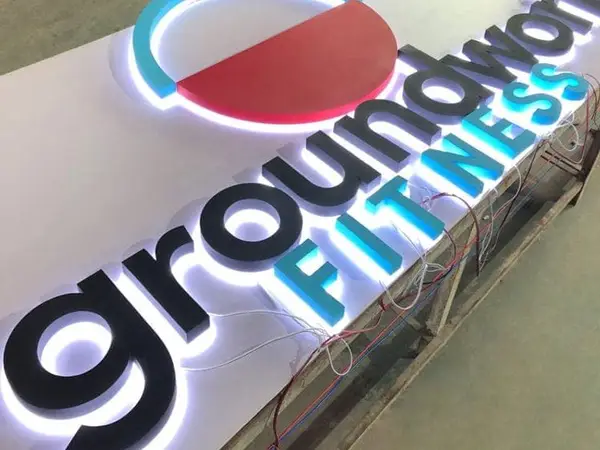
Real photo from our production floor — every sign we ship is made here.
Products mentioned or relevant to this topic — factory-direct, custom built.
From $24/letter · MOQ 1 piece · Flexible lead time · CE & UL certified · ships to 20+ countries
Custom sizes, colors, and finishes. Get a factory price in 24 hours.
Get a Free Quote Copy EmailWhatsApp +86 13865703472 · business@aochuangsign.cn
See pricing, specs, and get a free quote for the sign type you need. Built in our factory, shipped worldwide.