Look, I've been cutting acrylic and bending stainless since 2010. My hands still smell like denatured alcohol half the time. Storefront sign prices aren't a mystery if you know where the money goes. The problem is most buyers don't.
The clock says 11pm. I just finished an 8-hour aging test on a batch of front-lit channel letters. A customer emailed me three times today asking why our price per letter was $65 when his local guy quoted $450 installed. I sent him the material breakdown. He went quiet. Not a coincidence. That's what happens when you stop guessing and start understanding fabrication.
Factory price isn't a random number. Material cost plus LED count plus labor plus finish, divided by quantity. Our front-lit channel letters run $20-80 per letter at the factory. That spread comes from size, acrylic thickness, LED density, and whether you want a basic aluminum return or a polished stainless return.
We run a 3,000m² facility with 50+ skilled workers in Lu'an, Anhui. MOQ is one piece. Lead time is about 5-15 days. That's not a sales pitch. That's what a production line actually does when you batch laser cutting, TIG welding, grinding, CNC routing, LED assembly, and sealing in a single building.
Here's what nobody tells you: most of what you pay a domestic shop isn't the sign. Their rent. Their sales rep's commission. The fact that they subcontract half the work to a guy who subcontracts it again. When you buy factory-direct, the 10-step production process is the same. The markup isn't.
Let me give you actual factory numbers. Front-lit channel letters, our bread-and-butter storefront sign, run $20-80 per letter. Back-lit halo letters, the premium architectural look, run $35-120 per letter. Stainless steel non-lit letters run $15-40. 3D fabricated letters run $40-120. Aluminum letters run $10-25. Light boxes run $80-250 per square meter. LED neon flex runs $30-200 per sign.
Now compare that to US retail installed pricing. Front-lit channel letters at a local shop: $200-700 per letter installed. Back-lit halo: $400-1,000 per letter installed. That's not a typo. The product itself is the same 304 stainless or acrylic face with Samsung LEDs. The difference is the installation labor, the permit runner, the shop's overhead, and the markup for the risk they took buying it from a middleman.
If you're ordering front-lit channel letters for a storefront, you're looking at factory-direct savings of 50-65% on the product itself. I've watched sign shops pay $800 for a front-lit letter from a domestic fabricator. Same 304 stainless, same Samsung LEDs. We ship that letter for $120. That's not an insult to local shops. That's a warning about your supply chain.
For a premium architectural look, back-lit halo letters are where the money really shows. Factory price $35-120 per letter. Retail installed $400-1,000. If your client wants the halo glow, buy direct and find a local installer who only hangs signs. You'll still save thousands on a 10-letter storefront.
Acrylic isn't just acrylic. Mitsubishi or Degussa UV-resistant acrylic lasts 5-8 years outdoors. Domestic acrylic starts yellowing in 1-2 years. Light transmittance is 90-92% for quality cast acrylic. Common thicknesses are 2mm, 3mm, and 5mm. If your sign is over 2.5 meters in any dimension, use 5mm or it'll bow like a cheap shower curtain.
Stainless steel is a whole different animal. 304 stainless has 18% chromium and 8% nickel. It'll last 10+ years outdoors. 316 stainless contains 2-3% molybdenum and survives coastal salt spray for 15+ years. But it costs 20-30% more. For a strip mall in Ohio, 304 is fine. For Miami Beach, pay for 316 or you're replacing letters in 3 years.
If you want 304/316 stainless steel letters, ask for the mill certificate. Any factory that won't show you the alloy composition is selling you 201 stainless or worse. Density of real 304 is 7.93 g/cm³. Common thickness is 1.0-3.0mm. A 1.2mm return on a non-lit letter is standard. A 2.0mm return on a back-lit halo is overkill unless you're in a high-wind zone.
Aluminum weighs one-third of steel and lasts 8-12 years outside. Naturally rust-proof. Sheet thickness runs 1.0-1.6mm. Anodized, powder coated, or brushed finishes all work. But don't use aluminum for structural mounting plates. Use stainless brackets. Aluminum galls under vibration and the threads will strip.
LED quality is where rookies get burned. SMD 2835 modules run 100-150 lumens per watt and are the industry standard. SMD 5050 handles RGB. SMD 5730 puts out 40-60 lumens per chip, highest brightness. L70 rating of 50,000 hours is the baseline. Samsung, Osram, and Blueview modules last 5+ years real-world. Cheap no-name modules die in 12-18 months.
The ugly truth is most US buyers can't tell a quality LED module from a counterfeit Samsung. Quickest way to spot bad LED modules: look at the solder joints. Dull gray = won't last 18 months. Shiny silver = proper lead-free solder. I've rejected three suppliers in the last year for dull joints. Your sign's lifespan depends on that tiny bead of metal.
Color temperature matters more than you think. 3000-3500K warm white is for hospitality. 4000-5000K neutral white is for corporate and retail. 6000-6500K cool white is for industrial and highway. If you don't specify color temp on your PO, the factory will default to 6000K. That's not a mistake. Just the cheapest and most common. Don't let that happen.
For acrylic-faced signs, acrylic LED letters with a 3mm face pass 92% of light. A 2mm face passes 90%. Your customer won't notice the 2% difference, but they'll definitely notice the 40% cost bump on the 3mm. Use 2mm for small letters. Use 3mm only when the size demands rigidity.
Laser cutting gets you ±0.1mm accuracy on stainless and aluminum. Bending and TIG welding take 1-2 days per batch. Grinding and polishing take another 1-2 days, depending on the finish. Acrylic face CNC routing takes a day. LED assembly is 1-2 days. Sealing with neutral silicone is a day. Then we run an 8-12 hour aging test on every single sign. Then 100% QC inspection. Then export packaging with foam, carton, and plywood crate.
That 10-step process is why our lead time is about 5-15 days. Some buyers think a faster lead time means lower quality. Dead wrong. A faster lead time on a standard front-lit letter just means we have the jigs, the material inventory, and the workers who've done it 10,000 times. Custom 3D fabricated letters take longer because the bending and welding is all by hand.
I've seen this go wrong: a buyer orders a custom logo with a 0.5mm tolerance on a 6-foot letter. That's not fabrication. That's jewelry. You'll pay $120 a letter instead of $40, and the installer will still need to shim it because the wall isn't flat. Don't over-spec tolerances. The wall is never flat.
Aging tests are non-negotiable. We power every sign for 8-12 hours before it leaves. If there's a bad solder joint or a weak driver, it dies in our factory, not on your customer's storefront. That's the difference between a 2-year warranty and a 2-week angry phone call.
The ugly truth is installation, permitting, and engineering eat about as much as the sign itself. A factory-direct front-lit letter for $80 becomes a $500 installed letter because someone has to rent a lift, pull an electrical permit, mount a disconnect switch, and caulk the penetrations. And that's before you deal with the landlord's sign criteria.
UL 48 certification costs $4,000-15,000 and takes 4-9 months with quarterly audits. ETL is a cheaper alternative, 10-30% less. CE marking costs 20,000-50,000 RMB and takes 2-8 weeks. Most factories will say they have CE. Ask to see the certificate with today's date. Watch them sweat. Half of them have an expired cert or a photoshopped PDF.
IP ratings are another lie I hear constantly. IP65 means dust-tight and protected from water jets from any direction. That does NOT mean your sign survives a Florida hurricane. IP66 handles powerful jets for coastal areas. IP68 is submersible, for extreme weather or flood zones. For outdoor signs, IP65 is the minimum. If a factory tells you IP65 is "fully waterproof," they're either lying or they've never seen storm surge.
ADA compliance is a whole separate beast. Tactile signs need mounting between 48-60 inches, non-glare finish, and Grade 2 Braille. NEC Article 600 governs electrical signs in the US. If your installer doesn't know Article 600, don't let them touch the wiring. I've seen signs fail inspection because the disconnect switch was 24 inches above grade instead of 30.
Permitting fees vary wildly. Some towns charge $50 for a sign permit. Some charge $500 plus a variance hearing because your letters are 2 inches taller than the code allows. Engineering stamps add $200-800 depending on wind load calculations. Don't budget a sign project without adding 20-30% for install, permits, and engineering. You'll thank me when the invoice hits.
Here's what nobody tells you: the local sign shop isn't ripping you off when they charge $600 a letter installed. They have real costs. A shop in Dallas rents 5,000 square feet, pays three installers, carries liability insurance, and fronts the money for your sign before you pay. That's not free. But that doesn't mean you should pay them $800 for a letter that costs $120 factory-direct.
Factory-direct savings run 50-65% on the product. Shipping is where it gets real. Express shipping for small signs runs $30-100 and takes about 5-15 days. Air freight runs $4-12 per kilogram and takes about 10 days. Sea freight LCL runs $80-200 per cubic meter and takes about 65 days. Full container load runs $1,200-3,000. Then Uncle Sam hits you with a ~30% Section 301 tariff on imports from China.
LCL sea freight seems cheap until you realize your crate gets handled 6-8 times between our dock and yours. Every touch is a chance for damage. That's not in the brochure. If you're shipping 20 letters, pay for a plywood crate and insurance. If you're shipping 200 letters, go FCL and protect the whole load.
Direct importing isn't for everyone. If you need a sign in 10 days, factory-direct with express shipping from China is still about 5-15 days transit. That's cutting it close. For a local shop, that lead time is 2-3 weeks anyway because they're backed up. But if you're a sign shop owner or contractor who orders regularly, direct is the only way to keep your margins alive.
When you send an RFP, specify material grade, thickness, LED brand, IP rating, color temperature, and warranty. Don't just say "front-lit channel letter." Say "304 stainless return, 3mm acrylic face, Samsung SMD 2835 LEDs, 5000K, IP65, 2-year LED warranty." Then compare quotes line by line. Two quotes $40 apart per letter usually means one factory is using domestic acrylic and no-name LEDs. You won't know unless you ask.
Warranty tells you more than the sales pitch. Our standard is 2 years on LEDs, 1 year on power supply. If a factory offers 5 years on cheap LEDs, they're betting you won't still have the sign in 5 years. Read the fine print. Does the warranty cover shipping back to China? Usually not. That's a $200 round trip on a $50 letter. Factor that in.
Lead time is a spec, not a suggestion. Our about 5-15 days is from design confirmation to factory exit. That does not include shipping. Sea freight adds about 65 days. Air freight adds 10-20. Express adds 7-15. If your client needs the sign for a grand opening in 6 weeks, sea freight is fine if production starts tomorrow. If it starts in 3 weeks, you're flying it. Budget accordingly.
One more thing: MOQ of 1 piece means exactly that. You can order one letter. But the shipping cost on one letter makes it stupid. Order at least a full sign or a batch. Per-unit price drops when the factory batches cutting and assembly. Ordering one 12-inch letter express from China will cost you more in shipping than the letter. That's not a factory problem. That's physics.
FAQ: Questions I'm tired of answering
Why is your price per letter $40 when my local shop quoted $450 installed? Because you're comparing a factory product cost to a finished installed price. The $40 doesn't include shipping, import duty, installation, permit, wiring, lift rental, or profit. Add those and you're at $250-350. Still cheaper, but don't pretend it's apples to apples.
Can you match this 10-year warranty from another factory? No. And neither can they. A 10-year warranty on LED signage from a factory in Asia is a marketing gimmick. Real LED modules last 5+ years with good thermal management. After that, the power supply dies first. 2 years on LED, 1 year on power supply is honest. Anyone offering 10 is counting on you losing the invoice.
Is CE marking enough for the US market? No. CE is European. UL 48 or ETL is what US inspectors look for. CE costs 20,000-50,000 RMB to get. UL 48 costs $4,000-15,000 and takes 4-9 months. They're not interchangeable. Don't put a CE mark on a US storefront sign and expect the electrical inspector to care.
Can you ship me one sample letter? Yes, MOQ is one piece. But I already told you the express shipping on one 12-inch letter is $30-100. The letter might cost $35. You're paying more for the box than the sign. If you want a sample to check quality, order two or three letters. That's a real sample. One letter in a foam box tells you nothing about how they'll look installed.

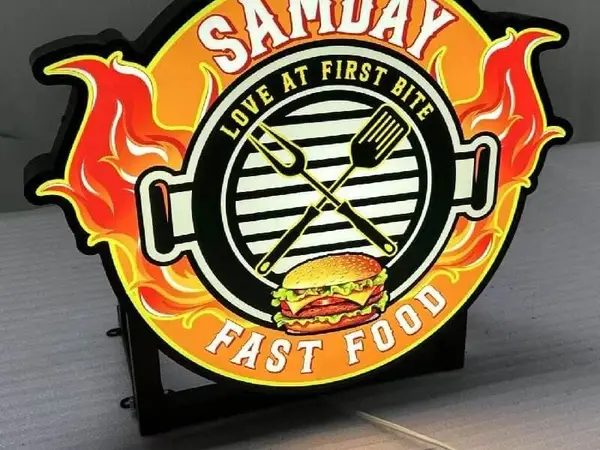
Real photo from our production floor — every sign we ship is made here.
Products mentioned or relevant to this topic — factory-direct, custom built.
From $24/letter · MOQ 1 piece · Flexible lead time · CE & UL certified · ships to 20+ countries
Custom sizes, colors, and finishes. Get a factory price in 24 hours.
Get a Free Quote Copy EmailWhatsApp +86 13865703472 · business@aochuangsign.cn