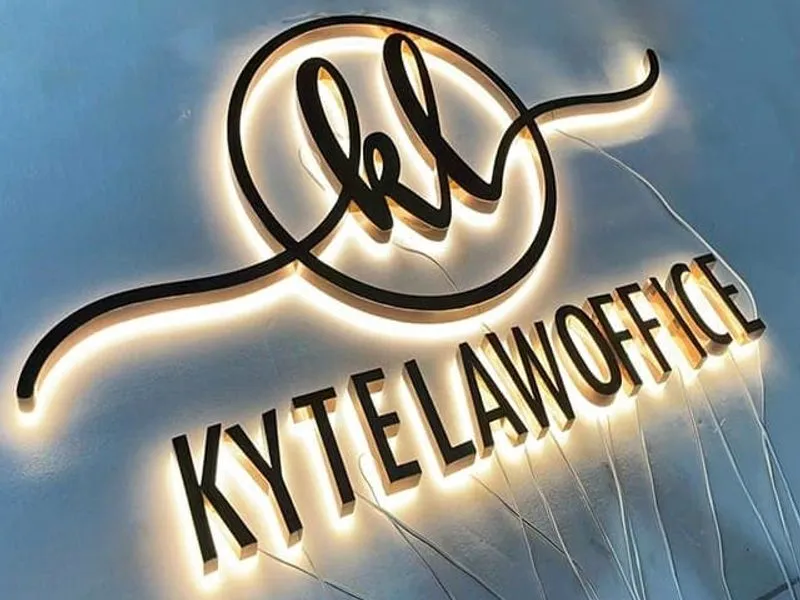
It's 11:42 p.m. I just peeled my safety glasses off. The last batch of LED neon flex letters for a burger chain is boxed and strapped to a pallet. I've burned my hands on hot acrylic, argued with LED suppliers about solder joints, and shipped signs to every time zone. You want to know about neon letters? Good. Sit down.
Most buyers who say "neon letters" don't mean glass tubes.
They mean a storefront sign that glows at night and doesn't die after a year. Get the terminology straight before you quote. Front-lit channel letters are the workhorse: an acrylic face, aluminum or stainless steel returns, and LED modules inside. Factory pricing runs $20–80 per letter, depending on size and finish.
Glass neon is a different animal. It needs high-voltage transformers, skilled glass benders, and a maintenance account that never sleeps.
I've replaced enough cracked glass tubes to know what happens when a delivery truck slams a side door. LED neon flex bends like rope, cuts with scissors, and ships at $30–200 per sign from our floor. If a client wants real glass neon, I ask them where they'll find a glass bender in Des Moines on a Sunday. They usually don't have an answer.
The ugly truth is this: glass neon is a maintenance contract with a pretty face.
LED neon flex costs $30–200 per sign factory-direct. Quality modules using Samsung, Osram, or Blueview LEDs last 5+ years in real conditions. Cheap LED modules fail in 12–18 months, and those failures always show up right after the warranty dies. You don't save money by buying junk.
Total cost of ownership isn't just the first invoice. A quality LED neon letter won't shatter when a truck door slams or a kid chucks a basketball at it. Less callback risk.
Here's what nobody tells you: the difference between a 5-year sign and an 18-month sign is the solder joint. Dull gray solder on LED modules means they won't last. Shiny silver solder is proper lead-free alloy. A $30 sign can become a $300 callback if you buy the dull stuff.
And don't buy glass neon because it's "authentic." Authentic means you'll be on a ladder with a voltage meter while the client wonders why their sign is half dark.
Look, durability starts with the face.
For acrylic, you want 90–92% light transmittance. Mitsubishi or Degussa UV-resistant acrylic lasts 5–8 years outdoors; domestic sheet starts yellowing in 1–2 years. If the letter is over 2.5 meters, use 5mm acrylic or it'll bow. Common faces are 2mm, 3mm, and 5mm.
304 stainless steel letters have a 10+ year outdoor life. That's 18% chromium, 8% nickel, and we cut returns from 1.0–3.0mm sheet.
316 stainless adds 2–3% molybdenum and costs 20–30% more. For a strip mall in Ohio, 304 is fine. For Miami Beach or a coastal repair job, pay for 316 or you'll be back in 3 years replacing rusted letters. That's not a suggestion; I've watched it happen.
Acrylic LED letters are versatile, but only if the fabricator seals them right. We use neutral silicone and run every sign through an 8–12 hour aging test before QC. Our 10-step flow is simple: design confirmation (1 day), laser cutting at ±0.1mm, TIG welding, grinding, CNC acrylic face, LED assembly, silicone seal, aging test, 100% QC, then export packaging.
That's 7–15 days total for most orders. If a factory won't tell you their process, walk.
Efficiency numbers don't lie.
SMD 2835 modules run 100–150 lumens per watt, and that's the industry standard. Color temperature changes the whole feel: 3000–3500K warm for hospitality, 4000–5000K neutral for corporate and retail, 6000–6500K cool for industrial and highway. Don't put cool white on a boutique hotel sign unless you want it to look like a gas station.
IP65 is the minimum for outdoor letters. It means dust-tight and protected from water jets. It does not mean your sign survives a Florida hurricane.
Here's what nobody tells you: CE marking costs 20,000–50,000 RMB and takes 2–8 weeks. Most factories will say they have it. Ask to see the certificate with today's date and watch them sweat. UL 48 is a different beast: $4,000–15,000 and 4–9 months with quarterly audits. ETL is the alternative, 10–30% cheaper.
If you're pulling permits in the US, NEC Article 600 applies. Don't argue with the inspector. I've tried. It doesn't work.
Brand consistency dies on the job site if you don't lock specs early.
A 3mm acrylic face cuts light output to 92%; 2mm cuts it to 90%. Your client won't notice the 2% difference, but they will notice a 40% cost bump if you over-spec. For a brand rollout across five locations, decide the face, the color temp, and the return finish once.
ADA tactile signs require 48–60" mounting and Grade 2 Braille. Non-glare faces are non-negotiable.
Design for the viewing distance, not the shop floor. A letter that looks huge in a vacuum means nothing if it's on a three-lane road with a 45 mph speed limit. I tell fabricators to mock up in photos, not CAD screenshots. The cheap render always lies.
For RGB or color-changing projects, SMD 5050 modules are RGB capable. If you need pure brightness, SMD 5730 delivers 40–60 lumens per chip. But don't spec RGB on a corporate logo just because it's available. It'll look like a nightclub.
I've watched sign shops pay $800 for a front-lit letter from a domestic fabricator.
Same 304 stainless, same Samsung LEDs. We ship that letter for $120. Factory-direct pricing runs $20–80 for front-lit, $35–120 for back-lit halo, and $15–40 for non-lit stainless. You're saving 50–65% on product before freight.
MOQ is 1 piece. Lead time is 7–15 days, not 6 weeks. Our facility is 3,000m², 50+ workers, ISO 9001, CE, and RoHS. Warranty: 2 years on LED modules, 1 year on power supplies.
I've seen this go wrong: LCL sea freight gets handled 6–8 times between our dock and yours. Every touch is a chance for forklift damage. Pay for the plywood crate, not just foam and carton. Or use air freight at $4–12/kg if you need it in 10–20 days.
Watch the US Section 301 tariff—it's around 30%. Add that to your landed cost before you quote your client. Sea freight runs $80–200 per cubic meter for LCL, but it takes 50–70 days. Express is 7–15 days for $30–100 on small packages.
Pick the shipping lane your deadline actually needs, not the one that looks cheapest on the quote.
Is glass neon better than LED neon flex? No. Not unless you're restoring a 1960s motel sign. LED neon flex uses SMD LEDs, lasts 5+ years with quality modules, and doesn't need a high-voltage transformer that can zap a curious kid.
What's your minimum order? One piece. Seriously. We're a factory, not a distributor. MOQ 1 piece, and standard lead time is 7–15 days.
Do you handle UL/CE certification? We have CE and RoHS. UL 48 is project-specific, costs $4,000–15,000, and takes 4–9 months. Don't ask a factory to include it free.
How long until my sign arrives? Express is 7–15 days for $30–100 on small packages. Air is 10–20 days at $4–12/kg. Sea is 50–70 days. Pick your budget and your deadline honestly.

Real photo from our production floor — every sign we ship is made here.
Products mentioned or relevant to this topic — factory-direct, custom built.
From $24/letter · MOQ 1 piece · Flexible lead time · CE & UL certified · ships to 20+ countries
Custom sizes, colors, and finishes. Get a factory price in 24 hours.
Get a Free Quote Copy EmailWhatsApp +86 13865703472 · business@aochuangsign.cn