I've been hanging signs for twenty years. My first franchise job was a dozen pizza joints across three states. The owner handed me a brand guide the size of a phone book and said, "Make 'em all look the same." I laughed. Six months later, every single sign had a different shade of red, different LED brightness, and one had a stainless steel face that didn't match the spec. The franchise got fined by corporate. I learned the hard way: a franchise signage program isn't about art. It's about reproducibility. And the only way to get that is to understand what actually happens in the factory, on the shipping dock, and at the install site.
Here's the number that'll wake you up: US retail installed price for a front-lit channel letter runs $200–700 per letter. That's for one location. Multiply by 50 locations. You're looking at six figures before you've even ordered the second batch. The rookie mistake? Assuming all letters will arrive looking identical. They won't. Not if you order from different fabricators, not if you change the material spec, and definitely not if you let a general contractor "source locally."
I've watched sign shops pay $800 for a front-lit letter from a domestic fabricator. Same 304 stainless, same Samsung LEDs. We ship that letter for $120 from our factory in China. That's not a typo. It's the difference between a factory-direct model and a distributor markup. But – and this is the brutal honesty part – factory-direct only works if you control the specs. If your franchisee calls their local shop and says "make it look like the one in Chicago," you're getting 50 different interpretations of "look like."
Pro tip: You don't need one sign company for all 50 stores. You need one sign program with a single approved manufacturer. We've exported worldwide from our 3,000m² facility in Lu'an, Anhui. Our lead time is 7–15 days, MOQ is one piece. That means you can order one test letter, approve it, then order 200 identical copies. The key is the spec sheet – exact material grade, exact LED chip, exact bending tolerance. No room for "or equivalent."
Quickest way to spot a bad franchise sign program: look at the stainless steel spec. Most brands write "304 stainless" and call it done. But 304 comes in thicknesses from 0.8mm to 3.0mm. A 1.0mm letter will dent if a bird lands on it. A 3.0mm letter will survive a delivery truck backing into it. We use 1.0–3.0mm, but our default for outdoor channel letters is 1.5mm. For coastal locations? You need 316. Don't make the mistake I made: I put 304 in a Miami Beach job once. Three years later, the letters looked like they'd been in a war. 316 costs 20–30% more, but it's worth it. The 316 contains 2–3% molybdenum that fights salt corrosion. For a strip mall in Ohio, 304 is fine. For anything within five miles of saltwater, pay for 316 or you're replacing letters in 3 years.
Then there's acrylic. Mitsubishi and Degussa UV-resistant acrylic: 5–8 years before yellowing. Domestic acrylic: 1–2 years. That's a 4-6 year difference. The price gap? About 30%. A franchise program that specs domestic acrylic is essentially guaranteeing that every location will look different after year two. The southern exposure stores will yellow first. The north-facing stores stay white. Your brand looks like a patchwork quilt.
Here's what the permit office won't tell you: they don't care about your material grade. They care about fire rating, electrical safety, and structural load. But your brand consistency depends on that material grade. So put it in writing. "All face acrylic shall be Mitsubishi UV-stabilized, 5mm minimum for letters over 2.5m in height." Spell it out.
I've seen it a hundred times. A franchisee buys cheap LED modules from Amazon. Installs them. They look great for six months. At month 12, the first letters start flickering. At month 18, half the sign is dark. The brand looks broken. The store looks closed. That's the cost of "saving money" on LEDs.
Quality LED modules use SMD 2835 chips from Samsung or Osram. They'll deliver 100–150 lm/W with an L70 lifespan of 50,000 hours – that's five years of real-world operation. Cheap modules use generic chips with dull gray solder joints. Dull gray = won't last 18 months. Shiny silver solder joints = proper lead-free solder. You can spot the difference with a $10 magnifier. We test every module before assembly with an 8–12 hour aging test. That's standard in our factory. It's not standard in a garage shop.
Color temperature matters too. A franchise program should specify one color temperature for all stores. 4000–5000K for corporate/retail. But even within that range, two different brands of 4500K LEDs will look different side by side. We match our modules to within 100K – that's tighter than industry standard. And we offer a 2-year warranty on LEDs, 1 year on power supply. That's printed. Not verbal.
Don't make the mistake I made: I once approved a "LED upgrade package" from a supplier that promised 30% more brightness. They swapped SMD 2835 for SMD 5730 chips. Higher brightness, yes, but the heat output increased. Without proper thermal management, our letters started delaminating. Never, ever change the LED spec without testing the whole assembly.
Every franchise program runs into this wall: "The sign must be UL Listed." That usually means UL 48, which costs $4,000–15,000 per product family and takes 4–9 months. Plus quarterly audits. It's expensive and slow. That's why many brands use ETL instead – same safety standards, but 10–30% cheaper. But here's the kicker: ETL is accepted by most U.S. jurisdictions, but not all. Chicago, New York City, and a few others still require UL. Check before you spec.
For international franchise programs, CE marking is the standard. It costs 20,000–50,000 RMB (roughly $2,800–$7,000) and takes 2–8 weeks. But – and this is my brutally honest moment – most factories will say they have CE. Ask to see the certificate with today's date. Watch them sweat. The certificate must be current (within 3 years) and match the exact product type. We have CE, RoHS, and ISO 9001. We'll show you the documents before you order.
IP ratings are another trap. IP65 means dust-tight and protected against water jets from any direction. That's minimum for outdoor signs. But IP65 does NOT mean your sign survives a Florida hurricane. For coastal areas, spec IP66 (powerful water jets) or IP68 (submersible). We build to IP68 for any sign within five miles of the ocean. The extra cost is about 15% – worth it when the franchisee doesn't have to replace the sign after every storm.
NEC Article 600 covers electric signs in the US. Grounding, disconnects, wiring methods. Your spec sheet should reference this article. If your factory doesn't know what NEC 600 is, run.
You've designed a perfect sign. You've specified the exact materials. The factory produces 200 identical letters. They pack them in foam, cartons, and plywood crates. Then they go to sea freight. LCL (less than container load) means your crate gets handled 6–8 times between our dock and yours. Every touch is a chance for damage. That's not in the brochure. We've seen crates dropped, crushed, left in the rain. A dented letter means it won't match the others. Brand consistency gone.
Our packaging standard: each letter individually wrapped in bubble foam. Then a carton. Then a plywood crate with internal bracing. We label every crate with the store ID and letter position. That's not optional – it's how you ensure the right letter goes to the right store. Sea freight from China to US West Coast takes about 65 days. Air freight takes about 10 days but costs $4–12/kg. Express (DHL/FedEx) for small orders: 7-10 days, $30–100. For a 50-store rollout, use sea freight for the bulk and air for replacements. Budget for 2% damage rate.
Pro tip: Don't forget the Section 301 tariff. It's about 30% on Chinese-made signs. That will land on your franchisee's invoice. Plan for it. Or use our US warehousing – we can air freight in bulk to a US port and distribute locally.
Here's the system I've seen work across 30+ states. First, order a single prototype from the factory. Test it on your actual storefront. Measure brightness with a lux meter. Check the color temperature against a Pantone chip. Bend the letter with gloved hands – does it give? Then approve that prototype in writing. That approval becomes the "golden sample." Every subsequent order must match that sample.
Second, create a master spec sheet. Include: material grades, thicknesses, finishing (brushed #4 or mirror #8 for stainless; anodized or powder coated for aluminum), LED chip model, color temperature, power supply brand, IP rating, mounting method (through-wall studs or raceway), and packaging spec. No ambiguities.
Third, require stackable testing. Every batch of modules is tested for 8–12 hours. Every complete sign runs before packing. We do 100% QC inspection – not sampling. That's the difference between a $120 letter that works and a $120 letter that fails.
Fourth, plan for replacements. Even the best program has a 1–2% failure rate in the first year. Keep 5% extra letters in inventory. Order them with the initial batch – same LED batch, same acrylic sheet lot. Color matching across different production runs is a gamble.
I've seen a 200-store fast-food chain do this exactly. Their sign program uses our LED modules, 304 stainless, Mitsubishi acrylic, ETL-listed. They pay $120 per letter delivered to their US warehouse. The local installers charge $150–200 per letter for installation and wiring

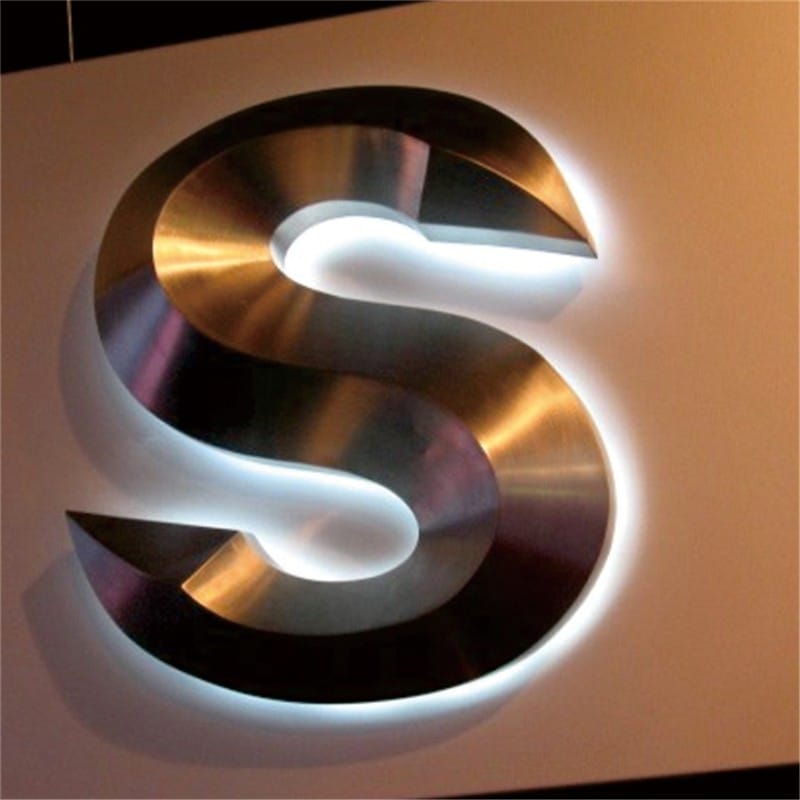
Real photo from our production floor — every sign we ship is made here.
Products mentioned or relevant to this topic — factory-direct, custom built.
From $24/letter · MOQ 1 piece · Flexible lead time · CE & UL certified · ships to 20+ countries
Custom sizes, colors, and finishes. Get a factory price in 24 hours.
Get a Free Quote Copy EmailWhatsApp +86 13865703472 · business@aochuangsign.cn
See pricing, specs, and get a free quote for the sign type you need. Built in our factory, shipped worldwide.