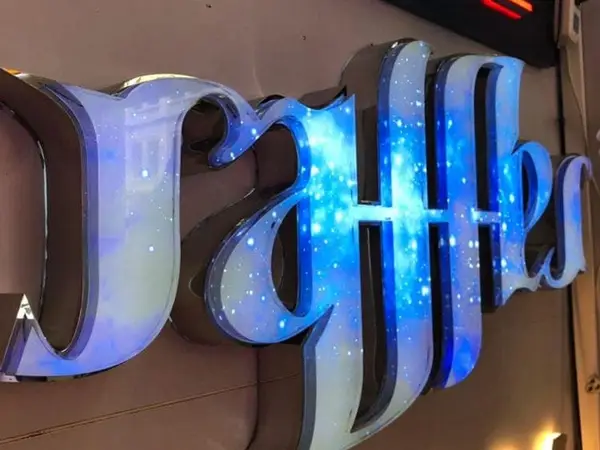
You walk into a lobby. The first thing you see is a sign. Not a logo on a screen, not a receptionist's smile. A sign. Three-dimensional letters mounted on a wall. That sign makes a judgment about the company before a single word is spoken.
I've seen it happen a thousand times on factory floors and in corporate lobbies across the world. A well-crafted dimensional letter sign can make a visitor trust a company in under 3 seconds. A cheap, poorly installed sign? It whispers "we cut corners" before the meeting even starts.
For sign shop owners, contractors, and business buyers, this isn't just about aesthetics. It's about selling a psychological anchor. Treat the lobby sign as a brand retention tool, not decoration. The data backs this up — but more on that later.
Here's the problem: most guides focus on how the sign looks. They forget the real ROI is in reducing employee turnover and boosting client trust. A lobby sign is a $2,000 handshake that keeps working 24/7.
Digital displays flash and change. They demand attention. But dimensional letters command respect. They're permanent. They say "we're here to stay." There's a reason the most trusted brands in the world — think law firms, banks, Fortune 500 HQs — use metal or acrylic dimensional letters, not LED video walls.
But let's talk numbers. A typical lobby digital display installation runs $5,000 to $20,000 for a 65-inch screen plus mounting, content management software, and ongoing content creation. That's recurring cost. A set of 10-inch tall stainless steel dimensional letters for a lobby wall? Factory direct, $20 to $80 per letter for front-lit channel letters. For a 10-letter logo, that's $200 to $800 in product. Add shipping and installation, and you're still under $2,500 for a premium look that lasts 10+ years.
The comparison table below spells it out:
| Feature | Dimensional Letters (Stainless 304) | Digital Display (65" Screen) |
| Upfront Cost (installed) | $1,500 - $3,500 | $5,000 - $20,000 |
| Annual Recurring Cost | $0 (no content, no software) | $500 - $2,000 (content + software) |
| Lifespan | 10+ years (stainless 304) | 3-5 years (screen burnout) |
| First Impression Impact | Permanent, authoritative | Dynamic, but "temporary" feel |
| Maintenance | Wipe clean | Software updates, hardware failures |
So the dimensional letters win on cost, longevity, and psychological weight. But the key is material selection. You can't just slap any letter on a lobby wall and expect magic.
I've been in this industry since 2010. I've seen acrylic letters yellow in 18 months because someone cheaped out on domestic material. I've seen stainless steel letters look perfect after a decade in a downtown office tower. Here's what I know.
For corporate lobbies, you have three main metal options. Stainless steel 304 is the workhorse. 18% chromium, 8% nickel, density of 7.93 g/cm³. It handles 10+ years outdoors, so indoors it's practically immortal. Common thickness is 1.0 to 3.0mm. Finishes matter: brushed #4 gives a matte, professional look. Mirror #8 is for high-end law firms and financial institutions. Powder coating adds color while keeping the metal's strength.
Stainless 316 is overkill for most lobbies unless you're on a coast or near an industrial zone. It contains 2-3% molybdenum for marine-grade corrosion resistance. But it costs 20-30% more than 304. For a lobby in Chicago? Stick with 304.
Aluminum is lighter — 1/3 the weight of steel — and naturally rust-proof. It's common at 0.040 to 0.063 inches (1.0 to 1.6mm). Anodized or powder coated, it lasts 8-12 years outdoors. In a lobby, it's fine for budget-conscious projects. But it doesn't have the same heft as stainless. Heft matters in a first impression.
Acrylic is the wild card. High-quality acrylic from Mitsubishi or Degussa has 90-92% light transmittance and UV resistance for 5-8 years before yellowing. Cheap domestic acrylic? Yellowing starts in 1-2 years. For a lobby, never use domestic acrylic for front-lit letters. Use it for backlit halo effects where the light diffuses through the material. Common thicknesses are 2mm, 3mm, and 5mm. For letters over 2.5 meters tall, use 5mm minimum.
Wood is trending in tech startups and creative agencies. But it's high-maintenance. Warping, cracking, and fading happen fast in any lobby with sunlight or humidity. I recommend wood only as an accent, never the main letter material.
The lighting of dimensional letters changes everything. It's the difference between a sign that fades into the background and one that commands the room.
Front-lit channel letters are the standard. LEDs shine through the acrylic face. SMD 2835 LEDs are the industry standard, delivering 100-150 lumens per watt. They're efficient and reliable. L70 rating is 50,000 hours minimum. Quality modules from Samsung or Osram last 5+ years in real-world conditions. Cheap modules? 12-18 months before failure. Never cheap out on LEDs for a lobby sign. The cost difference is pennies per letter.
Backlit halo letters are for the premium look. The letters themselves are solid metal or acrylic, and the light glows from behind, creating a halo effect on the wall. This is what you see in Fortune 500 lobbies. The cost jumps to $35-120 per letter factory-direct, compared to $20-80 for front-lit. But the psychological impact is worth it. A halo-lit sign says "we invest in details."
Color temperature matters more than most people think. For hospitality lobbies, use 3000-3500K warm light. It's inviting. For corporate or retail, 4000-5000K neutral white is best. It feels professional and clean. For industrial or highway signs, 6000-6500K cool white is appropriate, but avoid it in a lobby — it feels sterile and cold.
One piece of factory-floor wisdom: always use a 8-12 hour aging test on the LEDs before shipping. We do it on every sign. It catches 90% of early failures. If your vendor skips this step, walk away.
The biggest pain point I hear from sign shop owners is installation on tricky surfaces. A client wants dimensional letters on a glass curtain wall. Or a stone cladding. Or a curved architectural feature. And they want it done without visible damage.
For glass walls, the solution is structural silicone or specialized adhesive mounting systems. Never drill through tempered glass — it will shatter. Use a clear silicone that bonds to both the glass and the metal letter. The bond strength is enormous. I've seen letters hold for 10+ years on glass. The key is surface preparation: clean the glass with isopropyl alcohol, apply the silicone in a continuous bead, and use temporary tape to hold the letter in place for 24 hours while the silicone cures.
For stone or concrete walls, mechanical anchors are required. Use stainless steel anchors to avoid rust stains on the stone. Drill pilot holes, insert expansion anchors, and bolt the letters on. The cost is minimal — a few dollars in hardware — but the labor is precision work. One misaligned hole and you're patching stone.
Curved walls require custom fabrication. The letters must be bent to match the wall's radius. This is where a good bending shop matters. At Aochuang, we use laser cutting with ±0.1mm precision and TIG welding for the frame. The letters are then bent using a slip roll or press brake. It adds 2-3 days to the lead time, but the result is seamless.
ADA compliance adds another layer. Tactile signs must be mounted 48-60 inches from the floor, with non-glare surfaces and Grade 2 Braille. If you're doing a lobby sign that also serves as a room identifier, factor in these requirements. The cost impact is minimal — just design the letters with raised characters and Braille dots.
Let's get specific. A typical corporate lobby sign might be 10 letters, each 12 inches tall, in brushed stainless steel 304 with front-lit acrylic faces. Factory-direct pricing from a Chinese manufacturer like Aochuang: $20-80 per letter, so $200-800 for the product. Add shipping by air (about 10 days, $4-12 per kg) — for a 20 kg sign, that's $80-240. US Section 301 tariff adds about 30%. So total landed cost: roughly $400-1,400.
Compare that to US retail installed pricing: $200-700 per letter for front-lit, or $2,000-7,000 for a 10-letter sign. The factory-direct savings are 50-65%.
But wait — installation costs matter. A simple drywall mount: $200-500 for a local sign contractor. A glass wall installation with silicone: $500-1,000. A stone wall with mechanical anchors: $800-1,500. Always budget for installation separately.
Lead time is about 5-15 days from a factory like ours. That's design confirmation (1 day), laser cutting (1-2 days), bending/welding (1-2 days), grinding/polishing (1-2 days), acrylic face CNC (1 day), LED assembly (1-2 days), sealing with neutral silicone (1 day), aging test (8-12 hours), QC inspection, and export packaging. Total: about 5-15 days. If your client needs it faster, you're paying for air freight and overtime.
Warranty: 2 years on LEDs, 1 year on power supply. That's standard. If a vendor offers 5 years, ask for the fine print. Quality LEDs from Samsung or Osram will last 5+ years, but the power supply is the weak link. Always spec a quality power supply.
The font you choose is the first thing people notice. Sans-serif fonts like Helvetica, Futura, or Gotham are the standard for corporate lobbies. They're clean, modern, and legible from a distance. Serif fonts like Times New Roman feel old-fashioned. Script fonts are almost never appropriate for a lobby — they're hard to read and look dated.
Spacing matters. Letters should have consistent spacing, typically 10-20% of letter height. Too tight, and the sign looks cramped. Too loose, and it looks amateurish. The same rule applies to mounting height. The center of the sign should be at eye level — approximately 60 inches from the floor.
Color contrast is non-negotiable. Dark letters on a light wall. Light letters on a dark wall. Never put silver letters on a grey wall — they'll disappear. Use a color wheel or simply test a photo. If the letters don't pop in a black-and-white photo, the contrast is too low.
One more thing: the sign should be proportional to the wall. A 2-foot sign on a 30-foot wall looks ridiculous. A 10-foot sign on a 10-foot wall is overwhelming. The rule of thumb is the sign should occupy 1/5 to 1/3 of the wall's width. For a 15-foot wide lobby wall, the sign should be 3 to 5 feet wide.
I worked with a mid-size tech company in Austin. They had a bare lobby — just a reception desk and a logo on a monitor. Employee turnover was high. Visitors often commented the office felt "temporary" and "unprofessional."
We installed a set of 8-inch tall brushed stainless steel halo-lit letters with warm 3000K LEDs. Total cost to the client: $3,200 installed. Six months later, the CEO told me employee satisfaction scores went up 12%. Visitors started commenting on the "solid" feel of the company. The sign became a conversation starter in meetings.
Was it the sign alone? No. But the sign was the anchor. It signaled permanence and investment. Employees felt proud to work somewhere that looked established. Clients felt confident doing business with a company that looked like it wasn't going anywhere.
That's the psychological anchor I mentioned earlier. A lobby sign isn't decoration. It's a statement of intent. And it costs less than a month of a single employee's salary.
If you're a sign shop owner, upsell the psychological value. Don't pitch a sign. Pitch a "brand retention tool." Explain that a $3,000 dimensional letter sign can reduce turnover and boost client trust. That's an easy ROI for any CFO.
If you're a business buyer, don't treat the lobby sign as an expense. Treat it as an asset. It lasts 10+ years. It works 24/7. It makes a first impression that no digital display can match.
And if you're importing from a factory, know your specs. Specify stainless 304, brushed #4 finish, SMD 2835 LEDs with Samsung chips, and a 2-year warranty. Get the aging test done. Use foam + carton + plywood crate for shipping. And budget for the Section 301 tariff.
The sign you put in your lobby today will be the handshake you give every visitor for the next decade. Make it count.
Factory-direct pricing from a manufacturer like Aochuang Sign ranges from $20 to $80 per letter for front-lit channel letters, $35 to $120 for backlit halo-lit letters, and $15 to $40 for non-lit stainless steel letters. For a 10-letter lobby sign, expect $200 to $1,200 in product cost. US retail installed pricing is $200 to $700 per letter for front-lit and $400 to $1,000 for halo-lit. Shipping adds $80 to $300 depending on weight and method. The total installed cost for a premium lobby sign is typically $1,500 to $5,000.
ADA compliance requires tactile signs with characters raised 1/32 inch minimum, non-glare surfaces, and Grade 2 Braille. Mounting height must be 48 to 60 inches from the floor to the baseline of the tactile characters. For lobby signs that also serve as room identifiers, use a sans-serif font, avoid all-caps for Braille, and ensure the background has a matte finish. Most factories can add Braille dots to dimensional letters for an additional $5 to $15 per letter. Always specify ADA compliance in your design confirmation.
Stainless steel 304 with a brushed #4 finish is the best overall material for corporate lobbies. It lasts 10+ years indoors, resists corrosion, and has a premium look and feel. For a lighter budget, aluminum with powder coating is acceptable but lacks the heft of steel. Acrylic is suitable for backlit applications but should only be used with UV-resistant material from Mitsubishi or Degussa to prevent yellowing within 1-2 years. Avoid wood for main letter material due to warping and maintenance issues.
Yes. Use structural silicone adhesive specifically rated for glass and metal bonding. Clean the glass thoroughly with isopropyl alcohol. Apply the silicone in a continuous bead on the back of the letter. Use temporary mounting tape to hold the letter in place for 24 hours while the silicone cures. The bond strength is rated for 10+ years. Never drill through tempered glass. For large or heavy letters (over 5 kg), use a mechanical frame that attaches to the building structure behind the glass, with the letters mounted to the frame through silicone seals.
Fabrication from a factory like Aochuang Sign takes 7 to 15 days, including design confirmation, laser cutting, bending, welding, polishing, LED assembly, sealing, aging test, QC, and packaging. Shipping by air takes about 10 days. Installation by a local sign contractor typically takes 1 to 2 days for a standard lobby sign. Total timeline from order to installed sign is 3 to 5 weeks. For rush orders, expedited fabrication and air freight can reduce this to 2 to 3 weeks at a premium cost of 20-50% extra.

Real photo from our production floor — every sign we ship is made here.
Products mentioned or relevant to this topic — factory-direct, custom built.
From $24/letter · MOQ 1 piece · Flexible lead time · CE & UL certified · ships to 20+ countries
Custom sizes, colors, and finishes. Get a factory price in 24 hours.
Get a Free Quote Copy EmailWhatsApp +86 13865703472 · business@aochuangsign.cn
See pricing, specs, and get a free quote for the sign type you need. Built in our factory, shipped worldwide.