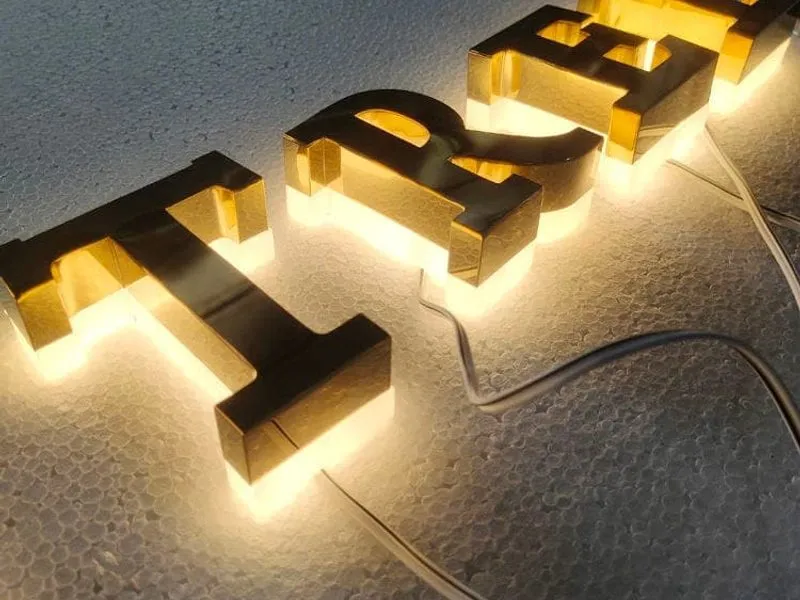
Here's what nobody tells you: the battle of welded vs flanged channel letter returns isn't about which one looks prettier. It's about who's installing it, where it's going, and how long it needs to survive.
I've been on the factory floor since 2010. I've watched importers burn money on over-engineered letters for a dry Arizona strip mall and watched contractors cheap out on flanged returns for a coastal Maine boardwalk — then pay for it twice.
So let's settle this. No corporate spin. Just the truth about how your sign is actually built.
## What The Hell Are We Talking About?
The "return" is the depth of the letter — the side wall between the face and the mounting surface. Think of it as the letter's body.
A flanged return has a flat lip bent outward at the back. That lip gets screwed or riveted directly onto your building or raceway. It's simple. It's been done for decades.
A welded return has the back edge welded to a separate flat plate — a back panel. The letter becomes a fully enclosed, sealed box.
Simple enough. But the difference in how they perform, what they cost, and who can actually build them right is where things get interesting.
Front-lit channel letters typically use one of these two return systems.
## The Welded Return: What You're Paying For
A properly welded letter is a sealed unit. We weld the return to the backing plate using TIG welding — usually .8mm to 1.0mm stainless steel wire — creating a continuous, watertight seam around the entire perimeter.
The ugly truth is that roughly 70% of "welded" letters I see from budget factories aren't actually sealed. They're spot-welded along the straight runs, with gaps in the corners. Water gets in. LEDs die. The letter fills with water like a fish tank.
I've seen this go wrong: a client in Florida ordered 14 welded letters from a broker pricing them 40% below market. Six months in, half the letters were condensing moisture so badly the LED modules were shorting out.
### Why go welded:
- Full perimeter sealing — no gaps for water, bugs, or wasps
- Vandal resistance — it's genuinely harder to get inside
- Clean interior look — critical for
back-lit halo letters where the inside edge shows
- Structural integrity — the closed box acts as one rigid unit, higher wind resistance
- Can be mounted flush without visible screw holes
### The downsides:
- Cost. We're adding a step (welding a back plate) plus material (the plate itself).
- Factory price runs $35-120 per letter for
front-lit channel letters with welded returns.
- A bad weld job is worse than no weld at all. Rust creep from a failed weld bead will destroy adjacent material.
## The Flanged Return: Simple, Cheap, Dependable
Flanged letters are simpler. We shear the return strip, notch the corners, bend the flange, and make the letter. At production, this is significantly faster — which means cheaper for you.
Here's what nobody tells you: for most retail applications below 20 feet, a flanged letter is plenty. The screws through the flange are hidden behind the letter body. It installs fast. Replacement is a five-minute job with a screw gun.
One sign shop I know — a loyal customer for years — orders flanged letters exclusively for their gas station and restaurant clients. They install a full set of 200mm letters in under two hours.
### Why go flanged:
- Factory price drops dramatically.
Aluminum letters with flanged returns start at $10-25 per letter at our factory.
- Faster production, faster lead times — about 5-15 days total, on par with everything we make.
- Lighter weight — easier and cheaper to ship and install.
- Easy on-site modification if a wall has unexpected obstacles.
### The downsides:
- The back is open. Bugs, moisture, and dust get inside.
- Less structural rigidity against wind loads.
- The mounting screws are a potential failure point (with — good quality, 10 years outdoors).
- You can't get a clean halo effect with an open back.
## Let's Talk Numbers: Material And Manufacturing
We run a 3,000m² facility in Lu'an with 50+ workers. I can tell you exactly how these two builds compare on the shop floor.
The fabrication for a flanged letter: cutting the aluminum or stainless steel (1.0mm to 1.2mm for most letters 300mm-500mm tall), notching, bending, and welding the return seam where needed. That return seam — a single vertical weld at the bottom and one at the top — is guarded by a crimp or a corner weld. Total fabrication time for a 400mm flanged letter: about 25 minutes including prep.
The welded version: same cutting and notching, then we weld the backplate on — a full perimeter weld. A 400mm welded letter takes about 45 minutes to an hour. Add material cost for the backplate itself.
That's why the price gap exists. It's not a myth or a markup — it's labor and material.
For stainless steel letters specifically —
check what you're buying — we only recommend welded returns for 304 grade with 10+ year outdoor expectations. Flanged 304 with exposed screws will show rust bleed in 2-3 years in humid climates unless the installer uses stainless screws and properly seals the flange.
## Installation And The Raceway Problem
Here's something most comparison guides never mention: how the letters get installed dramatically impacts which build you should choose.
If your job is a direct-to-wall mount on a clean facade, welded letters win. The sealed back means you can use through-wiring — a single hole from inside the letter into the wall. No visible conduits.
If you're mounting to a metal raceway spanning the building's parapet, flanged letters are actually preferred by most installers I talk to. Screw the flange to the raceway, wire each letter individually, level it, done. In this configuration, the raceway protects the open back. The letters themselves don't need to be weatherproof — the raceway does.
I've seen this go wrong: an importer ordered welded letters, paid extra, then mounted them on a raceway with an open back anyway. Wasted money on the welded build, completely negated by the mounting method. $4,000 down the drain for durability that never mattered.
## The Coastal Factor: Stand Your Ground On 316
If this sign is going within 5 miles of saltwater, listen to me.
Back-lit halo letters with welded returns in 316 marine stainless steel are your only choice for a 15+ year install. That's not a preference — that's physics.
We use 316 with 2-3% molybdenum. It's a 20-30% cost premium over 304. The molybdenum resists chloride pitting, which is what kills 304 in salt air — it doesn't just rust, it pits and corrodes through.
For inland locations — a mall in Denver, a restaurant in Chicago — 304 is fine. Paying for 316 in Colorado is burning money.
The decision matrix is simple: location + material + return method. Get those three right and you'll have a 10-year sign.
## Light Source And Heat: The Unmentioned Variable
Let's talk LEDs because they affect your return decision more than you'd think.
Dual-lit channel letters — front and halo lit simultaneously — generate more heat inside the letter cavity. A sealed welded letter needs proper thermal management. We use SMD 2835 modules at 100-150 lm/W; Q-tested quality modules from Samsung or Osram hold up 5+ years. Cheap modules die in 12-18 months. That's a fact, not marketing.
Here's what nobody tells you: heat trapped in a sealed welded letter can shorten LED life by 20-30% if the letter was designed without airflow consideration. When you're comparing letters, ask the factory about internal volume vs. LED density. We typically specify one module per 40-60mm of letter depth to manage heat.
But the sealed envelope also protects your LEDs from moisture, which is the number one killer of automotive-grade
LED neon flex products. It's a trade-off — you pay for isolation, and you manage heat.
## Certification Reality Check
Now for the part that often gets overlooked until customs has your shipment.
UL 48 is the standard for both letter types. A factory certifies a letter model — this costs $4,000-15,000 and 4-9 months of wait. ETL is cheaper, 10-30% less, and a viable alternative.
But here's the ugly truth: if you buy from a trading company that doesn't have UL 48 certified welded letters, you're assuming liability as the importer under US law. We run CE, RoHS, and ISO 9001. That's real. For the US, we can spec UL-listed components.
When you're comparing quotes, ask for the UL certification number — not a PDF. Look it up in UL's Product iQ database. If it's not there, it doesn't exist.
## Shipping And Tariffs: The Hidden Cost
Here's a brutal reality: the tariff on fabricated metal letters is around 30% under Section 301. That applies to both welded and flanged.
Stainless steel letters weigh more — density of 7.93g/cm³ — which means heavier crates and more expensive shipping. A set of 12 stainless steel letters, 400mm tall, might weigh 210 kg. At $4-12/kg air freight, an importer is looking at $840-2,520 just to fly the freight.
Aluminum letters weigh one-third as much. The savings on freight and tariff — calculated on landed cost, not just product price — often makes aluminum flanged letters the smart money play for
front-lit channel letters in non-coastal areas.
MOQ is 1 piece at our factory, lead time about 5-15 days. But logistics to the US East Coast by sea takes about 65 days. Plan your budget and timeline accordingly.
## What We Can And Can't Do
Honesty time.
What we do well: welded and flanged letters in stainless steel 304 and 316, aluminum, and acrylic. We cut with ±0.1mm precision, TIG weld, seal with neutral silicone, and run an 8-12 hour aging test on every job before it's packed.
What we don't do: we're not a custom art studio. If you need hand-wrought brass letters with patina finishes and chased details, you're talking to the wrong factory.
Brass letters we do, but with precision fabrication — not artisan blacksmith work.
We don't do UL listing in-house. We design to spec and use UL-listed components, but we're not a certified UL facility. We're honest about that so you know exactly what to expect.
We don't do "cheap." We're not the $10-a-letter factory. But for $20-80 per front-lit letter, you get a letter that will outlast the business next door.
## The Final Decision
If you're building a monument sign where each letter is the centerpiece, pay for welded letters. Good welding changes the game.
Dual-lit channel letters with welded returns, 304 stainless, powder-coated — that's the spec we recommend for a tenant who wants a 10-year sign and has money to spend.
If you're doing a storefront for a cell phone shop or a vape store that might not survive the lease cycle, your order should be flanged aluminum letters at $10-25 a letter. It's the same light output, 80% of the lifespan, at 55% below the cost. You aren't selling the building — you're selling a service. Don't gold-plate it.
Here's the final word from 14 years in the trenches: match the build to your margin targets, not to your pride.
Spec any
front-lit channel letters by asking for three numbers: the return depth (minimum 80mm for standard LED modules), the finish (bead-blasted, brushed, or powder-coated), and the weld spec (continuous or crimp). If the factory can't give you those numbers on the spot, move on.
We can. That's the practical difference between a welder and a factory.
Bottom line: welded wins on durability and aesthetics. Flanged wins on price and serviceability. Your job, your Wall conditions, your budget — that's the test. Choose the failure mode you can afford, and you'll have a sign that makes you money instead of eating it.