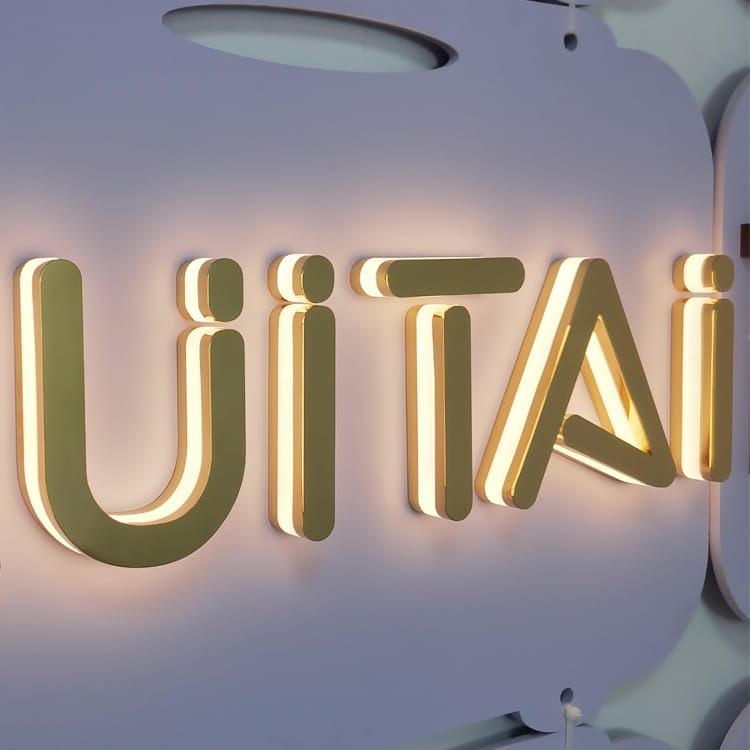
Front-lit channel letters are the play for a sushi restaurant. 304 stainless returns, 5mm acrylic faces, 4000K neutral white LEDs. Factory-direct, front-lit channel letters run $0.70–$0.90 per centimeter of letter height. A 45cm letter lands at $31.50 to $40.50 before the LEDs and freight.
I've seen sign shops fork over $800 for a front-lit letter from a domestic fabricator. Same 304 stainless, same Samsung LEDs. We ship that letter for $120.
But the best sign isn't the cheapest. It's the one your sushi client won't have to replace in 18 months, and the one the landlord's code inspector won't flag.
Look, a sushi bar on a side street gets maybe three seconds to convince a hungry driver to park. Maybe less. The sign is the only salesman working at midnight.
I had a client in Portland who opened a sushi counter with a cheap flat acrylic panel and a $12 power supply. At 8 months, the face had yellowed. At 14 months, half the LEDs were flickering. The restaurant didn't fail because of the sign, but the sign didn't help. Then he paid twice to replace it. Don't be that client.
Nobody tells you this: a properly built front-lit channel letter with SMD 2835 LEDs won't just light a name. It'll run 50,000 hours at L70. That's over five years if you leave it on 24/7. Cheap modules? 12–18 months before you're on a ladder with a soldering iron.
So yes, the sign decision is money. But it's money your client either pays once or pays every two years.
Channel letters are my go-to for a sushi restaurant. Dimensional, lit from inside, visible from both sides if you add a back. No contest.
For a storefront, stainless trim + acrylic front-lit letters run $0.70–$0.90 per centimeter of letter height. Electroplated or gold? $1.0–$1.2/cm. That's the face and return, not the LED, not the power supply.
A 50cm letter body is $35–$45. Ten letters for “SUSHI KAZU” runs $350–$450 for the bodies. Compare that to the domestic quote you probably got for $6,000 installed.
Double-sided lightboxes have their place—a 40cm round one costs $50, a 100cm round runs $200. But they're flat. A sushi place looking for modern Japanese aesthetic wants dimension. Lightboxes read “fast casual,” not “omakase.”
Monument signs and digital displays? I'll sell you a monument if you've got a pad site or a strip mall landlord demanding consistency. But for an inline restaurant, they're overkill and invite city permits, footings, and electrical inspections.
The ugly truth is most sign shops spec 3mm domestic acrylic because it's cheap. It yellows in 18 months. I won't build that for a restaurant unless you force me.
304 stainless steel is my default return material. 18% chromium, 8% nickel, 1.2–1.5mm thick. You'll get 10+ years outdoors without rust. For a sushi place in Miami Beach or any coastal strip, upgrade to 316 stainless. That adds 20–30% cost but buys 15+ years in salt air.
For the face, use 5mm UV-resistant acrylic. The Mitsubishi or Degussa stuff keeps 90–92% light transmittance for 5–8 years before yellowing. Domestic acrylic? 1–2 years. Your customer won't see the difference at install. They'll see it in year three.
Aluminum is another option if you want to cut weight and cost. It's one-third the weight of steel and rust-proof by nature. But for a sushi joint, brushed stainless or a matte black baked powder coat on stainless reads higher-end.
Nobody tells you this: a 2mm acrylic face cuts about 90% of light output, a 3mm face cuts 92%. The customer won't notice the 2% difference, but they'll notice the 40% cost bump for thicker material. Don't upsell them on 10mm optical-grade unless they've got an engineer on retainer.
LED. Trust me.
Okay, some context. SMD 2835 modules run 100–150 lumens per watt, L70 at 50,000 hours. That's the industry standard for channel letters. Our modules from Bluesky and Rishang have a real lifespan of 5+ years. Cheap modules from who-knows-where fail in 12–18 months because the solder joints are dull gray instead of shiny silver.
Glass neon? Gorgeous, sure. But it's fragile, pulls more wattage, and a $12 transformer can take down the whole sign. I've opened crates where 30% of the glass was shattered and the sign shop still tried to blame the freight forwarder.
The ugly truth? Sign shops sell glass neon because the mark-up is better, not because it's better for your client. If they want the neon look, use LED neon flex. It's shaped like neon, looks like neon, and won't put you back on a scissor lift every time a tube cracks.
Don't put 6000K cool white on a sushi sign. That's for highway hotels and industrial parks. It makes raw fish look like a morgue.
Warm 3000–3500K is hospitality. It flatters the food, flatters the wood, flatters the Japanese paper textures. If your client insists on a crisp modern counter, go 4000–5000K neutral. But make them understand the difference before they complain the tuna looks gray.
Red and black dominate sushi branding because red triggers appetite and black reads premium. But a sign that's 100% red gets lost on a busy strip. Use a white or warm-white face with red returns, or a black back panel, and the name jumps.
Fonts? Avoid thin scripts smaller than 3 inches of stroke. At 20 feet, a thin stroke disappears. Japanese-inspired typefaces work if the letter height is at least 30cm and the stroke is heavy enough to hold an LED module. I've seen too many chopstick-thin letters that look great in a PDF and disappear at night.
Nobody tells you this: the sign code will kill your project before your client ever sees a light. In the US, electrical signs have to meet NEC Article 600. That means a listed power supply, proper wiring methods, and no extension cords stapled to the fascia.
If your project requires UL 48 listing, budget $4,000–$15,000 and 4–9 months with quarterly audits. ETL is a valid alternative and runs 10–30% cheaper. Don't wait until the inspector asks for it.
For outdoor signs, IP65 is the minimum. It means dust-tight and protected from water jets. It does NOT mean the sign survives a Florida hurricane. Coastal? Step up to IP66. Extreme weather? IP68 is submersible-grade. Ask your factory for the test report, not just a printed label.
Projecting blade signs in restaurant districts often need landlord approval and city permits. Mount them at 48–60 inches if there's a tactile element. ADA signs need Grade 2 Braille and non-glare faces in that zone.
One more thing: CE marking costs 20,000–50,000 RMB to actually certify. If a factory says they have CE, ask to see the certificate with today's date. Watch them sweat. I can't count how many importers found out their “CE” was a Photoshop special after the container landed.
Placement matters more than size. A 30cm letter on a blade sign at eye level beats a 60cm letter 20 feet up. Drivers don't crane their necks.
Factory-direct pricing changes the math. A front-lit channel letter body at $0.70–$0.90/cm means a 50cm letter costs $35–$45. Add LEDs, power supply, and freight, and you're still nowhere near the $500-per-letter quotes I see from domestic fabricators.
Warranties matter. Our LEDs carry a 2-year warranty, the power supply 1 year. But the real number is L70 at 50,000 hours. That's the point where the LEDs drop to 70% brightness. Cheap modules die before the warranty expires. Good ones just keep humming.
Here's the maintenance talk I give every client: LEDs don't fail because the diode dies. They fail because water gets in through bad sealing. We use neutral silicone and run every sign through an 8–12 hour aging test before it ships. That catches the weak solder joints before the crate leaves Lu'an.
LCL sea freight gets handled 6–8 times between our dock and yours. Every touch is a chance for a forklift to hit the crate. Pay for the plywood crate. Don't let your freight forwarder “save money” by palletizing a face with bubble wrap. I've seen the repair bills.
If you need it fast, express freight runs 7–10 days. Air is roughly 10. Fast sea is 40–50 days. Standard sea is 65 days. Plan for that, or your client will open without a sign and blame you.
Q: Is a lightbox better than channel letters for a sushi restaurant?
No. Lightboxes read cheap and flat. Channel letters give you dimension and visible depth at night. If you must have a lightbox, use a double-sided lightbox in a walk-up window, not the main storefront.
Q: Do I need IP65 for an indoor sushi sign?
No. IP65 is for outdoor dust and water jets. Indoor signs can run IP20 if they're not near a dishwashing station. Don't let someone upsell you on marine-grade when your sign's next to the host stand.
Q: Can you match my client's brand red exactly?
Yes. Baked paint on stainless or acrylic can hit any RAL color. But the red on your screen won't look the same as a backlit red face. Ask for a physical sample, not a PDF proof.
Q: How fast can I get a custom sushi sign?
A sample takes roughly 5 days, production around 15 days, and then freight is 7–10 days express or 40–50 days fast sea. If you need it in 48 hours, call someone local and pay triple.
Products mentioned or relevant to this topic — factory-direct, custom built.
From $16/letter · MOQ 1 piece · 7–15 day production · CE & UL certified · ships to 20+ countries
Custom sizes, colors, and finishes. Get a factory price in 24 hours.
Get a Free QuoteWhatsApp +86 13865703472 · cairuisheng@aochuangsign.cn