You’ve heard it a hundred times. A client calls and says, “I need a sign outside my business.” That’s it. No detail. No type. Just a vague request that could mean anything from a tiny blade sign to a 50-foot pylon. And if you’re a sign shop owner, contractor, or importer, that ambiguity costs you. Rework. Change orders. Delays.
Here’s the hard truth: the sign industry has precise terminology for a reason. Using the wrong name with a manufacturer—especially overseas—can land you with the wrong materials, wrong dimensions, and wrong compliance. I’ve seen it happen. A client ordered “outdoor signs” and got indoor acrylic that yellowed in 18 months. Don’t be that person.
This guide breaks down every major business sign type, the exact terms you need, and how naming impacts procurement, pricing, and permits. No fluff. Just factory-floor knowledge from 15 years in the trenches.
Let’s get this straight. “Sign outside a business” is not an industry term. It’s a client’s way of saying, “I don’t know what I need.” Your job is to educate them. Fast.
In the commercial signage world, we categorize signs by mounting method, location, and function. Here are the most common types and their correct names:
When a client says “sign outside,” start with these options. Show them a quick visual. Nail down the location first—building-mounted or ground-mounted—then the illumination. This one conversation can save you 2-3 rounds of revisions.
This is the first fork in the road. Every business sign falls into one of two categories: building-mounted or ground-mounted. The choice affects structure, permits, and cost.
Building-mounted signs attach directly to the facade. The most common is the storefront sign—usually channel letters or a light box. But there’s also projecting signs (blade signs) that stick out, and wall signs that are flush. For these, you need to know the wall material. Brick? Drywall over steel? Each requires different anchors and load calculations.
Ground-mounted signs stand alone. Monument signs sit on a solid base, often masonry, and are 4-8 feet tall. They’re low-profile and blend with landscaping. Pylon signs are taller—20 feet and up—with one or more poles. They’re designed for maximum visibility from a distance. For a roadside business, a pylon sign is often the best ROI. But it’s also the most expensive to install and maintain.
Here’s the kicker: zoning laws often differentiate between these two types. Some cities ban pylon signs entirely. Others restrict monument sign heights. In Los Angeles, for example, monument signs are capped at 6 feet in many commercial zones. Always check local codes before quoting.
If you’re in this industry, you know channel letters. They’re the 3D letters you see on every strip mall and storefront. But not all channel letters are the same. The terminology gets specific.
| Type | Description | Typical Cost (Factory Direct) | Best Use Case |
|---|---|---|---|
| Front-lit (Face-lit) | LED illuminates through translucent acrylic face. Aluminum or stainless returns. | $20-80 per letter | High-visibility storefronts, day and night reading. |
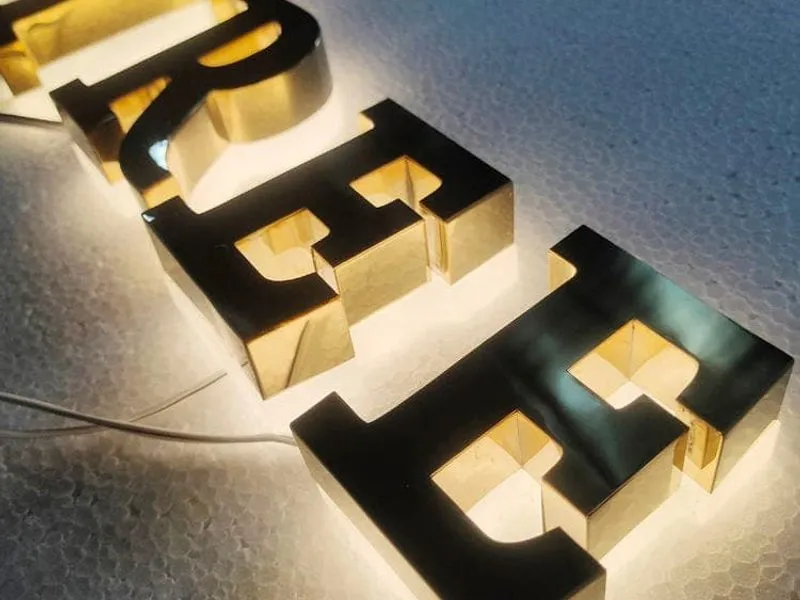
| Back-lit (Halo-lit) | LEDs inside the letter shine light onto the wall behind. Letter face is opaque metal. | $35-120 per letter | Upscale retail, restaurants, banks. Elegant glow. |
| Non-illuminated | No LED. Solid metal or acrylic letters. Cheapest option. | $15-40 per letter | Indoor or low-light areas. Budget-conscious clients. |
| Open-face (Neon-style) | Glass tubes or LED neon flex on exposed letters. Retro look. | $30-200 per sign | Bars, vintage shops, breweries. |
Here’s a hard-won tip: always specify the LED module brand in your quote. Cheap LED modules—the unbranded ones from Alibaba—last 12-18 months. Quality modules from Samsung or Osram (often sourced through Lan Jing) give you 5+ years real lifespan with L70 ≥50,000 hours. At Aochuang Sign, we use only the good stuff. Our warranty is 2 years on LEDs, 1 year on power supply. That’s the difference between a happy client and a callback.
Also, pay attention to acrylic thickness. For letters under 2.5 meters tall, 3mm acrylic works fine. Over 2.5 meters, you need 5mm to prevent sagging. Use Mitsubishi or Degussa acrylic for UV resistance—5-8 years without yellowing. Domestic acrylic? You get 1-2 years. Don’t cheap out here. Your reputation is on the line.
This is the most common confusion I see. A client says “monument sign” when they mean “pylon,” or vice versa. The difference is structural and legal.
Monument signs are low, solid bases. Typically 4-8 feet tall. They sit on a concrete footing and look like a small wall or pillar. They’re often made of stone, brick, or stucco over a steel frame. The sign panel is usually aluminum or acrylic. Because they’re low to the ground, they’re less obtrusive and easier to get permits for in residential-adjacent zones.
Pylon signs are tall—20 feet and up. They have one or two poles (monopole or bipole) and a large sign cabinet at the top. They’re designed for highway visibility. A pylon sign can cost $5,000 to $50,000 installed, depending on height and complexity. But the ROI is massive for a gas station or fast food joint on a busy road.
Which one should you recommend? Ask the client: “How far away do people need to see your sign?” If it’s a local business on a side street, a monument sign is fine. If it’s a highway exit, go pylon. But check the local sign code first. Many cities restrict pylon heights to 20 feet or ban them outright. You don’t want to design a 30-foot pylon only to find out it’s illegal.
Light boxes—also called cabinet signs—are the ubiquitous signs you see at McDonald’s, Subway, and every gas station. They’re a sealed box with a translucent face (usually acrylic or polycarbonate), internally lit with LEDs or fluorescent tubes. The face is printed or vinyl-cut with the logo.
Factory-direct pricing for light boxes runs $80-250 per square meter. That’s for the box, LED modules, and face. Add shipping and installation, and you’re looking at $200-600 per square meter retail installed. For a 2m x 1m sign, that’s $400-1,200 total.
The key spec is IP rating. For outdoor use, you need at least IP65 (dust-tight and water jets). Coastal areas? Go IP66 or IP68. A cheap light box with IP54 will leak in the first rainstorm. I’ve seen it. The water pools inside, shorts the LEDs, and the client calls you angry. Use neutral silicone sealant and test every box for 8-12 hours before shipping. At Aochuang, we do 100% QC inspection. It’s non-negotiable.
Here’s where naming gets expensive. If you’re importing signs from China—and many of you are—the tariff code you use depends on the product name. The US Section 301 tariff on Chinese goods adds about 30% to the cost. But the exact code matters. “Illuminated signs” (HTS 9405.60) have different rates than “electric signs” or “non-illuminated signs.” Get it wrong, and you’ll overpay or face customs delays.
Also, shipping costs vary by volume and weight. Channel letters are light and pack tightly. Sea freight for a full container load (FCL) runs $1,200-3,000, taking about 65 days. Less-than-container (LCL) is $80-200 per cubic meter. Air freight is faster—about 10 days—but costs $4-12 per kg. For small orders under 10 kg, express shipping via DHL or FedEx is $30-100 and takes 7-10 days.
And don’t forget compliance. For US installations, you need UL 48 certification for electric signs. That costs $4,000-15,000 and takes 4-9 months, plus quarterly audits. ETL is a cheaper alternative—10-30% less. For Canada, CSA is required. For Europe, CE marking runs 20,000-50,000 RMB and takes 2-8 weeks. If you’re importing without these certifications, you’re taking a huge risk. Your client’s insurance won’t cover a fire from an uncertified sign.
Every sign type has legal baggage. NEC Article 600 governs electrical signs in the US. It requires proper grounding, disconnects within sight, and weatherproof connections. ADA compliance applies to tactile signs (like room numbers and exit signs) mounted 48-60 inches above the floor, with non-glare finish and Grade 2 Braille. Monument signs for public buildings often need ADA-compliant text.
Zoning laws control size, height, illumination, and placement. Most cities have a sign code that specifies maximum square footage (e.g., 1 sq ft per linear foot of frontage). Illumination limits are common—no blinking lights near residential zones, no neon after 10 PM. Permits take 2-8 weeks and cost $100-1,000 depending on the jurisdiction. Always pull permits. The fine for an unpermitted sign can be $500-5,000 plus removal costs.
Here’s a pro tip: include a “permit contingency” clause in your contract. If the city denies the permit based on sign type, the client pays for redesign. That covers you when a client insists on a 30-foot pylon in a 15-foot zone.
You can build the best sign in the world, but if it’s installed wrong, it fails. Mounting methods depend on the wall. For brick or concrete, use expansion anchors. For steel studs, use toggle bolts or through-bolts. For pylon signs, the concrete footing must be at least 1/3 the height of the pole. A 30-foot pylon needs a 10-foot deep foundation.
Electrical requirements: Most channel letters use 12V or 24V LED drivers. You need a weatherproof junction box at the sign location. Run conduit from the building’s main panel. For light boxes, use a GFCI-protected circuit.
Maintenance schedule: Clean acrylic faces every 3 months with mild soap and water. Check seals annually—reapply neutral silicone if cracked. Replace LED modules when they dim (usually after 50,000 hours). For stainless steel signs, wipe down with a stainless cleaner to prevent corrosion. Type 304 stainless lasts 10+ years outdoors. Type 316 is for coastal areas—it has 2-3% molybdenum and resists salt spray, but costs 20-30% more.
The average sign lifespan: aluminum (8-12 years), acrylic (5-8 years with UV-resistant), stainless (10-15 years). LED modules last 5+ years if quality. Cheap ones die in 12-18 months. Your maintenance contract should reflect this.
1. What is the most common term for a sign mounted on a building facade?
That’s a storefront sign or wall sign. In the industry, we usually say “storefront channel letters” if it’s illuminated, or “fascia sign” in the UK. Avoid “facade sign”—it’s vague. Be specific: “front-lit channel letters on a 3mm acrylic face with brushed aluminum returns.”
2. How do I explain sign types to a client who only says “I need a sign outside”?
Show them a quick visual menu with 4-5 options: storefront sign, monument sign, pylon sign, blade sign, and light box. Ask two questions: “Is it going on the building wall or on the ground?” and “Do you want it lit up at night?” That narrows it down to 2-3 choices. Then discuss budget. Factory-direct channel letters cost $20-80 per letter. Monuments start at $1,000-5,000. Pylons start at $5,000. Let the budget drive the decision.
3. What is the difference between a monument sign and a pylon sign?
Monument signs are low (4-8 feet) and sit on a solid base. Pylon signs are tall (20+ feet) and have one or more poles. Monuments are for local visibility. Pylons are for highway visibility. Monuments are easier to permit. Pylons are more expensive and often regulated. Choose based on distance to traffic and local code.
4. Are there legal restrictions on the size or illumination of business signs?
Yes. Most cities have a sign code. Common limits: maximum sign area (e.g., 1 sq ft per linear foot of frontage), maximum height (e.g., 20 feet for pylons), and illumination restrictions (no flashing, no neon after 10 PM in residential zones). ADA requires tactile signs at 48-60 inches. Always check local zoning before ordering. The permit process takes 2-8 weeks. Don’t skip it.
5. What sign type offers the best visibility for a roadside business?
For a highway or major road, a pylon sign is king. It’s tall (20-80 feet) and visible from half a mile away. For a side street or shopping center, a monument sign works well. For a storefront on a busy street, front-lit channel letters are the standard. Cost-wise, channel letters are the most affordable for small businesses. Pylons are the best ROI for high-traffic locations. Just factor in the permit and installation costs—they add up fast.
Sign terminology isn’t just about sounding professional. It’s about getting the right product, at the right price, with the right compliance. Use the correct terms, educate your clients, and you’ll cut change orders by 50%. I’ve seen it happen. Now go build some signs.

Real photo from our production floor — every sign we ship is made here.
Products mentioned or relevant to this topic — factory-direct, custom built.
From $24/letter · MOQ 1 piece · Flexible lead time · CE & UL certified · ships to 20+ countries
Custom sizes, colors, and finishes. Get a factory price in 24 hours.
Get a Free Quote Copy EmailWhatsApp +86 13865703472 · business@aochuangsign.cn
See pricing, specs, and get a free quote for the sign type you need. Built in our factory, shipped worldwide.