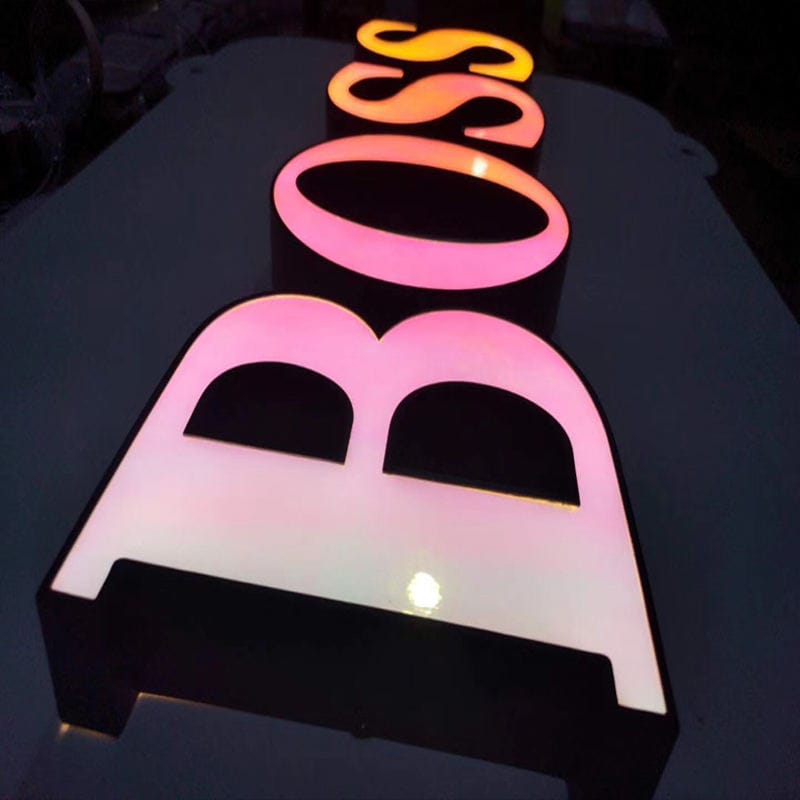
White channel letters are the Toyota Corolla of signage—everybody needs one, and most folks spec 'em wrong.
Look, a white channel letter isn't just a white plastic shell with a light inside. You're dealing with a metal return, a white acrylic face, LED modules, and a power supply—all fighting the elements together. Usually you spec aluminum returns at 1.0–1.6mm thick or 304 stainless at 1.0–3.0mm. That white acrylic face transmits 90–92% of the light you pump into it. Standard acrylic faces run 2mm or 3mm. If the letter gets taller than 2.5 meters, step up to 5mm or you'll watch it bow in the wind.
Types? Standard front-lit channel letters come with a trim cap, rimless, or domed. White channel letters are almost always front-lit channel letters—the bread-and-butter storefront sign. Standard return depth runs 3 to 5 inches. Deeper returns spread the LED hot spots before they hit the face. Shallower returns show every module placement like a flashlight against paper.
Here's what nobody tells you: acrylic face thickness hardly moves the needle on light output. A 3mm white acrylic face cuts 92% of light output. A 2mm face cuts 90%. Your customer won't notice that 2% difference. But they'll notice the 40% cost bump on the thicker sheet. Use 3mm for normal letters—not because it's brighter, but because it's stronger.
The ugly truth: most "white" acrylic isn't white forever. Domestic acrylic starts yellowing in 12 to 18 months under UV. UV-resistant acrylic from Mitsubishi or Degussa holds 5 to 8 years. If your client's sign faces west in Phoenix, the cheap sheet turns cream before the lease is up.
LED color temperature separates the pros from the amateurs. 3000–3500K warm white looks creamy behind a white face—perfect for hospitality. 4000–5000K neutral white is your corporate/retail workhorse. 6000–6500K cool white reads blue-white, best for industrial or highway signs. A warm 3000K module behind white acrylic doesn't look like incandescent; it looks like a smoker's teeth. That's not an insult. That's a fact.
Modules: SMD 2835 at 100–150 lm/W is the industry standard for white channel letters. Need more punch? SMD 5730 chips run 40–60 lm per chip. Cheap modules with dull gray solder joints die in 12 to 18 months. Shiny silver lead-free solder joints signal Samsung, Osram, or Blueview modules with a real 5+ year lifespan.
Return material matters. Aluminum weighs one-third of steel and lasts 8–12 years outdoors. 304 stainless gives you 10+ years. For coastal or industrial zones, 316 stainless adds 2–3% molybdenum and costs 20–30% more—but it's the difference between replacing in 3 years and 15+ years. A strip mall in Ohio can run 304. Miami Beach pays for 316 or pays twice.
If you're spec'ing acrylic LED letters with white faces, don't order domestic acrylic just to save $3 per sheet. You'll lose that savings when you're re-facing the sign before the contractor's warranty expires.
Here's what nobody tells you: LED spacing matters more than the brand on the module. Overcrowd them and you get hot spots. Spread them too thin and the white acrylic face looks patchy at night. Standard SMD 2835 modules in a 3-inch return need consistent spacing tied to stroke width, not just letter height.
If your project requires UL 48 in the US, that's a $4,000–$15,000 certification with 4–9 months of testing and quarterly audits. ETL is 10–30% cheaper and recognized by most AHJs. Don't let a factory tell you they "have UL" for your specific sign unless they can show the certificate with today's date and your configuration on it. Most factories have CE, RoHS, and ISO 9001. CE marking costs 20,000–50,000 RMB and takes 2–8 weeks. CE is a baseline, not a UL substitute.
Outdoor white channel letters need IP65 at minimum. IP65 means dust-tight and protected against water jets from any direction. IP65 doesn't mean your sign survives a Florida hurricane. For coastal exposure, specify IP66. For anything submerged, you're doing it wrong unless it's IP68.
Design the returns before the face. Laser cutting at ±0.1mm means every return, back, and trim cap fits. TIG welding the corners with 304 stainless or aluminum keeps the letter rigid. Power supplies need ventilation inside the letter or a separate remote enclosure—burying a 12V driver in a sealed 2-inch return gets your 1-year power supply warranty denied.
Look, I've watched sign shops pay $800 for a front-lit white channel letter from a domestic fabricator. Same 304 stainless return, same Samsung 2835 LEDs, same 3mm white acrylic face. We ship that letter factory-direct for $120. That's 50–65% savings on product, and it's why US sign companies buy overseas and still mark up installed labor.
Factory pricing benchmarks: front-lit channel letters run $20–80 per letter. Back-lit halo letters run $35–120. Stainless non-lit letters run $15–40. US retail installed pricing for front-lit white channel letters lands at $200–700 per letter. That gap is your margin—just don't eat it all in shipping and tariff mistakes.
Price drivers: return depth, finish, LED brand, certification, and acrylic grade. A 316 stainless return adds 20–30% over 304. UV-resistant acrylic adds cost now, prevents yellowing later. If you want stainless steel letters with a white acrylic face and UL 48, you'll amortize the certification cost across the order. One letter? You're paying for the certificate too. Twenty letters? The math changes.
Shipping: express takes 7–15 days for $30–100 on small signs. Air freight runs 10–20 days at $4–12/kg. Sea freight takes 50–70 days and costs $80–200 per cubic meter LCL or $1,200–3,000 for a full container. Add the US Section 301 tariff of roughly 30% on top of your landed cost. I've seen contractors forget the tariff and blow their whole margin.
I've seen this go wrong: a factory promises you white channel letters in 10 days, then sends a photo of unpainted steel returns and calls it "production." Real production follows a 10-step process. Design confirmation in 1 day. Laser cutting at ±0.1mm in 1–2 days. Bending and TIG welding in 1–2 days. Grinding and polishing in 1–2 days. Acrylic face CNC in 1 day. LED assembly in 1–2 days. Sealing with neutral silicone in 1 day. Then an 8–12 hour aging test, followed by 100% QC inspection and export packaging with foam, carton, and plywood crate. Total: 7–15 days.
Aochuang Sign runs 3,000 square meters with 50+ workers in Lu'an, Anhui. MOQ is one piece. That matters because plenty of factories won't touch a six-letter storefront order without a $5,000 setup fee. Aochuang Sign gives you a 2-year warranty on LED modules and 1 year on power supplies. If a factory offers 5 years on LEDs with no questions asked, ask who's underwriting the replacement when those cheap modules die at month 18.
The ugly truth: certifications get photoshopped. CE marking costs 20,000–50,000 RMB. Most factories say they have it. Ask for the certificate with today's date. Watch them sweat. If they can't produce it in 24 hours, walk.
Permitting for white channel letters isn't optional. NEC Article 600 governs electric signs in the US. Your AHJ may require UL 48, ETL, or just a licensed electrician's sign-off. Check before you fabricate, not after the letters are on a boat.
Installation: use stainless or powder-coated aluminum raceways or direct-mount studs. Seal every penetration with neutral silicone. Water kills white channel letters faster than UV. A 12V power supply mounted in a sealed, unventilated return will cook itself—1 year warranty, gone in three months.
Maintenance is mostly cleaning the acrylic face with a non-abrasive cloth. The LED L70 lifespan is ≥50,000 hours on quality modules. That's about 5.7 years of continuous operation. Cheap modules hit L70 in 12–18 months—not because the spec was lower, but because the solder joints fail from heat cycling. You're not buying a light bulb; you're buying solder quality.
If you're installing near saltwater, spec 316 stainless returns and IP66. I don't care if the customer says they're 5 miles from the coast. Salt travels.
White channel letters are brighter and more classic than colored faces. A white acrylic face transmits 90–92% of the LED output. A dark blue face might transmit half that. Colored faces look sharp in daylight but die at night unless you overdrive them with higher-output modules. White faces don't fight you.
Halo-lit letters are a different animal. You mount the LEDs behind an aluminum back and let the light spill onto the wall. That's a premium architectural look, and it costs accordingly. Factory pricing for back-lit halo letters runs $35–120 per letter versus $20–80 for front-lit white channel letters. Installed US pricing for halo can hit $400–1,000 per letter. If the client wants subtle, spec halo. If they want readable from 300 feet, white front-lit wins every time.
The performance gap comes down to light control. White front-lit channel letters put light through the face, so luminance depends on LED density and acrylic diffusion. Halo-lit letters skip the face and use the wall as a reflector. That's softer but lower contrast at distance. For a drive-by storefront, white channel letters with 2835 modules and a 3mm acrylic face will out-read any halo sign on the block.
What's the best LED color for white channel letters? 4000–5000K neutral, unless you know why. 3000K looks yellow behind white acrylic; 6500K looks blue. Stop asking for "daylight white" unless you've seen both on a wall at night.
How long will my white channel letters last? Quality LEDs with shiny solder joints and UV-resistant acrylic: 5+ years before noticeable degradation. Cheap modules: 12–18 months before you're on a ladder.
Do I need UL listing for white channel letters? Maybe. If your AHJ requires it, yes. NEC Article 600 covers electric signs, but UL 48 is a certification, not a law. Ask your inspector before you pay $4,000 for something you didn't need.
Can I order one sign from the factory? Yes. MOQ is one piece. That's not a typo.

Real photo from our production floor — every sign we ship is made here.
Products mentioned or relevant to this topic — factory-direct, custom built.
From $24/letter · MOQ 1 piece · Flexible lead time · CE & UL certified · ships to 20+ countries
Custom sizes, colors, and finishes. Get a factory price in 24 hours.
Get a Free Quote Copy EmailWhatsApp +86 13865703472 · business@aochuangsign.cn