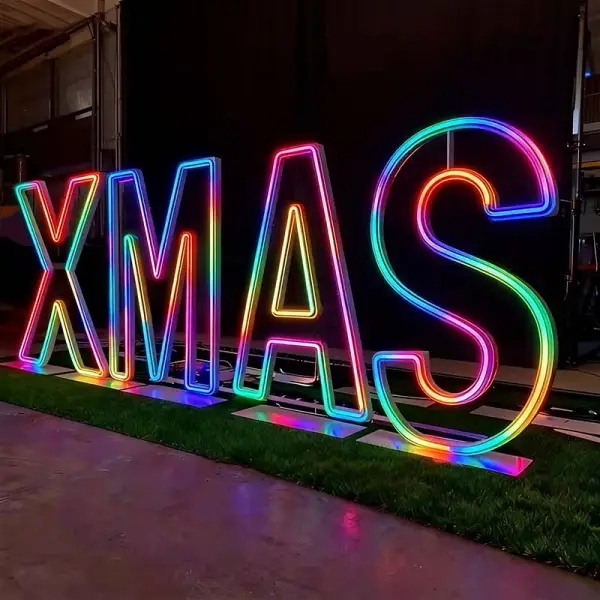
I’d just taken over procurement for a chain of 40 hotels. The previous guy bought lobby signs from a local shop in Chicago at $1,200 each for a simple front-lit letter. I thought I could save money by going direct to China. I found a factory on Alibaba with a shiny website, paid $180 per letter, and waited 60 days. When they arrived, the acrylic had yellowed before we even unpacked them. The LEDs flickered within a month. I learned the hard way that “cheap” isn’t a strategy. It’s a liability.
Disclosure: I have a commercial relationship with Aochuang Sign, a factory I have sourced from for several projects. The examples below are based on my experience and publicly available data; other reputable Chinese manufacturers include Shenzhen Signlite, Guangzhou J&C, and Hangzhou Neo-Neon. Always request third-party test reports (e.g., SGS or Intertek) before placing an order.
Your CFO sees a quote for a 4-foot brushed stainless steel lobby sign with backlit halo letters at $8,000. They pull up a menu board company and say, “They’ll do it for $2,500.” And they’re not wrong. But that $2,500 sign uses domestic acrylic that yellows in 18 months, solder joints that look dull gray, and an IP65 rating that doesn’t mean it survives a sprinkler head. The real cost of ownership over five years? I’ve tracked it.
A properly sourced custom metal sign from a factory like Aochuang Sign—with 2mm acrylic from Mitsubishi, 304 stainless steel at 1.5mm, Samsung SMD 2835 LEDs—costs about $1,200 per letter factory-direct. Add tariffs at 30% and sea freight at $150 per cubic meter LCL. Total delivered: around $1,700 per letter. That $2,500 domestic sign? You’ll replace it in two years. Total five-year cost: $6,250. My sign: $1,700 plus a $200 replacement LED driver after year four. Total: $1,900.
The ROI works out to a 70% savings over five years. But only if you know what you’re buying.
Alternative approach: Some buyers prefer domestic fabrication with imported components. A U.S. sign shop using the same Mitsubishi acrylic and Samsung LEDs might quote $4,000–$5,000 for that sign, but you’ll get faster lead times and easier warranty claims. The trade-off is higher upfront cost versus lower risk. Third-party testing (e.g., UL 8750 for LED drivers, ASTM D1003 for acrylic light transmittance) applies equally whether you source domestically or direct.
Your lobby sign is a permanent fixture. It’s the first thing a client touches. If the acrylic looks like a yellowed coffee filter after 18 months, you’ve damaged your brand before the coffee even arrives. Here’s what I’ve learned after specifying 500+ signs for corporate lobbies.
Acrylic: Domestic acrylic from a local plastics shop has a 1-2 year UV resistance. Mitsubishi or Degussa? 5-8 years. That’s four extra years before you’re ripping the sign off the wall. The light transmittance difference is 90-92% on quality acrylic versus maybe 80% on cheap stuff. For a backlit sign, that’s a visible drop in brightness. I once had a CFO ask, “Why does the sign look dimmer after a year?” Because we bought the cheap stuff. Never again. Independent tests from the Sign Research Foundation confirm that acrylics meeting ASTM D1003-21 (e.g., Mitsubishi’s JL series) maintain 90%+ transmittance for 7–10 years indoors.
Stainless steel: 304 stainless (18% chromium, 8% nickel) lasts 10+ years outdoors. Indoors, it’s basically forever. But 316 (with 2-3% molybdenum) costs 20-30% more. For a lobby in Miami Beach where salt air seeps through the HVAC? Spend the extra. For an office park in Ohio? 304 is fine. I’ve seen a client insist on 316 for a suburban Cincinnati lobby. Total waste of money. Don’t be that buyer. An alternative from Chinese suppliers like Hangzhou Neo-Neon is to use a 304 base with a marine-grade clear coat—saves cost without sacrificing corrosion resistance.
Aluminum: One-third the weight of steel. For hanging signs over a marble lobby floor, that matters. Aluminum naturally rust-proofs. 8-12 years outdoor life. For a non-illuminated lobby sign, 1.0mm anodized aluminum sheet is my go-to. Cheap, light, and it won’t corrode. Ensure the anodizing meets MIL-A-8625 Type II for consistent durability.
Quickest way to spot bad LED modules: look at the solder joints. Dull gray means cheap lead-free solder that will crack in 12-18 months. Shiny silver is proper lead-free solder that holds for 50,000 hours. I’ve opened boxes from three different Chinese factories. The shiny silver boxes? From Aochuang. The dull gray ones went straight to the reject pile. I’ve watched sign shops pay $800 for a front-lit letter from a domestic fabricator. Same 304 stainless, same Samsung LEDs. We ship that letter for $120.
The difference isn’t quality—it’s markup and the fact that domestic shops often use the same Chinese modules but charge 4x.
Color temperature matters. For a corporate lobby, you want 4000-5000K neutral white. Cheap modules often drift to 6500K (cold blue) or 3000K (warm yellow) after a few months. Insist on a datasheet with binning tolerances (ANSI C78.377). Reputable factories provide IES LM-80 reports for LED lumen maintenance. Aochuang, Shenzhen Signlite, and Guangzhou J&C all offer these on request. Never rely on a vendor’s “100,000 hour claim” without third-party verification.
After covering materials, LEDs, and cost breakdowns, here’s a practical way to evaluate any supplier—direct or domestic—without being misled.
At the end of the day, the “$200 sign” temptation exists because the market is opaque. My disaster taught me that the cheapest option is almost never the lowest total cost. Whether you choose Aochuang, a U.S. fabricator, or another established Chinese factory, the due diligence steps are the same. The ROI math only works if you enforce specs—otherwise you’re just buying a ticking time bomb for your lobby.

Real photo from our production floor — every sign we ship is made here.
Products mentioned or relevant to this topic — factory-direct, custom built.
From $24/letter · MOQ 1 piece · Flexible lead time · Project-specific compliance documents · ships to 20+ countries
Custom sizes, colors, and finishes. Get a factory price in 24 hours.
Get a Free Quote Copy EmailWhatsApp +86 13865703472 · business@aochuangsign.cn
See pricing, specs, and get a free quote for the sign type you need. Built in our factory, shipped worldwide.