I’ve been on this floor for 16 years. I’ve unwrapped competitor shipments that looked great in photos and fell apart on my inspection table. This isn’t a sales pitch. It’s the list I wish every importer read before wiring a deposit.
I’m not talking about a polished catalog shot. I mean a grainy phone photo of your actual letters being bent, with today’s newspaper in the frame. If they hesitate, walk.
Good factories have nothing to hide. We run 3,000 square meters of production space here in Lu’an, Anhui. Fifty-plus workers. I can walk over to the laser cutter and snap a stainless steel letters order mid-cut. You’ll see the ±0.1mm precision that keeps your returns flush against a stucco wall. If the salesperson claims the factory is “in another city” or “cameras aren’t allowed,” you’re talking to a trading company. They’ll pocket 30% and outsource to the lowest bidder.
Look, I lost a $12,000 order last year to a “factory” with a prettier website. The client sent me their final product three months later. The aluminum faces were .032” — paper-thin. They’d been punched, not laser-cut, so the edges looked chewed. The sign shop had to scrap the whole batch. That’s a $40,000 installed project gone because someone couldn’t provide one live photo.
Impossible. That’s a lie.
Genuine UL 48 listing for electric signs costs $4,000 to $15,000, demands quarterly factory audits, and takes 4 to 9 months. ETL is a solid alternative, 10-30% cheaper, but no legitimate lab issues a full certification that fast. What you’ll get instead is a “UL component” letter — a test report for the LED strip, not the entire fabricated channel letter. The sign burns, the fire marshal asks for the label, and you’ve got nothing.
Here’s what nobody tells you: most overseas factories ship thousands of signs to the US every year with zero UL. They count on electricians not checking. When a building inspector in Houston catches a 30-foot pylon sign without a field label, your contractor calls you at 6 AM. Suddenly you’re paying a local engineer $3,000 for a field evaluation, and the sign is unplugged for two weeks. We offer full UL-listed front-lit channel letters for volume clients. The paperwork adds 12 weeks to your lead time. If you can’t wait, we’ll build to UL-compliant materials and hope your local inspector is reasonable. I’d rather lose the order than sell you a fake certificate.
IP65 sounds impressive. It means the enclosure is dust-tight and protected against water jets from any direction. It does not mean your sign survives a Florida hurricane or a Minnesota freeze-thaw cycle. The ugly truth is that many factories test one 6-inch square sample in a chamber, then stamp IP66 on a 20-foot sign with silicone beads thinner than a wedding ring.
I’ve seen this go wrong: a franchise chain ordered 80 back-lit halo letters with an IP67 guarantee. Within six months, 14 letters had failed power supplies. The factory drilled drainage holes and sealed them with hot glue — yes, hot glue — because the water intrusion was so bad. Real IP66 for coastal work means stainless 316 returns with welded and pressure-tested seams, marine-grade silicone, and sealed cable glands. It costs 20-30% more. For a strip mall in Dallas, IP65 with 304 stainless and proper neutral silicone is enough. For Miami Beach, pay for 316 and insist on IP66. If the factory doesn’t ask about your installation’s wind load and salt exposure before quoting, they’re guessing.
CE marking is another fantasy. A real CE compliance test on a light box takes 2-8 weeks and costs 20,000-50,000 RMB. I’ve visited factories that keep a PDF of a 2016 certificate and change the company name in Photoshop. Ask for a photo of their spectroradiometer. Ask for today’s date on the document. Silence usually follows.
You’d be shocked how often a salesperson types a price after seeing only a logo. If I don’t ask what state you’re in, whether the sign faces south, and if you need 120V or 277V, I’m not engineering a sign — I’m shipping a decoration.
Here’s the reality: an aluminum letter set for a shaded courtyard in Seattle needs different mounting hardware and finish than one baking on a Phoenix wall. Color temperature matters. 6000K cool white works for a highway pylon but makes a boutique hotel look like a surgery ward. I’ve spec’d 3000K warm white for hospitality signs using 90+ CRI LEDs, then watched a competitor quote the same job with 6500K SMD 2835s at half the brightness. The client saved $800 on product and spent $5,000 replacing the entire sign after the landlord complained.
We stock SMD 2835, 5050, and 5730 modules. Samsung and Osram for jobs that demand 5+ real years of lumen maintenance. Cheap modules burn out in 12-18 months. That’s not guesswork — I’ve measured the output on an integrating sphere. When a buyer tells me “your price is high,” I ask if they’d rather pay now or pay their electrician $120/hour to re-lamp a sign in two winters. They usually come back.
A full stainless steel front-lit channel letter costs $20-80 at factory door. A premium back-lit halo letter, $35-120. That’s the range with 304 stainless, 3M acrylic, and a Mean Well power supply. If someone quotes $12 for a halo letter, you’re getting 201 stainless that rusts in 18 months, domestic acrylic that yellows in two years, and a generic driver that hums like a fridge.
Look, I’ve lost count of the “help me” emails. A contractor in Toronto bought 100 neon flex signs for a food hall. The supplier used PVC backing instead of aluminum, and the lowest-rent LED neon with a 6-month warranty. The signs sagged. The colors faded to a weird green. The end client withheld the final payment. That contractor’s margin — gone — on a $16,000 job because he chased a $3,000 savings.
Actual factory pricing from a transparent supplier looks like this: acrylic light boxes from $80-250 per square meter. food menu signs from $30 to $150. Stainless non-lit letters at $15-40. Those are our numbers, and they leave enough margin for real 304, proper sealing, and an aging test before packing. If the quote doesn’t include line items for material grade and LED brand, you don’t have a quote — you have a wish.
We call it the “golden sample.” A single letter crafted by the factory owner’s nephew, polished for four hours, and photographed under studio lights. The 49 letters that follow land on your dock with grinding marks, uneven returns, and LED placement that looks like a drunk plotted it.
I’ve seen this go wrong: a Dallas sign shop ordered 40 rimless channel letters. The sample was flawless — sharp corners, invisible welds, uniform 6500K glow. Production arrived with 6mm acrylic faces that should have been 5mm, so they bulged. The silicone seal failed the first rain. The factory’s response? “You approved the sample.” Technically true, legally useless.
At Aochuang, every single letter goes through an 8-12 hour burn-in test. All 50-plus workers know that QC isn’t a sticker — it’s a 100-point checklist signed at each station. We photograph each crate before loading. I’ve canceled shipments that didn’t meet spec. It costs me a week’s production, but it’s cheaper than air-freighting replacements to Chicago.
The ugly truth is that many overseas factories quote FOB and pretend import costs don’t exist. Then you get a call from the freight forwarder with $900 in terminal handling, $1,200 in LCL fees, and a 30% Section 301 tariff on top of the declared value. Suddenly your $6,000 order is $9,000, and the factory just shrugs.
Here’s what nobody tells you: air freight is $4-12 per kilo, and a 30-letter channel letter crate can hit 80 kilos fast. Express shipping a single sign costs $30-100 but scales poorly. Sea freight LCL runs $80-200 per cubic meter; a full container FCL is $1,200-3,000. We quote DDP whenever possible — delivered, duty paid. We eat the risk of tariff classification because I’d rather argue with customs than have a client blindsided. I’m not a customs broker, but after shipping worldwide, I know that a sign labeled “illuminated advertisement” gets flagged, while “acrylic display” sometimes doesn’t. That’s a conversation we have before you pay.
We’ve been in this facility since 2010. 3,000 square meters of laser cutting, TIG welding, and assembly. We’re ISO 9001, CE certified, RoHS compliant. I can look at a CAD file and tell you if a 2.5-meter-tall letter needs 5mm acrylic instead of 3mm to avoid bowing — and I’ll tell you before you order, not after a hurricane reveals the weak spot. I can’t turn a 7-day lead time into 3 days. I can’t make the US government drop the 30% tariff. I can build you dual-lit channel letters with Samsung LEDs and 316 stainless that outlast your lease. And I’ll send you a photo of them on my bench, today’s paper in the shot, without asking twice.
When you’re ready to order, ask the factory for their mill certs, their test chamber date, and a live video of the floor. If they squirm, you know why. If they welcome the question, you’ve found a partner.

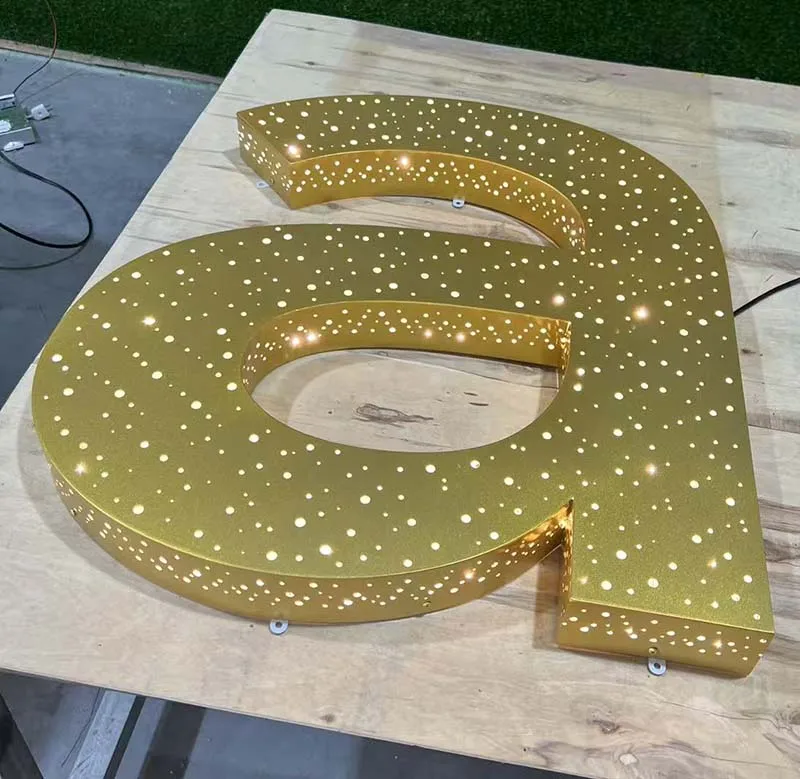
Real photo from our production floor — every sign we ship is made here.
From $24/letter · MOQ 1 piece · Flexible lead time · CE & UL certified · ships to 20+ countries
Custom sizes, colors, and finishes. Get a factory price in 24 hours.
Get a Free Quote Copy EmailWhatsApp +86 13865703472 · business@aochuangsign.cn
See pricing, specs, and get a free quote for the sign type you need. Built in our factory, shipped worldwide.