I’ve seen a $12,000 lobby sign turn into a chalky, peeling mess in 14 months. The aluminum itself was fine. The finish wasn’t. That’s the conversation nobody has early enough. The choice between anodized and powder coated aluminum isn’t about looks first — it’s about how the surface dies. And all surfaces eventually die.
We cut, bend, and finish roughly 8,000 aluminum letters a year here in Lu’an. Some get loaded onto container ships bound for humid Gulf Coast cities. Others fly out by air freight to dry mountain towns in Switzerland. The finish has to match the weather. I’m going to walk you through what I’ve learned in 16 years on the factory floor, no glossing over the ugly parts. There’s a place for both anodized and powder coated aluminum. But if you choose wrong, your sign won’t make it to its second lease renewal.
Anodizing isn’t a coating. That’s the first mistake rookies make. It’s an electrochemical process that grows the aluminum’s natural oxide layer into a hard, porous film, usually 5 to 25 microns thick. The pores are then sealed, trapping air or dye inside. It becomes part of the metal. You can’t peel it because there’s no layer to peel.
Powder coating is a dry polymer powder sprayed electrostatically onto the aluminum, then baked at 180-200°C. It melts into a continuous skin, typically 60 to 80 microns thick. That skin sits on top of the metal, held by a pre-treatment layer — usually a chromate conversion coating or a thin etch primer. If that pre-treatment is cheap or skipped, the powder coat becomes a shrink-wrap that lets go the moment moisture creeps underneath at a scratch.
Here’s what nobody tells you: both can fail spectacularly. I’ve seen anodized signs with “15-year warranty” turn dull and blotchy after three because the dye was cheap organic pigment instead of metallic salts. I’ve seen powder coated letters blister in a single New England winter because the fabricator used generic polyester powder and no chromate pre-treatment. Good material, wrong chemistry.
Clear anodized finish is near-perfect for corrosion resistance. The sealed oxide layer is harder than the raw aluminum underneath. It doesn’t chalk. It doesn’t grow mold. If you have a sea-facing restaurant and want a crisp metallic look, clear anodized aluminum letters, properly done, can last 15 to 20 years outdoors. We use it often for architectural stainless steel letters when the budget can’t stretch to actual 316, because clear anodized on 1.6mm aluminum gives you a similar cool tone at a third the weight.
Now the brutal part. Colored anodized aluminum fades. No, not “ages gracefully” — it chemically decomposes in UV. Most shops won’t tell you that because it sells. Organic dyes, even the expensive ones, break down under 3-5 years of direct sunlight. Inorganic dyes (like tin or cobalt) hold up better, maybe 7-10 years, but your color palette is limited to bronze, black, gold. If a client demands a bright red or navy blue in anodized, I tell them no. We can do it, but we won’t warranty the color past two years. The ugly truth is that any anodized color besides muted metallics is a ticking clock, and you’re the one who’ll get the angry call when it fades patchy.
Another thing. You scratch anodized aluminum, you live with that scratch. You can’t touch it up. The factory can try to re-anodize, but it strips the whole part. On a 5-foot-tall custom letter, that’s scrap. Keep that in mind if the sign is within reach of a shopping cart or a pressure washer wand.
Look, anodized isn’t a bad finish. But it’s the wrong finish if the buyer expects vibrant, long-lasting color or easy field repair. I push it for corporate lobbies, interior directional signs, and outdoor applications where a subtle silver or champagne metallic is the entire point. For our rimless channel letters, we sometimes use clear anodized aluminum returns because the face is acrylic and the returns are barely visible, but the client demands zero rust worries for 15 years.
A premium polyester powder coat applied over a chromate conversion coating can outlast colored anodized two to one in direct sunlight. The powder is engineered for UV stability. We use super-durable polyester powders from Tiger or AkzoNobel for bright reds, yellows, and corporate blues that live on south-facing walls. Our clients in Dubai and Phoenix have had powder coated aluminum letters up for 8+ years with minimal chalking because the chemistry was right from day one.
Here’s where the industry shoots itself in the foot. A lot of fabricators — not us, but plenty — skip the chromate step because it adds cost and time. They’ll shoot powder straight onto degreased aluminum. For a year, it looks fine. Then water finds a pinhole, gets under the powder at a fastener point, and you get filiform corrosion: those ugly white worm trails spreading under the paint film. I’ve seen this go wrong: a chain of coffee shops rebranded in bright orange, hired a lowest-bidder sign shop who used cheap epoxy powder with no pretreatment, and within two years every sign above every storefront looked like it had a skin disease.
Powder coat is thicker and more impact-resistant than anodizing. It absorbs dings better. A small scratch can be wet-sanded and touched up with a matching lacquer, which isn’t factory-perfect but buys you a few more years. It’s also the only way to get a true matte or textured finish that doesn’t show fingerprints, which matters a lot for light boxes and menu boards at eye level. Our food menu signs almost always get a matte powder coated frame.
The ugly truth is powder coat can chalk. Even the good stuff. In extreme UV, the resin at the very surface degrades and leaves a dusty white film. On a dark color, it’s noticeable within 10-12 years if you’re in a place like Miami. On a light color, you won’t see it for 15-20. That chalk can be cleaned and a clear topcoat reapplied in the field if the structure is sound — which is another advantage over anodized. You can revive a powder coated sign. You can’t revive a bleached anodized one.
When you order our aluminum letters, you’ll specify either anodized or powder coated based on the environment. And we’ll be blunt about which one makes sense for you, even if it means a smaller order. I’ve talked customers out of colored anodized for a beachfront hotel and into a marine-grade powder coat. They called me six years later to order three more hotels. That’s how you build trust.
Let’s put numbers down. These are averages from our own warranty-tracking database. Indoor life doesn’t matter — everything lasts indoors. Outdoors is where the finish earns its keep.
1. UV Resistance. Clear anodized: excellent, no organic colorants to break down. Colored anodized: fair to poor, 2-7 years before visible fading. Premium polyester powder coat: excellent for 10-15 years before noticeable chalking, especially with super-durable grades. Cheap epoxy powder: chalk and fade in 2-3 years. RAL 3000 red powder coat from a good batch is still rich after a decade; the same red in anodized looks like a faded barn after four summers.
2. Corrosion Resistance. Clear anodized, properly sealed, withstands salt spray testing for 1,000+ hours. Powder coat with chromate pretreatment withstands 1,500+ hours. That’s measured by ASTM B117. Both beat raw aluminum into the ground. But a scratch through the powder coat down to bare metal is a corrosion starter. A scratch through anodized is less catastrophic because no moisture can get under a separate layer. So in a high-salt, high-scratch zone (think shipyard sign, not typical storefront), clear anodized has the edge.
3. Impact & Abrasion. Powder coat is softer than anodized oxide but thicker, so it dents less readily. Anodized surfaces are Mohs 7-8 hardness (the oxide is alumina, same as sapphire), excellent for scratch resistance from cleaning tools. But if a rock hits it hard enough, the aluminum under it will deform, cracking the brittle oxide layer. Powder coat flexes. For signs near a gravel parking lot, powder coat usually wins.
4. Color Range and Consistency. No contest. Powder coat gives you any RAL or Pantone, metallics, textures, gloss levels from 10% to 95%. Anodized gives you clear, champagne, bronze, black, and a handful of muted tones if you use inorganic dyes. And anodizing batch-to-batch color matching is a nightmare. We fought a 4,000-letter project where the client wanted an exact champagne match across three shipments. Never again. Powder coat, we match within ΔE 1.0 consistently.
5. Repairability. Powder coat can be cleaned, sanded, and recoated in the field or with a touch-up bottle. Anodized cannot be repaired without stripping. That’s a lifetime-cost factor a contractor should consider before installing 50 letters 30 feet up. If one gets gouged by a scaffold pole three years later, the powder coated letter can be saved; the anodized one becomes an expensive piece of scrap metal.
Here’s what nobody tells you: all these tests assume the sign is installed with proper drainage and airflow. Trapped water behind a letter is the real killer, not the finish itself. We always specify 10mm thick spacers for aluminum letters mounted directly on stucco or brick, so water sheets off. The best anodized finish will pit if a pocket of salty rainwater sits against it for months.
If your sign is on a coastal boardwalk, within a mile of breaking surf, don’t use anodized with color. Don’t even use aluminum if the budget can stretch to 316 stainless steel letters. The salt mist will eat the anodized dye first, then eventually the aluminum. We ship 316 letters to places like Santa Monica and Bermuda for exactly that reason. If the budget is tight, go with a well-sealed clear anodized aluminum letter or a high-grade marine powder coat with chromate pretreatment, and expect to do a maintenance wash twice a year.
For a corporate office park in Dallas, 20 miles inland, the UV is your enemy, not the salt. Powder coat in a super-durable polyester is the right call for anything with bright brand colors. Clear anodized works for a subtle mill-finish look. But if the architect specifies a matte black letter with zero chalking for 15 years, we push a textured powder coat. Black anodized will turn purple-gray in the Texas sun long before the lease is up.
Retail storefronts with a 5-year rebrand cycle? You might not care about 15-year durability. In that case, colored anodized gets you a slick, modern look that holds fine for 3-4 years, and it costs a bit less than high-end powder coat at our factory. For our front-lit channel letters, the aluminum returns are usually powder coated in the same RAL as the storefront because it’s affordable, fast, and matches the pylon sign. Nobody sees the return after dark anyway.
Look, I’ve seen national fast-food chains switch their entire sign specification from anodized to powder coat in one year because three franchisees complained about fading. Then I’ve seen luxury hotel brands stick with clear anodized for 20 years on back-lit halo letters because the up-lit glow against a brushed, slightly reflective surface is exactly the vibe they want. There’s no universal winner.
We’re in Lu’an, Anhui, not a magic cleanroom. We can anodize up to 2.4-meter lengths using a local partner with a sealed, temperature-controlled tank. But we only offer clear and champagne anodizing in-house because those are the most consistent. For dark bronze or black anodized, we sub it out to a specialist in Shanghai, adding 3-4 days to the lead time. If you need a large order of bright anodized colors, we’ll tell you to switch to powder coat or to limit the color risk. I’d rather lose a $200 line item than ship something I know will cause a warranty claim.
Our powder coating line is the real workhorse. We run a Gema automated system with a 5-stage pretreatment tunnel: degrease, rinse, chromate, rinse, DI water rinse. The powder we use is 80% super-durable polyester from Tiger for outdoor work. We can match any RAL, and we regularly hit 80-100μm thickness consistently on letter faces and returns. For indoor only, we do offer a cost-saving epoxy-poly hybrid, but we label it clearly on the quote: “Not for exterior use.”
The finished aluminum letters from us ship with a 2-year warranty on the LED, but also a 1-year warranty on the finish against manufacturing defects — that doesn’t cover environmental fading because, as I’ve said, some fading is inevitable. We’ll show you the ASTM test data for your chosen color so you know what to expect. If you need a warranty that guarantees <2 DE color shift over 15 years, that’s a different product, a different price, and honestly a conversation for a different factory. We build signs that outlast most rebrands.
Before you pay a deposit, ask these five questions. I’ve used them to train my own project managers.
We keep installation photos from clients on file — Florida, UAE, Singapore, Norway. The Singapore dual-lit channel letters with dark bronze powder coat on the returns still look tight after six monsoon seasons because the pretreatment held and the drainage gaps worked. The anodized champagne aluminum letters on a Napa Valley winery are developing a slight patina just like the owner wanted. We’ll show you both.
One final thing. If your project demands a finish that lasts longer than 20 years with near-zero change, skip aluminum entirely. Go to 304 or 316 stainless steel letters with a brushed or PVD finish. Yes, it’s heavier and pricier. But metal never lies. We’ll build them for you, and we’ll be honest about the cost. No sales pitch, just three decades of watching finishes die so yours doesn’t have to.

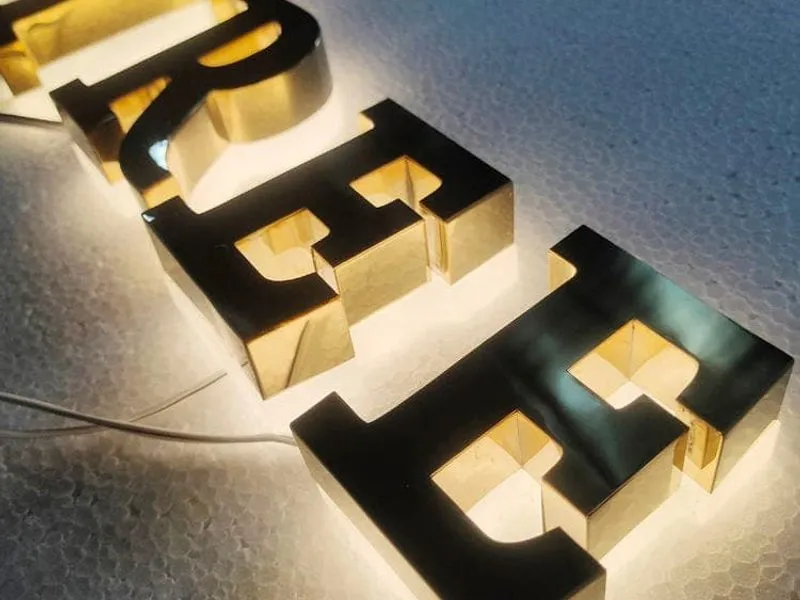
Real photo from our production floor — every sign we ship is made here.
Products mentioned or relevant to this topic — factory-direct, custom built.
From $24/letter · MOQ 1 piece · Flexible lead time · CE & UL certified · ships to 20+ countries
Custom sizes, colors, and finishes. Get a factory price in 24 hours.
Get a Free Quote Copy EmailWhatsApp +86 13865703472 · business@aochuangsign.cn
See pricing, specs, and get a free quote for the sign type you need. Built in our factory, shipped worldwide.