I just got off the factory floor at 11 p.m. after re-welding a stainless return on a 42-inch bank letter because the first pass was a half-degree off. Bank signage isn't like a pizza shop. One bad return and the branch manager's corporate sign-off dies at the mockup. I've been building signs since 2010 in Lu'an, Anhui, exporting to the U.S. and Europe, and I'll tell you what actually matters when you're sourcing bank signs.
Most bank branches need three things: a street sign, a building sign, and interior wayfinding. You'd be surprised how many procurement folks skip the third and then get an ADA lawsuit.
For the main exterior, front-lit channel letters are the workhorse. Acrylic face, aluminum or stainless returns, internal SMD 2835 LEDs pushing 100-150 lumens per watt. Factory cost per letter runs $20-80. U.S. installed retail sits at $200-700 per letter. That markup isn't greed; it's local labor and code compliance.
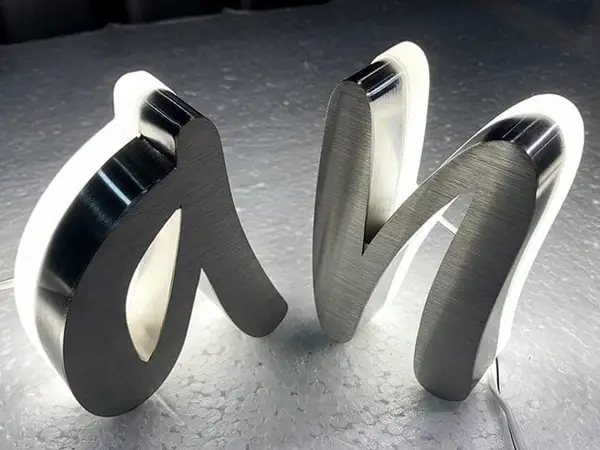
Wealth management or flagship branches want back-lit halo letters. That's the high-end look architects love: the letter body floats off the wall, light spills behind it. Factory price $35-120 per letter, installed retail $400-1,000.
Look, a drive-thru or ATM lane doesn't need a halo sign. It needs a double-sided light box or a pylon that a driver can read from 200 feet in 1.2 seconds. That's the whole job.
Interior signs are where wayfinding and directional systems come in. Tactile, non-glare, Braille. If your branch can't route a person in a wheelchair to the restroom, you're not compliant, and it won't go unnoticed.
Here's what nobody tells you: federal ADA, local zoning, historic overlays, and the bank's own brand standards don't talk to each other. You're the translator.
ADA for tactile signs: mounting height 48-60 inches, non-glare finish, Grade 2 Braille. That's not optional. NEC Article 600 covers electrical signs. If your installer doesn't know Article 600 by heart, send them packing.
Zoning varies by city, sometimes by block. Historic overlay? Some boards won't let you use aluminum or certain finishes. I've seen a bank pay $18k in fees to get a halo sign through a historic district, then have to powder-coat it matte bronze to match the 1920s masonry.
UL 48 listing costs $4,000-15,000 and takes 4-9 months with quarterly audits. ETL is an accepted alternative and runs 10-30% cheaper. CE marking in China costs 20,000-50,000 RMB. The ugly truth? Most factories will tell you they have CE. Ask to see the certificate with today's date. Watch them sweat.
Luminance limits and dark-sky ordinances sit more in the LED section, but banks in residential-adjacent zones get hammered by them. A 6000K flood of white light looks like a police raid. Most banks should be at 4000-5000K neutral white, not cool white.
I've seen this go wrong: a regional bank rebranded 43 branches in 90 days. They ordered acrylic faces from three local shops to save time. Three different whites. Corporate made them redo all of it. $180,000 lesson. Bad move.
Brand consistency doesn't hinge on the font. What matters is the exact white point of the acrylic, the exact reveal of the return, the exact LED color temperature. If branch 12 in Cincinnati looks bluer than branch 7 in Tampa, someone at corporate will notice. And you'll pay for the replacement.
Factory-direct manufacturing fixes this because one factory uses one process. Our laser cutter holds ±0.1mm. Our 10-step process—design confirmation, laser cutting, TIG welding, grinding, CNC acrylic face, LED assembly, silicone sealing, 8-12 hour aging test, 100% QC, export packaging—is the same for letter one and letter five hundred. MOQ is 1 piece. You can order one exact match ten months later.
Look, local fabricators are great for one-offs. But if you've got a 27-branch rebrand, you need a single source. That's not an opinion. I've watched the alternative fail too many times.
Banks don't replace signage every few years, so you're not building for this quarter. You're building for 10-15 years. That changes material math.
304 stainless steel letters are the default for exterior metal signs: 18% chromium, 8% nickel, 10+ year outdoor life. For coastal branches, 316 with 2-3% molybdenum gets you 15+ years and costs 20-30% more. For a strip mall in Ohio, 304 is fine. For Miami Beach, pay for 316 or you're replacing letters in 3 years.
Aluminum is one-third the weight of steel, naturally rust-proof, and good for 8-12 years outdoors. Thickness runs 0.040-0.063 inches. Aluminum won't take a hit like steel, but for fascia signs it's lighter and cheaper.
Acrylic faces: Mitsubishi or Degussa UV-resistant acrylic lasts 5-8 years. Domestic Chinese acrylic starts yellowing in 1-2 years. Light transmittance is 90-92%. A 3mm face cuts 92% light output; a 2mm face cuts 90%. Your customer won't notice the 2% but they will notice the 40% cost bump. Use 3mm unless the sign is heavily price-sensitive.
Ugly truth: "stainless steel" from the cheapest bid is sometimes 201 grade with zero nickel. It rusts at the welds in 18 months. Check the mill cert. Ask for 304 or 316. If the vendor blinks, walk.
Go bigger than 2.5 meters in any dimension and you need 5mm acrylic or a structural backer. We TIG weld, grind, polish, CNC the faces, assemble LEDs, seal with neutral silicone, run an 8-12 hour aging test, then do 100% QC. That's the floor, not the gold standard.
SMD 2835 modules at 100-150 lm/W are the industry standard. SMD 5050 gives you RGB, but most banks don't need a light show. SMD 5730 gets you 40-60 lumens per chip, highest brightness, but more power and heat. Quality modules from Samsung, Osram, or Blueview last 5+ years real-world. Cheap modules die in 12-18 months. Quickest way to spot bad LED modules: look at the solder joints. Dull gray = won't last 18 months. Shiny silver = proper lead-free solder.
Color temperature matters more than most people think. 3000-3500K is warm hospitality; 4000-5000K is neutral corporate/retail. For a bank, stay at 4000-5000K. 6000-6500K is for highway signs and industrial parks, not a branch on Main Street.
IP ratings confuse everyone. IP65 means dust-tight and protected from water jets from any direction. That doesn't mean your sign survives a Florida hurricane. IP66 handles powerful jets, good for coastal. IP68 is submersible, which you don't need unless the sign is in a fountain.
Energy codes and dark-sky ordinances may cap luminance at the property line. A quality factory can give you a photometric file, but you or your local sign contractor still need to verify against municipal limits. Don't assume a UL-listed sign passes local code automatically.
Digital signage ROI: LED modules carry an L70 rating of ≥50,000 hours. That's about 11 years at 12 hours per day. But the power supply is the weak link—our warranty is 2 years LED, 1 year power supply. That's not because we don't trust the supply. Power supplies are the first thing to die in every LED sign ever built.
If you're doing a flagship branch with changing rates or promotions, an IoT smart sign lets corporate push content from an app. But don't over-complicate a standard branch. Static front-lit letters don't need Wi-Fi, and maintenance guys don't want another login.
I've watched sign shops pay $800 for a front-lit letter from a domestic fabricator. Same 304 stainless, same Samsung LEDs. We ship that letter for $120. That's not a typo. Factory prices: front-lit channel letters $20-80 per letter, back-lit halo $35-120, stainless non-lit $15-40, 3D fabricated $40-120, aluminum $10-25. Light boxes run $80-250 per square meter.
Factory-direct savings are 50-65% on product. Then you add shipping and tariffs. Express is about 5-15 days and $30-100 for small orders. Air freight is about 10 days at $4-12/kg. Sea freight is about 65 days at $80-200 per cubic meter LCL, or $1,200-3,000 for a full container. U.S. Section 301 tariff on Chinese signs is roughly 30%. Run the math before you assume savings.
Here's what nobody tells you: factory-direct is not for emergencies. If you need three letters by Thursday, call a local shop. If you're outfitting 12 branches and can wait about 5-15 days for production plus shipping, factory-direct wins on both price and consistency. We've got 3,000 square meters and 50+ skilled workers doing nothing but signs. MOQ is 1 piece. Lead time is about 5-15 days.
Cost engineering means don't over-spec. 3mm acrylic costs 40% more than 2mm but only gains 2% light output. 316 stainless costs 20-30% more than 304 and only pays off in coastal or industrial air. If a supplier upcharges you for "marine grade" on a Nebraska branch, they're padding the invoice.
Ugly truth: some importers buy the cheapest factory price and ignore certification. UL 48 is $4,000-15,000. CE is 20,000-50,000 RMB. If a supplier doesn't have both when you ask for them, you're not saving money—you're deferring it.
Permitting is where everything goes sideways. NEC Article 600 for U.S. electrical, local zoning, landlord sign criteria, historic overlays, and sometimes FAA if you're near an airport. Start paperwork before you order letters.
Installation isn't just hanging a sign. LCL sea freight gets handled 6-8 times between our dock and yours. Every touch is a chance for damage. We pack in foam, carton, and plywood crate, but if your installer opens the crate with a crowbar, that's not our warranty problem.
Lifecycle management is boring but it's the only thing that makes ROI real. Clean acrylic faces annually. Check power supplies every 18 months. Re-torque mounting hardware after year one. A 5+ year LED module won't matter if water gets in through a failed silicone bead because the installer nicked it with a knife.
Warranty: 2 years on LED, 1 year on power supply. That's what we offer. If someone offers 10-year LED warranty, ask them what happens in year 9 when the company no longer exists.
FAQ time—because I can't believe I still have to explain this.
Does my bank sign need UL listing? If it's electric and it's in the U.S., yes. UL 48 or ETL. End of story. Your local inspector will not accept a CE mark alone.
Can I install the sign myself? No. Unless you're a licensed electrician and sign contractor, you're not listed, insured, or code-approved. I've seen a bank branch manager try to save $2,000 and end up with a $40,000 fine.
Why is sea freight so cheap but so slow? Because it's a boat, not a teleporter. Budget about 65 days transit plus port congestion. If your branch opening is in 45 days, use air freight or express.
What's the biggest mistake buyers make? Buying on price per letter instead of total landed cost. A cheap letter with dead LEDs in 18 months costs more than a good letter with a 5+ year module. Always compare landed cost, warranty, and certifications.
Official references relevant to the standards and terminology discussed in this article:
Requirements vary by product, installation and jurisdiction. Confirm final specifications with the responsible engineer and authority having jurisdiction.

Real photo from our production floor — every sign we ship is made here.
Products mentioned or relevant to this topic — factory-direct, custom built.
From $24/letter · MOQ 1 piece · Flexible lead time · Project-specific compliance documents · ships to 20+ countries
Custom sizes, colors, and finishes. Get a factory price in 24 hours.
Get a Free Quote Copy EmailWhatsApp +86 13865703472 · business@aochuangsign.cn