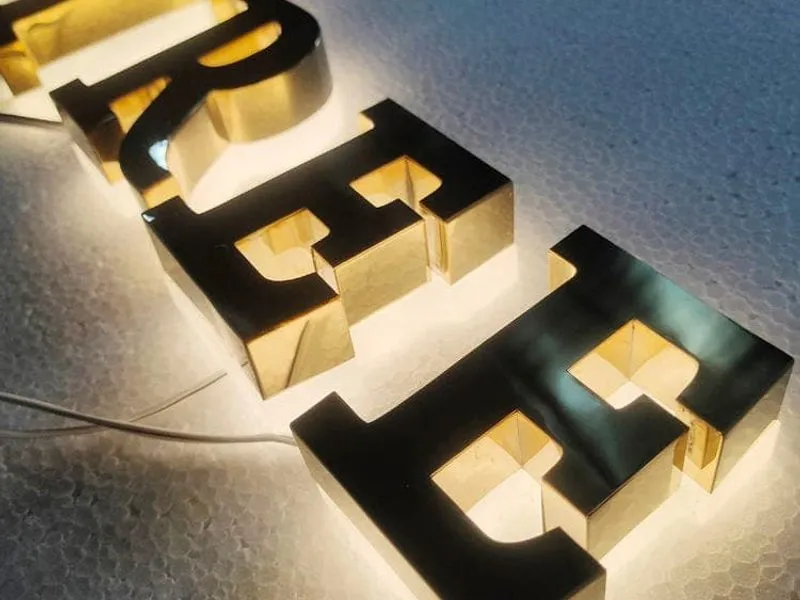
Look, I've been building signs on a factory floor since 2010, and I can smell a fake custom LED sign manufacturer from a PDF alone. Usually it reeks of stock photos and a CE certificate from 2019.
Every strip mall in America wants a glowing sign that doesn't crap out in 18 months. The retail price for an installed front-lit letter runs $200 to $700 a letter in the US — halo-lit runs $400 to $1,000. That's installed, with a bucket truck and a permit. A factory ships that same front-lit letter for $20 to $80, back-lit for $35 to $120. You're not paying for signmaking skill at retail. You're paying for local overhead, rent, and a crew with insurance.
Here's what nobody tells you: the custom part isn't the LED. What matters is the aluminum extrusion thickness, the acrylic face grade, and whether the welds hold past year three.
Retail signage isn't optional for most commercial tenants. Cities demand visible address numbers, brands want color consistency, landlords need signs that survive a five-year lease without a service call. That's pushed more sign shops and importers toward factory-direct sourcing.
If you're ordering front-lit channel letters for a strip mall, the spec sheet tells you more than the render. US retail installed prices sit at $200 to $700 per letter. Factory prices run $20 to $80 for the same basic build. The gap is real. Local shops aren't greedy — their overhead includes a storefront, a bucket truck, and an electrician on payroll.
The market now splits into three camps: sign shops that fabricate in-house, importers who buy factory-direct and resell, and end users who think they can skip both. The dangerous camp is the importer who doesn't know landed cost. That's the one who quotes $90 per letter, then discovers Section 301 tariffs and freight eat the entire margin.
Most RFQs I see are useless. They say "make it pop" or "modern look." That's not a spec. It's a mood. You need six numbers before any manufacturer can quote you honestly.
Letter height, material, LED color temperature, IP rating, mounting method, and power supply. Here's the hard part: color temperature isn't a vibe. 3000–3500K is warm hospitality. 4000–5000K is neutral corporate and retail. 6000–6500K is cool industrial or highway work. Get that wrong and the sign looks like a fast-food menu board at a law firm.
Acrylic thickness depends on letter size. For anything under 2.5 meters, a 2mm or 3mm face is fine. Over 2.5 meters, you need 5mm or the face flexes in wind and eventually cracks. LED type matters too: SMD 2835 runs 100–150 lumens per watt and is the industry standard. SMD 5730 gives you highest brightness at 40–60 lumens per chip. Don't let a factory upcharge you for 2835 like it's special.
For stainless steel letters, the alloy matters more than the finish. 304 stainless has 18% chromium and 8% nickel, and it'll last 10+ years outdoors in a normal climate. 316 stainless adds 2–3% molybdenum and survives 15+ years in coastal or industrial air. But 316 costs 20–30% more than 304. For a strip mall in Ohio, 304 is fine. For Miami Beach, pay for 316 or you're replacing letters in three years.
Cheap LED modules don't fail because the diode dies. The solder joint corrodes. Quickest way to spot bad modules: look at the solder joints. Dull gray means cheap, poorly alloyed solder that'll crack and oxidize within 18 months. Shiny silver means proper solder that holds for 5+ years. Quality modules from Samsung, Osram, or Blueview last 5+ years real-world. Cheap modules last 12–18 months. I've seen both on the same bench.
Acrylic matters too. UV-resistant acrylic from Mitsubishi or Degussa holds its color for 5–8 years and transmits 90–92% of light. Domestic acrylic yellows in 1–2 years. A 3mm face transmits 92% of light output. A 2mm face transmits 90%. Your customer won't notice the 2%, but they will notice the 40% cost bump if you spec thick acrylic for no reason.
IP65 sounds impressive. Dust-tight and protected against water jets from any direction. But don't think that means your sign survives a Florida hurricane. For coastal or extreme weather, you need IP66 or IP68. IP65 is the minimum for outdoor signage, not a badge of toughness.
I've watched sign shops pay $800 for a front-lit letter from a domestic fabricator. Same 304 stainless, same Samsung LEDs. We ship that letter for $120. That's not a typo. Factory-direct savings on product run 50–65%.
But product price isn't landed cost. A premium back-lit halo letter from a factory runs $35 to $120 each. Express shipping on a small sign costs $30 to $100 and takes 7–15 days. Air freight runs $4–12 per kilogram and takes 10–20 days. Sea freight LCL costs $80–200 per cubic meter and takes 50–70 days. Then Section 301 tariffs add about 30% on many LED sign products.
Here's what nobody tells you: LCL sea freight means stevedores handle your crate 6–8 times between our dock and yours. Every touch is a chance for damage. Forklifts lift it, stack it, unstack it, and sometimes a pallet of tile sits on top. That risk isn't in the brochure or the unit price.
Total cost of ownership includes warranty too. Our factory offers 2 years on LED modules and 1 year on power supplies. If a power supply dies in month 10, you eat that replacement cost if you bought from a trading company that vanished. Factory-direct means you have someone to yell at.
When you specify acrylic LED letters, demand the face material brand. Not just "acrylic." Ask which extruder. Then ask for the LED bin and the power supply brand. If the sales rep goes quiet, you're talking to a trading company, not a factory.
Our production floor runs 3,000 square meters with 50+ workers in Lu'an, Anhui. We run 10 steps: design confirmation in 1 day, laser cutting to ±0.1mm, TIG welding, grinding and polishing, CNC acrylic face cutting, LED assembly, sealing with neutral silicone, an 8–12 hour aging test, 100% QC inspection, then export packaging with foam, carton, and plywood crate. Normal lead time runs 7–15 days. MOQ is one piece if you want it.
CE marking costs 20,000–50,000 RMB and takes 2–8 weeks. Most factories will say they have it. Ask to see the certificate with today's date. Watch them sweat. For the US, UL 48 certification runs $4,000 to $15,000 and takes 4–9 months with quarterly audits. ETL is a legitimate alternative and costs 10–30% less. CE doesn't mean UL. Don't let anyone tell you otherwise.
Rookie mistake I still see weekly: a buyer specs IP65 and thinks that covers them for everything. Then the sign goes up near a car wash and dies in six months. Every week. Match the IP rating to the actual environment, not the cheapest option.
Installation isn't the factory's job, but a good manufacturer designs for it. NEC Article 600 governs US electrical signage. ADA tactile signs need mounting between 48 and 60 inches, non-glare faces, and Grade 2 Braille. If you're buying a wall sign without a mounting template, you're buying a headache.
RGB and DMX integration looks fancy, but it adds failure points. A power supply for RGB needs enough headroom for all channels running white at full brightness. Most cheap quotes undersize that supply. Then the sign flickers and the customer calls you at 9pm on a Friday.
Lifecycle support means aging tests before shipment. Our signs run 8–12 hours powered before packing. 100% QC means we check every letter, not every batch. Packaging matters: foam, carton, then plywood crate. I've seen signs arrive with crushed corners because someone used only cardboard and hope.
Before you send money, get on a video call and ask to see the production floor. Not the showroom. The floor. Look at the soldering station. Ask for LED binning documentation and the power supply brand list. If they can't show you a real solder joint photo within 10 minutes, move on.
Ask these five things: What aluminum extrusion thickness do you use for the can? What acrylic brand is the face? What LED bin and driver are you speccing? What's the real IP test procedure? What warranty do you actually honor? If any answer starts with "don't worry," worry.
Here's the final truth: a custom LED sign is only as good as the factory's soldering iron, the acrylic extrusion, and the person who answers your email after the deposit clears. We've been at this since 2010. CE, RoHS, ISO 9001? Yep, we've got them. MOQ is one piece. Lead time is 7–15 days. Warranty is 2 years on LED, 1 year on power supply. If you can't verify that with a live video call, you're gambling.
What's the real lead time? 7–15 days production, then shipping. Express is 7–15 days, air 10–20 days, sea 50–70 days. Don't ask us to rush after you sat on the deposit for two weeks.
Is MOQ really one piece? Yes. But shipping one small sign by express will cost more than the sign. That's your problem, not ours.
Do I need UL for the US? If your local inspector says yes. UL 48 costs $4,000–15,000 and takes 4–9 months. CE doesn't count in the US. Stop asking.
304 or 316 stainless? If you're within five miles of salt water, 316. Otherwise 304. I've already answered this three times this week.

Real photo from our production floor — every sign we ship is made here.
Products mentioned or relevant to this topic — factory-direct, custom built.
From $24/letter · MOQ 1 piece · Flexible lead time · CE & UL certified · ships to 20+ countries
Custom sizes, colors, and finishes. Get a factory price in 24 hours.
Get a Free Quote Copy EmailWhatsApp +86 13865703472 · business@aochuangsign.cn